
The Vectrex was sold as an all-in-one machine — monitor, console and game in a single box — which makes its accessory shelf a pleasant surprise: GCE looked at its self-contained little arcade and asked what else a glowing vector screen could be for. The answers were a pair of devices so ambitious they still sound like trade-show fiction. A pair of glasses with a spinning colour wheel that promised 3D and colour from a black-and-white tube. And a light pen that turned the screen into a drawing board and a piano. The 3D Imager and the Light Pen are the Vectrex’s wild years in two objects: one a mechanical marvel that anticipated virtual reality’s ambitions, the other a quiet proof that the machine’s designers always thought of it as something more than a games console.
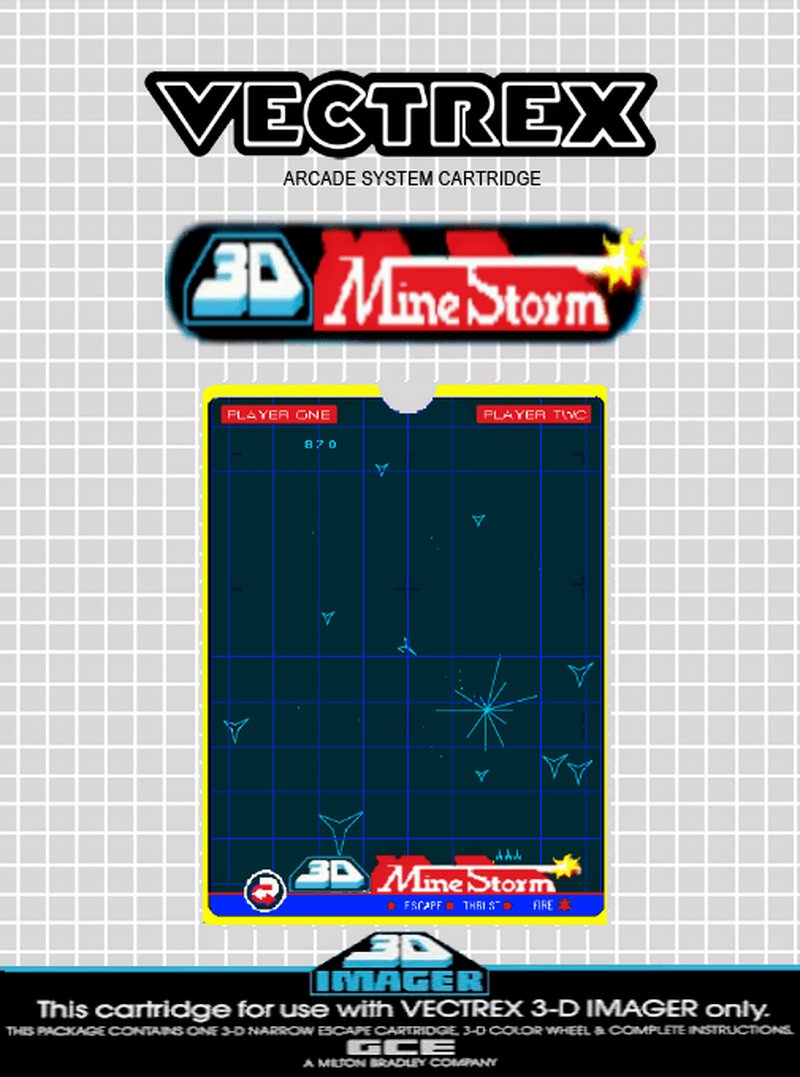
Start with the Imager, because everyone does. Released in 1984, in the machine’s Milton Bradley twilight, the 3D Imager is a headset visor containing a spinning disc. Half the disc is given to colour filters — red, green, blue segments — and the disc spins in synchronisation with the game, while the Vectrex draws the image in timed slices: the left eye and right eye receive different views through the disc’s windows, and the colour segments tint each slice as it passes. The result, when the sync holds and the room is dark, is genuinely startling: true stereoscopic depth and real colour, conjured from a monochrome tube by clockwork. Three games were made for it — 3D Mine Storm, 3D Crazy Coaster and 3D Narrow Escape — each a remix of the hardware’s talents: a minefield with depth, a rollercoaster that climbs out of the screen, a maze that surrounds you.

Clockwork virtual reality
The Imager’s paradox is that it worked. Not approximately, not as a advertising claim — owners then and collectors now agree that the depth effect is real, the colour is real, and a session of 3D Mine Storm in a dark room is one of the great uncanny experiences of 1980s gaming, forty years early to a party VR would later throw with worse food. Its problems were the era’s problems: cost, fragility, the small library, and a parent company in the process of exiting the business. The Imager arrived as the Vectrex line was being wound down, sold briefly and in small numbers, and consequently became one of the great collector’s pieces of the whole 8-bit era — boxed Imagers change hands for sums that would have bought a roomful of Vectrexes in 1984. The three 3D cartridges, playable only through the Imager’s spinning eye, ride in its slipstream.
The Light Pen is the Imager’s opposite in temperament: not a spectacle but a tool. Plug it into the second controller port, touch its tip to the glass, and the Vectrex — reading where the pen meets the beam’s drawing position — knows where you are pointing, with the eerie precision that only a display drawing one point of light at a time can offer. Its software defines it: Art Master, the drawing program, turns the little screen into a sketchpad; AnimAction extends drawing into animation; Melody Master turns the glass into a musical staff and keyboard, composing by touch. None of it is gaming, exactly. All of it is the Vectrex’s designers making good on the machine’s secret identity — not a console with a monitor, but a small vector computer that happened to ship with games.

What the wild shelf teaches
Between the two headliners sits a supporting cast worth a sentence each: the second controller, that unglamorous enabler of Space Wars duels and Rip Off partnerships, without which half the library loses its best mode; and the ghosts — the peripherals GCE demonstrated or promised in the machine’s ambitious first years, including a home-computer expansion with a keyboard, which trade-show visitors saw and history declined to ship. The pattern is the point. The Vectrex’s accessory strategy was not the usual shelf of steering wheels and dust covers. It was a platform play, an attempt to grow a single-purpose machine into a display technology with a future, cut short by the Crash and by Milton Bradley’s retreat — the same collapse that killed the console itself.
True stereoscopic depth and real colour, conjured from a monochrome tube by clockwork: the 3D Imager was virtual reality forty years early, with a spinning wheel for a graphics chip.
Today the wild shelf has a second life. Collectors prize the Imager as the machine’s crown jewel; tinkerers have built modern successors and replacement wheels; the Light Pen’s software is demonstrated at every retro show to visitors who cannot believe the date on the box. And both devices still make the same argument they made in 1984: that the little vector screen was never just a way to play games. It was a way of drawing with light, and drawing with light turned out to have more futures than the games industry of 1982 had time to explore.
The pen that read the beam
The Light Pen’s party trick deserves a technical footnote, because it explains why the Vectrex, of all machines, could offer one. A light pen works by timing: the display draws each point of the picture at a known instant, so when the pen’s sensor sees the beam pass beneath it, the machine can calculate the pen’s position from the clock. On a raster television this is approximate. On a vector display — where the beam visits points one at a time, in an order the program itself controls — a pen can be startlingly precise, and the Vectrex’s software exploited it: Art Master’s lines follow the pen like ink, and Melody Master’s staff accepts notes placed by touch with a responsiveness that still surprises first-time users at exhibitions. The pen was, in effect, a mouse for a machine that drew its own mousepad fresh sixty times a second.
That both flagship accessories were creative rather than competitive tools — one for seeing in three dimensions, one for drawing and composing — tells you what GCE thought the Vectrex could become before the market corrected them. Consoles of the era accessorised towards more game: more joysticks, more paddles, more war. The Vectrex accessorised towards more medium. It lost the argument commercially and won it historically, which is the machine’s whole biography in one sentence.
The aftermarket, inevitably, has joined in: replacement Imager wheels, modern pen alternatives and newly built controllers circulate in the community, lowering the drawbridge to a shelf that once admitted only the wealthy and the lucky. Purists will keep hunting the originals, and the originals will keep their premiums. But the accessories’ second life means the experiences survive even where the objects are scarce — and for devices whose entire purpose was an experience, that is the ending their designers would have chosen.
The crown jewels
Every console has accessories. The Vectrex has relics — a spinning wheel that faked colour and depth so well it barely counts as faking, and a pen that turned a games machine into an art studio while the decade was still young. If the library is the argument for the Vectrex as a games machine, the Imager and the Light Pen are the argument for it as something stranger and larger: the first home computer display that dreamed in three dimensions, armed with a pencil made of light.