
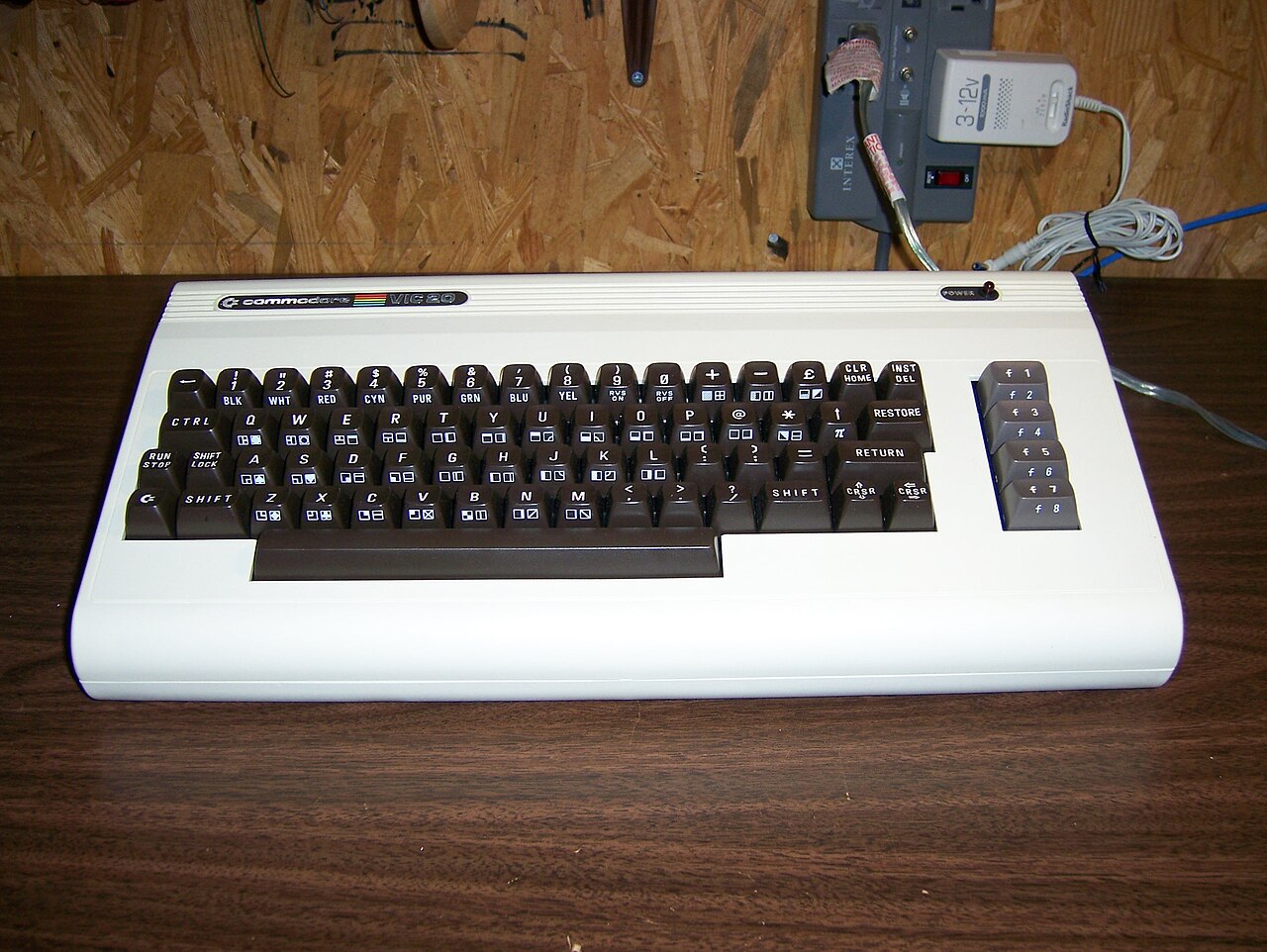
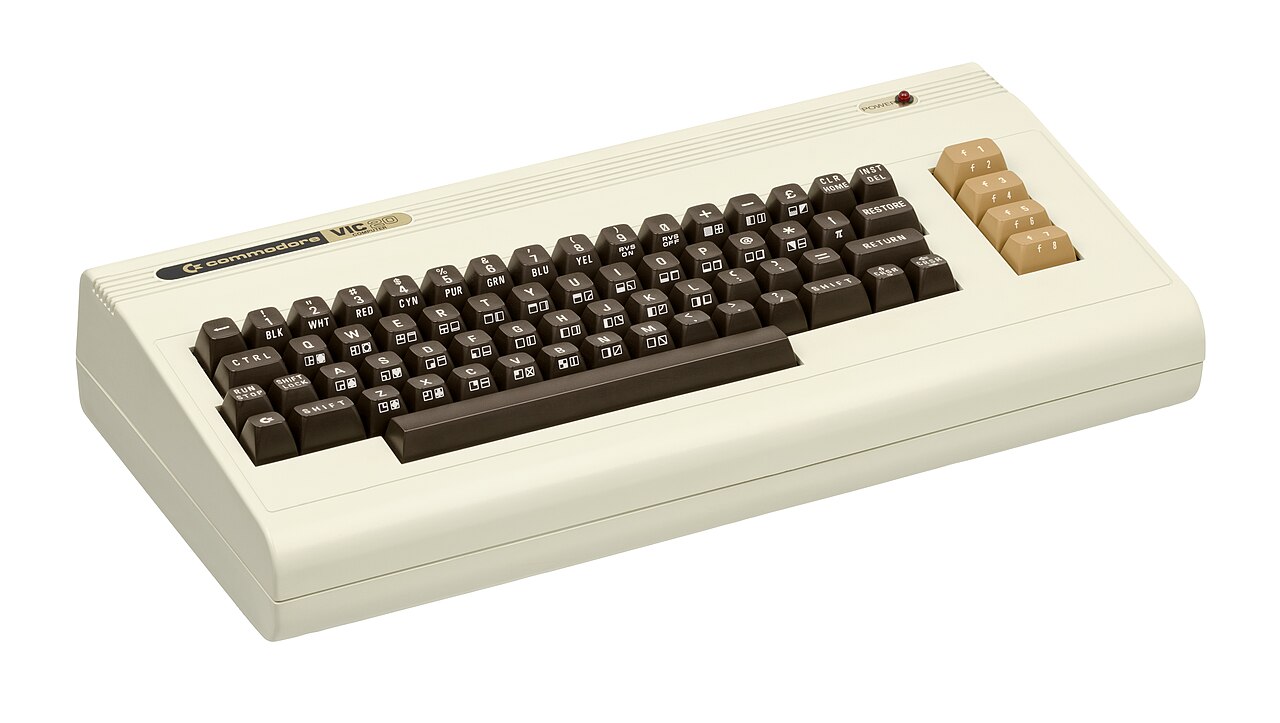
The Commodore VIC-20 was the first computer to sell a million units, the first computer many families ever touched, and the opening move of the most successful home-computer story ever told. Launched in 1980-81 at $299.95 – a third of a comparable machine’s price – it put a colour screen, a real keyboard and William Shatner on television asking America why anyone would buy just a video game. Only 5KB of memory, and barely 3.5KB of that usable, yet within it fit the start of an industry’s mass age: the machine that made Commodore inevitable, taught Jack Tramiel’s price doctrine to the world, and warmed the chair for the C64. It also walked into the classroom before almost anyone else – school districts bought VICs by the trolley-load at prices no rival could answer, and Commodore’s own Programmer’s Reference Guide, written in Tomczyk’s friendly voice, taught the teachers. For a measurable slice of the world’s children, “computer” first meant this beige keyboard and its fat, friendly pixels. This is the complete story of the friendly computer.
Jack Tramiel’s Other Revolution: Project Vicky Becomes the VIC
The VIC-20 grew out of a chip looking for a home. MOS Technology, Commodore’s semiconductor arm, had built the VIC – the Video Interface Chip – and demonstrated it around the trade in 1980 without finding buyers; Commodore’s president Jack Tramiel, whose doctrine was “computers for the masses, not the classes,” ordered the orphaned chip turned into a computer before the Japanese industry could flood the low end instead (the machine’s name kept the chip’s, with the 20 added by marketing folklore variously explained ever since). The design brief was Tramielite minimalism in service of a price: a 6502 processor, the VIC chip providing colour graphics and sound (176×184 pixels, 22 columns of text, three voices plus noise – modest specifications, but colour and sound at all, in 1981, at this money), 5KB of RAM of which 3.5KB reached the user, a genuinely good full-size keyboard inherited from the PET line’s cost-down, and the serial and cartridge ports that would carry an ecosystem. Unveiled in Japan in 1980 (as the VIC-1001, where it launched first) and in the West through 1981, the VIC-20 was received by the specialist press with amused condescension – and by the public with a stampede. The price was the specification: $299.95 falling toward $200 and below within two years, in department stores, with Shatner’s televised pitch (“Why buy just a video game?”) framing the purchase as the sensible family’s upgrade from a console. By late 1982 the VIC-20 was the best-selling computer in the world; in early 1983 it crossed the million mark, the first computer of any kind to do so, and Commodore’s production lines in three countries ran flat out to make a machine its maker’s critics had reviewed as a toy.
Living in 3.5K: The Software of Scarcity
The VIC-20’s software culture is the ZX81’s American cousin – creativity enforced by scarcity – with one decisive difference: the cartridge slot made the machine a games console’s rival in the shops. Commodore’s own cartridge line set the tone, and it was remarkably literate: Scott Adams’s text adventures (Adventureland, Pirate Cove and their siblings, squeezed onto cartridges for a machine with 3.5K free), arcade translations of surprising fidelity (Rally-X as Radar Rat Race, Omega Race from Bally Midway’s catalogue, a Donkey Kong via Atarisoft later), and the eccentric masterpiece Gorf. The type-in and cassette economy thrived in parallel – COMPUTE! magazine’s listings, the early issues of a home-computing press that the VIC did as much as any machine to create – and the third-party labels that would define the C64 era served their apprenticeships here: HesWare, Creative Software, and a young Electronic Arts-era generation of American independents. Expansion was the culture’s running argument with the hardware: RAM cartridges at 3K, 8K and 16K transformed what the machine could hold, switchable and banked in combinations that taught a generation of owners the word “configuration” the hard way, while the datasettes loaded at the era’s usual meditative pace. Judged by its screen the VIC-20 was crude – fat pixels, few columns. Judged by what it asked of its programmers and what they returned, it was a conservatory.
The People: Yannes, Tomczyk and the Friendly Doctrine
Two names explain the VIC-20’s character. The hardware was designed under Robert Yannes, a young Commodore engineer who would follow the VIC by designing the SID, the C64’s immortal sound chip – the VIC-20 was his first computer, and its economy of means (one video-sound chip, one processor, memory counted in single kilobytes) marks the start of the most influential chip-design career of the home-computer era. The doctrine was Michael Tomczyk’s. Commodore’s “VIC czar” ran the machine as a mission rather than a product line – user groups courted as “VIC commandos,” documentation written to be read by frightened beginners, the phrase “the friendly computer” coined as an explicit strategy: the first computer sold not on specification but on reassurance. Between Yannes’s minimalism and Tomczyk’s evangelism sits the whole VIC phenomenon, and between them both and Tramiel’s price knife sits the template – technical thrift, populist marketing, vertical integration – that Commodore would run once more, at eight times the memory, to conquer the decade.
The Cartridge Shelf in Depth
The VIC-20’s essential shelf, for the collector assembling one today: Commodore’s own Gorf and Omega Race, the arcade translated with a confidence the hardware hadn’t earned; Jupiter Lander, the house Lunar Lander, all thrust and terror in the launch window; Scott Adams’s Adventureland and Pirate Cove, the medium’s first great text adventures compressed onto cartridges for a machine that measured its free memory in single digits; Sword of Fargoal, Jeff McCord’s procedurally-generated dungeon crawler, which began life here in 1982 before its more famous C64 incarnation and stands as one of the founding documents of the roguelike; and the Llamasoft founding trilogy – Andes Attack, Traxx and above all Gridrunner, Jeff Minter’s first commercial works, written for the VIC-20’s fat pixels and frantic pace, the starting gun of a career still running. Around those anchors orbits the type-in immensity of the COMPUTE! years and the expansion-dependent epics that needed 16K and nerve. It is a small shelf next to the C64’s library. Per kilobyte available to it, it may be the most ingenious in this entire hub.
The World Market: VC-20s, VIC-1001s and the Million-First Headline
The VIC-20 was a genuinely global machine in a way few American computers of its moment managed. In Japan, where it launched first as the VIC-1001 – with a katakana-capable character set and Commodore Japan’s full weight behind it – it was a real contender in the pre-MSX market and a respectable success, the era’s unusual case of an American design competing on Japanese shelves at all. In Germany the machine was renamed the VC-20 (the oft-told explanation holds that “VIC,” read aloud in German, collided with a profanity – Commodore was taking no chances) and became a fixture of the Federal Republic’s first computer generation. In Britain it was the shop-bought establishment choice of 1981-82, the “proper” computer against Sinclair’s mail-order insurgency, and the schoolyard split between VIC and ZX81 households prefigured the Spectrum-C64 war that followed. The millionth-unit milestone, reached in early 1983, was therefore a world event rather than an American one – the first computer to sell a million anywhere had sold them everywhere, which is precisely the point: the VIC-20 did not just invent the mass-market computer’s price. It invented its geography.
The Price War and the Million
The VIC-20’s historical weight sits in its economics. It was the first proof, at industrial scale, that a computer could be a consumer appliance: priced like one, advertised on television by a starship captain, sold where families shopped, and bought by people who had never read a computer magazine. Commodore’s vertical integration – owning MOS, the chip maker – let Tramiel cut prices with a freedom that bled rivals white, and the VIC-20 years were the rehearsal for the slaughter of 1983-84, when the same doctrine applied to the C64 helped collapse Texas Instruments’ computer division and most of the American industry with it. The VIC itself sold roughly 2.5 million units across its life (the million-first headlines belong to its peak years, 1982-83), with Germany – where it was sold as the VC-20, the expansion of the initials being diplomatically adjusted – among its most devoted markets. It also built the runway its successor used: the dealer network, the software catalogue, the public’s new default assumption that a household might own a computer at all. When the Commodore 64 launched in August 1982 at $595 with eight times the memory, it did not create its market. It inherited the VIC-20’s.
The Pitch: Shatner, Parents and the Anti-Console
The VIC-20’s advertising deserves its own paragraph in marketing history, because it solved the home computer’s founding problem: the person with the money was not the person who wanted the games. William Shatner’s television spots addressed the parent over the child’s shoulder – the famous question, “Why buy just a video game?”, positioned the VIC not against other computers but against the games console, reframing $299.95 as the prudent purchase: a real computer, with a real keyboard, that taught programming and merely happened to play superb games. The education halo was the eighties’ master sales device, and the VIC-20 industrialised it; every subsequent home computer, and a good many consoles in disguise, ran the same play to the same wallet. Retail completed the strategy: the VIC sat in Sears and Kmart and toy shops beside the consoles it was out-arguing, a headline Christmas item in 1982, available to be bought by people who did not know what a kilobyte was and did not need to. Commodore understood, before the rest of the industry, that a computer for the masses had to be sold like a television and priced like a toy while being reviewed like a computer – and that the captain of the Enterprise was exactly the man to hold those three ideas in one thirty-second spot.
Ownership in Practice: Datasettes, Disk Drives and the First Cheap Modem
The VIC-20 as actually owned was an expanding archipelago of beige. The foundation was the C2N Datasette, Commodore’s cassette drive, on which programs arrived at the usual glacial pace until software turbo-loaders – routines that rewrote the tape format for speed – cut the ritual from minutes to tolerable, a folk technology the whole Commodore world inherited. Above it sat the VIC-1540 disk drive, a 170KB floppy unit that cost more than the computer and transformed it: the premium tier, owned by the serious, envied by the rest. Printers (the VIC-1515 and its successors) completed the “real computer” claim for school reports and small businesses. But the VIC-20’s most prophetic accessory was its cheapest trick: the VICModem of 1982, at $99.95 the first modem under a hundred dollars, bundled with a taste of CompuServe. On it, a meaningful number of ordinary families went online for the first time – onto CompuServe’s forums and the young BBS scene – years before the phrase “information superhighway,” on a computer with 3.5K free. Every later mass-online moment, from AOL discs to the smartphone, follows the VICModem’s formula: collapse the price of the terminal until curiosity does the rest. The friendly computer was, among its other firsts, the first online computer of the mass age – and it managed that with less memory than a modern dishwasher’s display.
The Fade: Big Brother Arrives
The VIC-20’s decline was fratricide, administered by its own family. The C64, deliberately positioned as the VIC’s bigger brother rather than its killer, took the advertising, the shelf space and the developers through 1983; the VIC’s price fell below $100 in the war’s endgame, where it sold on as the bargain machine even as Commodore’s attention moved upmarket, and production ended in January 1985 after a run of around four and a half years – an eternity by the standards of the crash it had helped cause. Its reputation suffered the specific injustice of successful older siblings: remembered as the C64’s crude warm-up act, its chunky text and scant memory quoted as limitations, its million-first milestone footnoted. The comparison is backwards. The C64 was possible because the VIC-20 had already normalised the home computer, built the retail channels and trained the audience and the industry; and the VIC-20, at its peak, outsold every computer on earth. In the canon of the era it is not the warm-up. It is the opening statement, and the C64 is the elaboration. The silicon tells the same story in miniature: the humble VIC chip, designed to be sold to other manufacturers and adopted by none, became inside Commodore the ancestor of the VIC-II that powered the C64 and, downstream, of the whole dynasty of Commodore video chips. The chip nobody wanted founded the graphics line of the best-selling computer in history – the orphan had the last word after all.
Afterlife: The Friendly Computer Remembered
The VIC-20’s community is one of retro computing’s warmest, organised around the Denial forum (named for a Tramiel-era quote) and a homebrew scene that treats 3.5K the way the ZX81’s treats 1K – as a discipline. New VIC software still appears, including full-scale modern productions that lean on the expansion ecosystem the eighties built; the Mega-Cart and modern storage and memory expansions have turned the machine into a complete, self-contained retro system in a way its original owners could only dream about; and emulation (VICE, fittingly, began as the VIC’s emulator before it grew to carry the whole Commodore family) is exact. The collectors’ market rates the VIC kindly – common, affordable, indestructible, the starter classic of the Commodore shelf – and the historians have increasingly given it its due as the pivot between the hobbyist seventies and the mass eighties. Collectors learn its two production lives quickly: the original machines with their two-prong 9V AC supplies, and the 1983 cost-reduced revision that adopted the C64-style round power connector and restyled board, plus the modern conveniences – all-in-one cartridges like the Penultimate+ that bundle the RAM expansions, the classic cartridge library and the diagnostic tools the eighties sold separately – which have quietly made a £100 VIC-20 a more capable machine today than any £1,000 setup of 1982. It is the rare founding artefact that remains both historically enormous and practically free. Somewhere in the historical record sits the perfect summary, delivered by its own advertising before the fact: why buy just a video game, indeed. For $299.95, a million families first answered: don’t. Buy the friendly computer, and see what happens. What happened, in the end, was everything that fills this website.