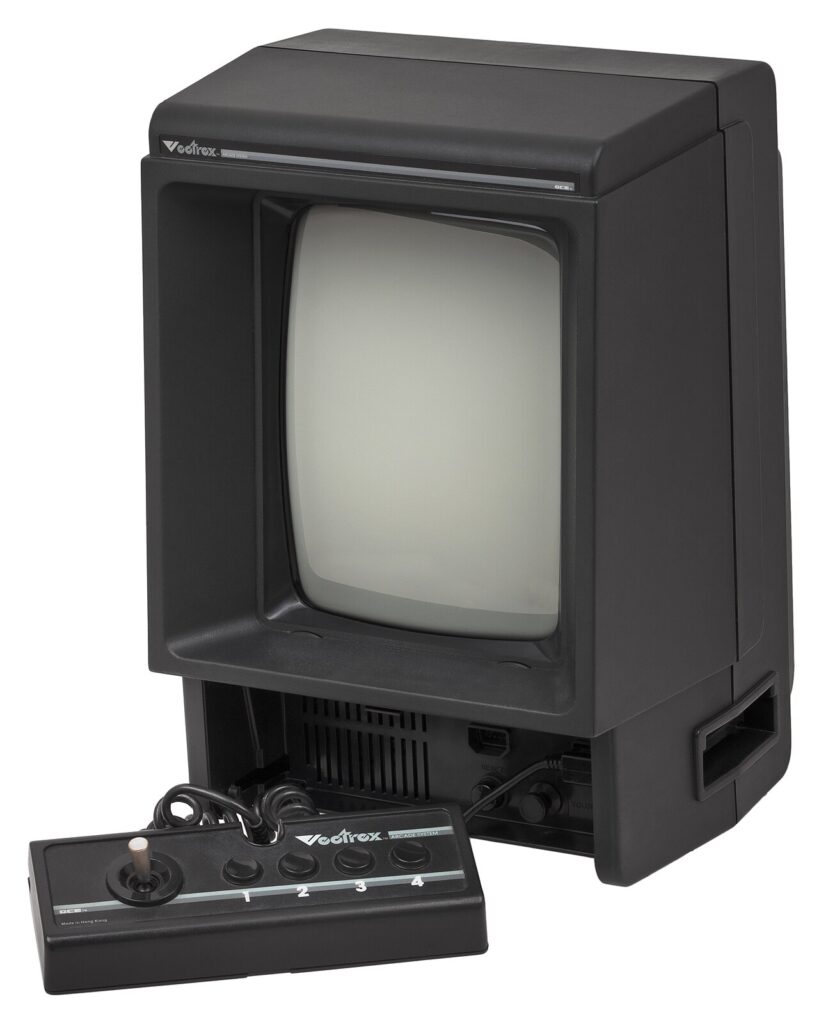
The Vectrex is the only games console ever built that brought its own screen – and the only one that drew its pictures the way the arcade’s most beautiful machines did, as lines of pure light on a vector display. Launched in November 1982 at $199, dead by 1984, it should be a footnote. Instead it is one of the most beloved objects in the medium’s history: a self-contained, glowing monument to a different technological path, sustained for forty years by the most legally blessed homebrew scene in retro gaming. This is the complete story of the console that drew in light: the surplus tubes, the astonished reviews, the crash that killed it in eighteen months, and the blessing that brought it back forever.
Western Technologies and the Surplus-Tube Insight
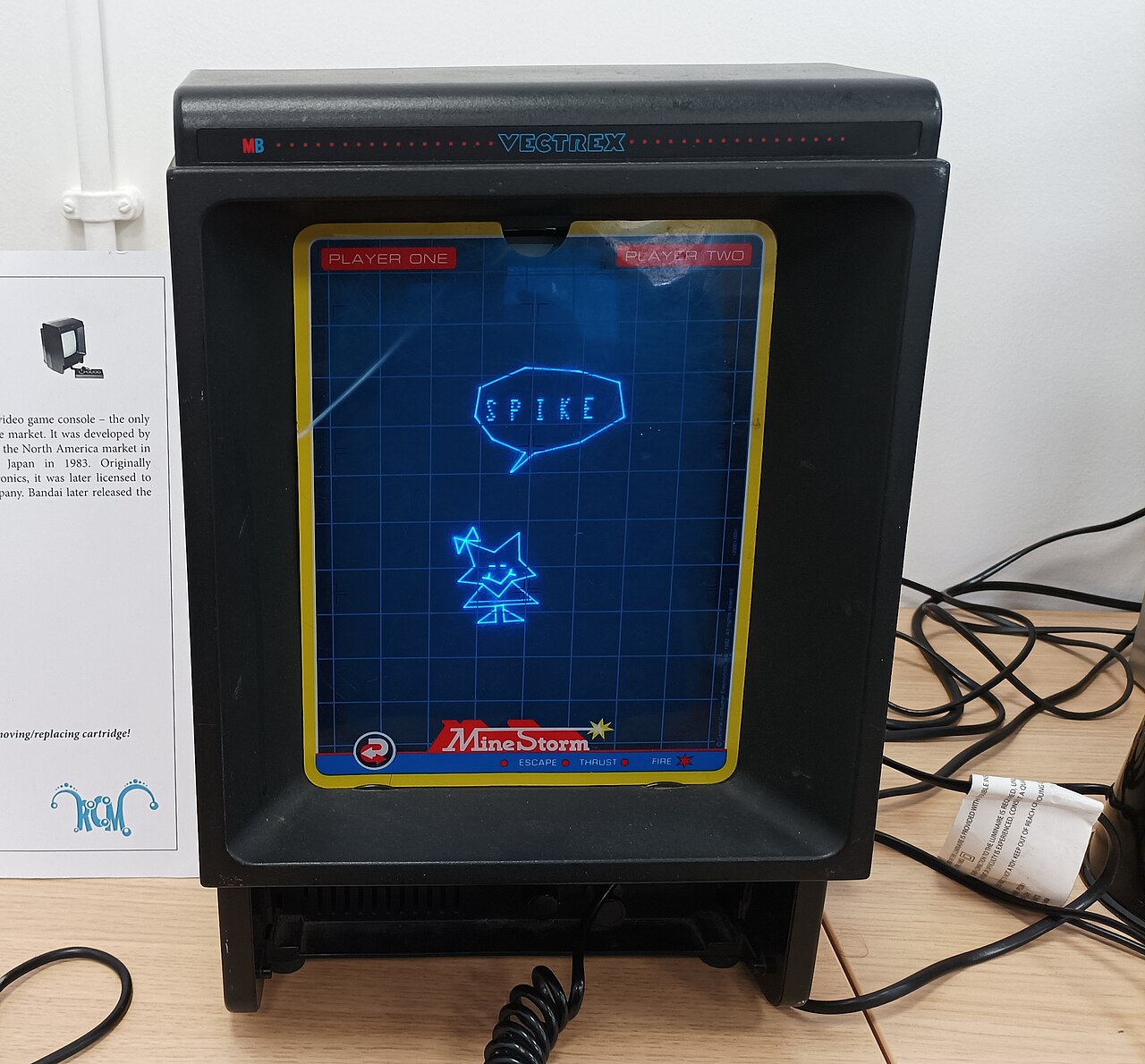
The Vectrex was designed by Western Technologies – the Smith Engineering shop of Jay Smith, the team behind the Microvision, the first cartridge handheld – and it began, as its creators told the story, with a stock of small, inexpensive CRT displays looking for a purpose. The insight built on that accident was profound. The home machines of 1982 drew raster graphics on televisions, and the results, next to the arcade’s vector displays – the razor lines of Asteroids, Battlezone and Tempest, generated by steering an electron beam directly from point to point – looked smeared and cheap. A vector monitor at home was impossible at console prices, unless the console was the monitor: build the display in, tune the whole machine around it, and the living room could have the arcade’s most distinctive technology entire. So the Vectrex is a 9-inch black-and-white Samsung CRT with a games machine wrapped around it: a Motorola 6809 processor (the connoisseur’s 8-bit CPU), an AY sound chip doing music, effects and even speech synthesis, and – the detail that shames its contemporaries – a proper self-centering analog joystick with four buttons. In the same season that the Atari 5200’s floppy non-centering stick was sinking a more powerful machine, the little Vectrex shipped analog control done right, because its designers understood the stick was the product. Colour, which a home vector tube could not economically provide, was solved with the medium’s most charming hack: a translucent coloured overlay clipped over the screen for each game, tinting zones of the playfield – Star Trek’s blue command palette, Minestorm’s deep-space frame – so that the overlays became part of each title’s visual identity, and, being fragile plastic, the first component every surviving set has lost. And the masterstroke of packaging: the best game, Minestorm, an Asteroids evolution of genuine brilliance, was built into the machine. A Vectrex with no cartridges at all was already worth owning, which no rival could claim then or since.
Launch, Milton Bradley and the 3D Imager
General Consumer Electronics launched the Vectrex in America in November 1982, and the press reaction explains the machine’s survival in a word: astonishment. Magazine reviewers who had seen everything the young industry offered wrote about the display the way hi-fi critics write about a new speaker technology, because screenshots could not prepare you – the vectors burned brighter than the room, sharp at any size, with a phosphor glow no raster set could counterfeit. In 1983 Milton Bradley acquired GCE and took the Vectrex global: the toy giant’s distribution put the machine into department stores across America and Europe, while Bandai handled Japan. The peripheral line from this confident period remains the most inventive of any console’s: a light pen with the Art Studio cartridge, turning the vector screen into a drawing instrument, and the 3D Imager – a headset containing a synchronised spinning colour disc that divided the display’s frames between the eyes, manufacturing genuine stereoscopic 3D and colour, mechanically, in 1983, decades before either trick was fashionable. Games like 3D Minestorm and 3D Crazy Coaster justified it as more than a novelty. Then the floor vanished. The North American crash of 1983-84 annihilated Milton Bradley’s games adventure (the losses contributed to MB’s own absorption by Hasbro in 1984), and the Vectrex – premium-priced, single-purpose, stocked by retailers in full retreat – was discontinued in 1984, roughly eighteen months after launch, with its European and Japanese runs ending alongside. The rights reverted, in time, to Smith Engineering. What happened next is the reason this article exists.
The Library: Twenty-Eight Cartridges, Almost No Filler
The Vectrex’s official catalogue – some twenty-eight cartridges, overlays clipped on, largely designed in-house by GCE’s small teams – is the most quality-dense of any failed console’s, because the hardware dictated taste: vector displays flatter wireframe space games and geometric action, and embarrass everything else, so the library is a procession of exactly the games its screen was born for. Minestorm, built in, remains the system’s Asteroids answer and its eternal demo. Berzerk is arguably the finest home version of Stern’s robot nightmare, voice-adjacent menace intact. Scramble translates Konami’s side-scrolling shooter into vectors with startling fidelity. Armor Attack and Rip-Off port Cinematronics’ vector arcade line home; Star Castle does the same for the hardest of them. Cosmic Chasm carries the library’s strangest distinction: GCE designed it for the Vectrex first, and Cinematronics then licensed it outward into the arcade – the only vector title of the era whose home version is the original. And Spike, the mascot platformer, gave the machine its voice: the AY chip’s synthesis chirping “Eek! Help, Spike!” in digitised speech that owners can still quote. Pole Position, Star Trek, Web Wars, Fortress of Narzod, Clean Sweep and Hyperchase fill the shelf without a true dud among them, and the prototypes recovered since – games frozen by the crash mid-development – read as outtakes from a catalogue that knew precisely what it was. The presentation deserves its footnote: each overlay carried its game’s colour zones inside a printed decorative border, so the screen arrived framed like a cockpit or a starship viewer, and the boxes and manuals sustained a starfield-and-grid design language that made a Vectrex shelf recognisable across a shop. It was art direction as a substitute for colour television, and it worked so well that the platform’s graphic identity survives, unmistakably, in every tribute the homebrew scene produces today.
The Technology of Light: How the Pictures Are Drawn
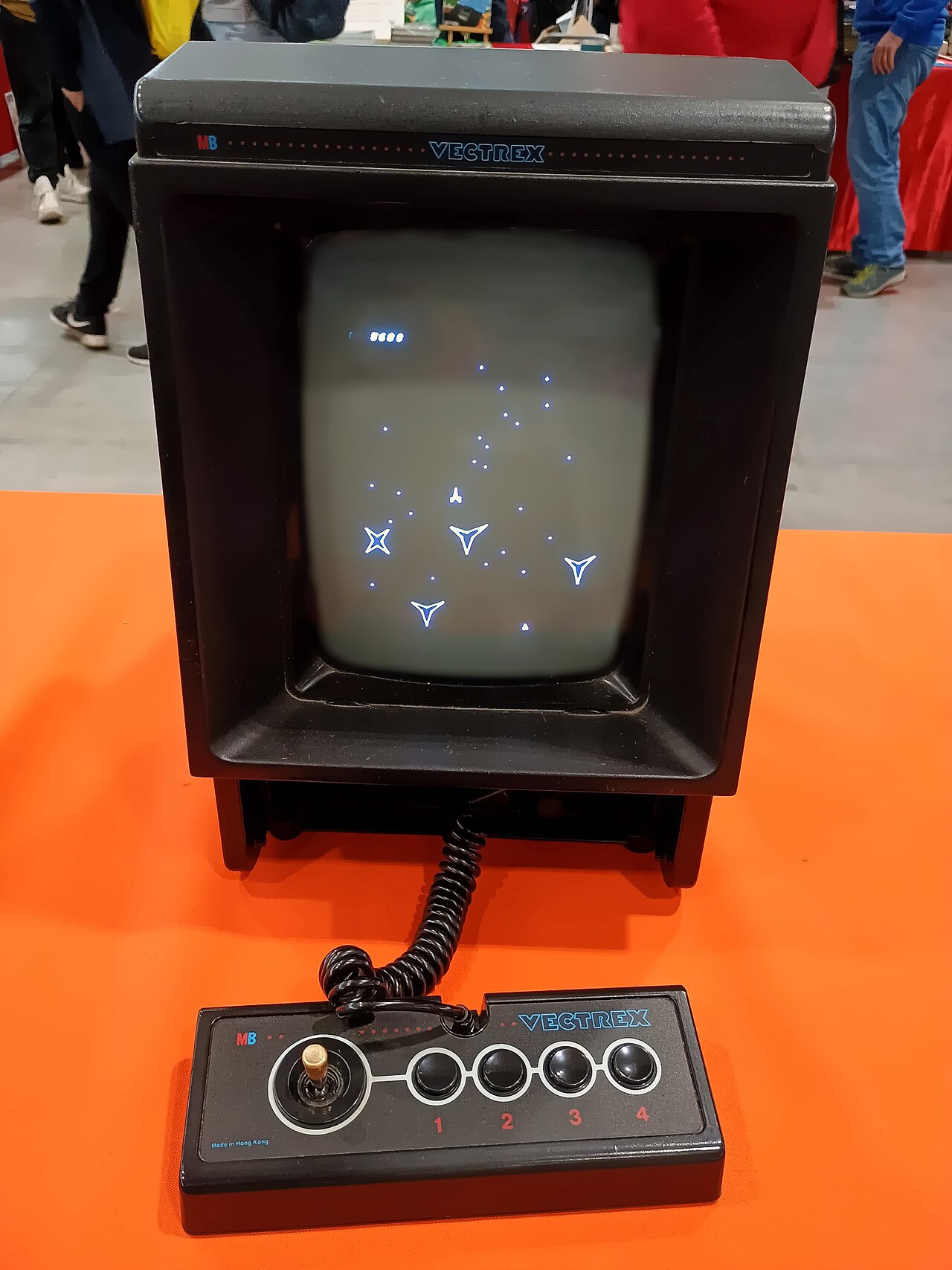
A vector display does not paint. The Vectrex’s 6809 computes the endpoints of lines, digital-to-analog converters turn those coordinates into voltages, and the CRT’s electron beam is steered, point to point, tracing each segment with a brightness proportional to how long it lingers – which is why Vectrex vertices bloom, why diagonal lines shimmer with a life no pixel grid has, and why the screen darkens the room around it like a small moon. The system has an inherent governor: the beam must retrace every object in the scene each frame, so complexity costs refresh rate, and a crowded Minestorm wave flickers at the edge of perception in a way owners register as urgency rather than defect – the machine visibly working at its limit, in light. The overlays, necessary for colour, tax the brightness they tint, which is why Vectrex play is traditionally a lights-down ritual and why the surviving overlays, unbroken and unfaded, carry collector value out of proportion to printed plastic. Even the flaw is technological poetry: the celebrated buzz in the speaker is the sound of the display’s high-voltage world leaking into the audio circuitry a few centimetres away – the machine’s pictures, audible. Raster won the eighties for reasons of cost and versatility that were entirely rational. But everyone who has watched a Vectrex draw Star Castle in a dark room understands what was given up: the only display technology in the home that was ever, in the literal sense, luminous.
A Category of One
The Vectrex never had a rival, which is a distinction no other machine in this hub can claim. The reasons are instructive: a console that includes its own monitor forfeits the television’s economies (the most expensive component in the box was the one every household already owned), and by 1983 raster graphics were improving fast enough to close the perceived gap for everyone except connoisseurs of line and light. So the category began and ended in eighteen months, and the machine’s regional lives were brief variations on the theme – Milton Bradley’s European editions, sold in local-language boxes and remembered with particular warmth in Germany, where the Vectrex scene has been disproportionately strong ever since; Bandai’s Japanese run, the rarest of the regional variants and a collector’s grail in complete form. What the category-of-one status bought, at the price of commercial scale, was purity: there is no Vectrex-compatible, no Vectrex clone, no Vectrex II diluting the record. The platform is a single, sealed, perfectible object, which is one more reason its community’s husbandry has the character of a historical society rather than a fan base. Other consoles were product lines. The Vectrex was an edition – printed once, never reissued, and all the more collectible, studyable and lovable for the seal on the run.
The Endgame: Fire Sales, a Lost Computer and the Rights Coming Home
The Vectrex’s final commercial year deserves its own record, because it contains the seed of everything after. Through 1983 the price slid as the crash deepened – $199 to $149, and in the 1984 clearances to $99 and below, at which price the machine was, and remains, the single most poignant bargain of the crash: the industry’s most advanced home technology sold off beside the E.T. cartridges. On the drawing boards died the platform’s expansionist future, most tantalisingly a keyboard and BASIC package that would have converted the Vectrex into a colour-vector home computer – prototypes existed, and the concept (imagine the demo scene that never was) haunts the platform’s mythology. Milton Bradley’s games division closed as Hasbro absorbed the company, and the unsold inventory passed into discount channels and, soon enough, into the hands of the teenagers who would form the first Vectrex fandom. But the decisive event was legal rather than commercial: the rights, rather than disappearing into a conglomerate’s vault, found their way back to Smith Engineering – to the machine’s own creators. Every failed platform leaves orphans; the Vectrex’s parents kept custody. It is the direct reason that, a decade later, there was someone with the standing to answer the fans’ letters with a blessing instead of a cease-and-desist – and the reason the Vectrex’s story is the only one in the crash’s casualty list that bends, unmistakably, toward comedy rather than tragedy.
The Public Domain Miracle: The Scene That Permission Built
Every retro platform has a homebrew scene; the Vectrex’s has a founding legal document. In the mid-1990s, as the early web’s Vectrex fans began asking what could legitimately be shared, Jay Smith and Smith Engineering – who held the rights – gave the answer that made the machine immortal: the Vectrex’s software and documentation were released for free non-commercial duplication and development. It was one of the earliest acts of its kind in the industry, a rights holder formally blessing the afterlife, and its consequences compound to this day. With legality came infrastructure: John Dondzila’s Vector Vaders (1996) opened the modern homebrew era; Sean Kelly’s Multi-Cart gathered the whole original catalogue onto single cartridges; emulators (VecX and successors) spread without a legal shadow; and the physical scene matured into an artisanal industry – new games in boxed editions with fresh-printed overlays, limited runs, Christmas specials like the Save the Trees and Stocking Filler releases covered elsewhere on this hub, an unbroken forty-year software lineage no other 1982 machine can match. The hardware husbandry is its own culture: the Vectrex’s famous audio buzz (display interference in the speaker line) has its canonical fixes, its CRTs are recapped and nursed like vintage amplifiers, and a working machine is understood to be a ward, not a possession. Permission, it turns out, is a preservation strategy: the console whose owners were told to share is the console that never died.
Owning One: The Liturgy and the Nursing
Vectrex ownership has a liturgy, and it begins in the dark: power on, the built-in Minestorm’s attractor blooming as the tube warms, the overlay of the evening clipped over the glass. It has a nursing discipline to match. The capacitors in a forty-year-old power supply are a scheduled replacement, not a surprise; the buzz has its hierarchy of cures, from grounding tweaks to full audio-board surgery; the controller’s self-centering spring, the part Atari’s rival couldn’t build, is cherished and, when it tires, rebuilt. And over every working machine hangs the platform’s one true horror – the centre burn, the permanent bright scar left if a failing deflection circuit parks the beam, at full brightness, in the middle of the tube. Owners speak of it the way organists speak of fire. The modern conveniences have arrived without breaking the spell: SD-based multicarts in the VecMulti line hold the entire official and homebrew catalogue behind a menu the 6809 handles without complaint, which means the practical Vectrex of 2026 is simultaneously a museum piece and the most convenient vector arcade ever sold – a duality no other console in this hub offers in a single object.
Afterlife: The Console in the Museum
The Vectrex’s modern position is unique and slightly comic: it is the failed console that museums exhibit as design. Its all-in-one silhouette – screen, speaker grille, flip-down control panel, handle in the spine – is the one object in a retro collection that a non-gamer guest will cross the room to ask about, and its glow remains unreproducible: emulation approximates the vectors with shaders and bloom, honourably, while conceding that a phosphor tube drawing lines in the dark is a display technology, not a resolution, and cannot be faked by pixels at any density. The market agrees; complete sets with overlays have climbed steadily, and the machine anchors the “alternative eighties” wing of the hobby beside the Adventure Vision and the Microvision – Jay Smith’s other beautiful dead ends, which between them might constitute the most interesting failure portfolio in the industry’s history. But the truest measure is the software: turn a Vectrex on in 2026 and there are new cartridges to buy for it, made this decade, legally, by people who were given permission in 1996 and never stopped. The console that drew in light was on sale for eighteen months. It has been in continuous creative production for over forty years. No other machine on this hub, successful or failed, can say that – which is why the Vectrex’s story is filed, correctly, not as a tragedy of the crash, but as the industry’s first proof that a platform’s second life can be longer, richer and better loved than its first.