
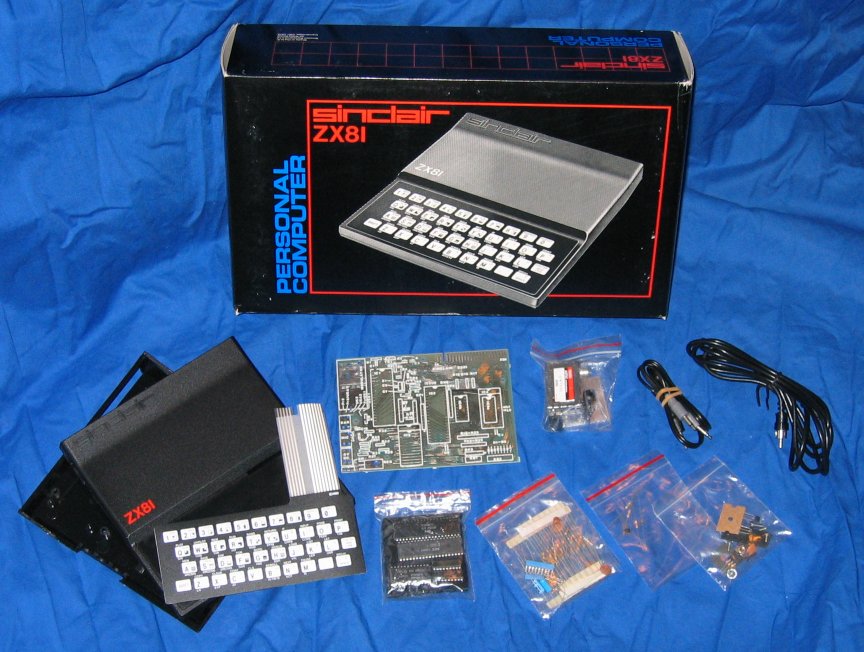
The Sinclair ZX81 is the most consequential cheap object in British technology. A black plastic wedge with a membrane keyboard, four chips, one kilobyte of memory and a price of £49.95 as a kit, it sold a million and a half units, dragged a real computer into the British living room years before the phrase “home computer” had meaning, and started the careers, companies and culture that became the UK games industry. The Spectrum gets the glory. The ZX81 did the founding – in living rooms, in classrooms’ shadow, in the back pages of magazines, and in the heads of the children who would spend the next forty years building on what a kilobyte taught them about wanting more. This is the complete story of the £50 computer.
Clive Sinclair and the Engineering of Cheap
The ZX81 was the purest expression of its inventor’s lifelong method. Clive Sinclair’s businesses – calculators first, then the ZX80 computer of 1980 – ran on a single doctrine: strip a product to the minimum component count that still delivers the essential function, design it beautifully enough that nobody reads cheapness as poverty, and sell it at a price competitors call impossible. The ZX80 (£99.95, Britain’s first genuinely mass-market computer) had proven the demand and exposed the compromises: twenty-one chips and a display that vanished while you typed, because the processor doubled as the video generator. The ZX81, launched in March 1981, was the doctrine perfected. Its genius was a single custom chip: a Ferranti uncommitted logic array that absorbed the ZX80’s sprawl of logic into one part, taking the whole computer to four chips – the ULA, an NEC Z80-family processor at 3.25MHz, the ROM, and a single kilobyte of RAM. The 8KB BASIC in that ROM was, remarkably, the sophisticated part: proper floating-point arithmetic, string handling, and the one-touch keyword system that let the membrane keyboard’s forty keys each enter whole BASIC words, the legends printed in thickets around every key. Rick Dickinson’s black wedge case made the austerity look like the future. Even the display compromise became a feature with a name: SLOW mode, in which the machine shared its processor with the screen and everything crawled but stayed visible, and FAST mode, four times quicker with the picture blanked – a trade-off no modern user would tolerate for a minute, accepted without complaint by a million and a half people who had never owned a computer before.
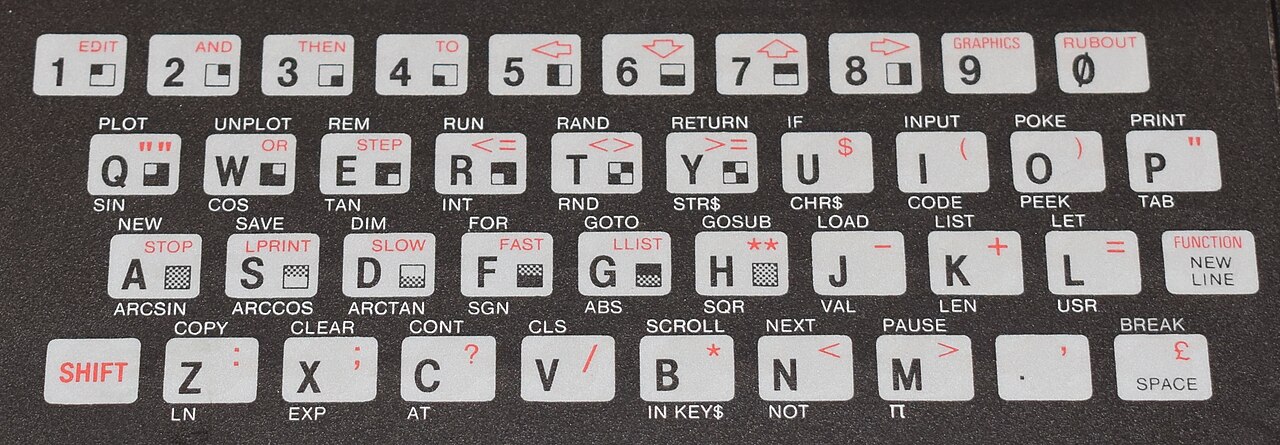
The Machine, Piece by Piece: Video Made of Software
The ZX81’s deepest economy is invisible: it has no video chip. The picture on the television is manufactured by the processor itself, executing the screen memory as if it were program code and converting what it finds into a video signal on the fly, with the ULA tidying the result into a broadcastable image. This is why the ZX80’s display vanished during computation – the CPU could draw or think, never both – and the ZX81’s signature improvement was a small interrupt circuit that let the processor interleave the two: SLOW mode’s visible screen, bought with a three-quarter tax on speed. The display file itself was thrifty to the point of poetry, collapsing empty lines so that a blank screen cost almost no memory, and expanding as you typed. Everything else about the specification reads the same way: a 24-line, 32-column monochrome picture built from a chunky block-graphics character set that became the machine’s visual accent; cassette storage at a meditative 300 baud; and an exposed edge connector at the back that was less a port than an invitation. The aftermarket accepted it wholesale – Memotech’s beautifully made aluminium memory packs and interfaces, dk’tronics’ full-travel keyboard cases that rehoused the board entirely, printer alternatives, sound and graphics add-ons – until a fully-expanded ZX81 could cost five times its purchase price and resemble its £49.95 self only in the board at its heart. The ZX81 was not so much a computer as a kernel around which a computer could be accumulated, and thousands of owners accumulated happily.
The £50 Revolution: WH Smith, Mail Order and the RAM Pack Wobble
Distribution was the second breakthrough. Sinclair’s mail-order advertisements filled the electronics magazines, but the masterstroke was retail: WH Smith put the ZX81 on the high street, in the shops where Britain bought its magazines and stationery – the first time an ordinary family could walk in and buy a computer with the weekly shopping. The kit version, £20 cheaper than the assembled £69.95 machine, turned construction into a rite of passage for thousands of teenagers. In America the design landed as the Timex Sinclair 1000 in 1982, at $99.95 the first computer under a hundred dollars, and sold in the hundreds of thousands before Timex’s enthusiasm cooled. Around the machine an economy assembled itself overnight: the £49.95 ZX Printer, sparking listings onto silvered paper by the roll; cassettes loaded with the era’s squealing patience; and above all the 16K RAM pack, the essential expansion whose connector fit achieved immortality as the RAM pack wobble – the expansion’s tendency to shift microscopically and crash the machine mid-keystroke, countered by a generation with Blu Tack, elastic bands and held breath. The wobble is folklore now, but it records something real: the ZX81’s owners were not consumers of a finished product. They were participants in a cheap, fragile, miraculous experiment, and they loved it the way you love things you have personally kept alive.
Games in One Kilobyte: 3D Monster Maze and the Constraint Artists
The software that grew on the ZX81 remains the purest demonstration in games history that constraint is an art form. Inside 1K, programmers produced a working chess program – ZX Chess, a complete if austere implementation in under a kilobyte, still cited in size-coding circles with awe – and magazine listings traded in 1K games the way later scenes would trade demos. The 16K expansion opened the door to the machine’s masterpiece: 3D Monster Maze, written by Malcolm Evans and released by his New Generation Software in 1981-82, put the player in a wireframe-and-blocks labyrinth with a Tyrannosaurus rex, rendered in the ZX81’s chunky monochrome, hunting by rules the game announced in escalating status lines – REX LIES IN WAIT; HE IS HUNTING FOR YOU; RUN, HE IS BESIDE YOU – that produced genuine, documented panic in grown adults. It is routinely and rightly called the first home 3D game and the ancestor of survival horror, and it ran on a £50 computer with less memory than this sentence’s metadata – a fact its players understood perfectly well and repeated to each other with pride for the rest of their lives. Psion – a company founded substantially on Sinclair software – supplied Flight Simulation and the machine’s serious applications; Bug-Byte, Artic and a dozen bedroom labels founded the British software industry in its margins; and a generation of future Spectrum stars learned their trade typing listings into the membrane, saving to cassette, and losing everything to the wobble at least once.
The American Adventure: Timex, Dundee and the $99 Computer
The ZX81’s second life began on a factory floor. Timex, the watchmaker, manufactured Sinclair’s machines at its plant in Dundee, Scotland, and the partnership that followed was an industrial marriage before it was a marketing one: Timex licensed the designs for America and launched the Timex Sinclair 1000 in the summer of 1982 – a ZX81 with double the memory (2KB) and a $99.95 price that made it the first computer under a hundred dollars in the United States, sold through the department stores and jewellers that already stocked Timex watches. The first months were a phenomenon: queues, national press, sales in the hundreds of thousands, and the brief, surreal spectacle of a watch company leading the American computer revolution. Timex developed the line further – the silver-cased TS1500 with a proper-ish keyboard and 16KB built in, and the Spectrum-derived TS2068 – but it was fighting the American home-computer price war at its most suicidal, against Commodore and Texas Instruments’ mutually assured destruction, and in February 1984 Timex withdrew from computers entirely. The Dundee plant, which had built ZX81s and Spectrums by the million, passed into Scottish industrial legend. The American episode is usually filed as a footnote to the Sinclair story; in scale it was nothing of the kind – for about eighteen months, the ZX81’s family was the best-selling computer line in the United States as well as Britain, and the four-chip wedge was, by unit count, close to the world’s default first computer.
The Magazine Culture: Print Was the Internet
To understand what owning a ZX81 felt like, picture the support network: no internet, no manual worth the name beyond the (actually excellent) BASIC handbook, and a monthly tide of magazines – Your Computer, Sinclair Programs, Personal Computer World, and from 1982 Sinclair User – carrying the culture on paper. The type-in listing was the era’s defining ritual and its real curriculum: pages of BASIC, keyed in over an evening on the membrane, debugged character by character when the inevitable error surfaced, saved to cassette if the RAM pack held its nerve. Britain learned to program from those pages – not metaphorically but literally, an entire cohort’s first contact with variables, loops and the peculiar joy of making a machine obey. The magazines’ back pages were the industry being born in classified form: Bug-Byte, Artic, Quicksilva and their rivals advertising cassettes with hand-drawn art, mail-order only, cheques and postal orders accepted. Above it all hung the era’s class geography, which the ZX81 exposed rather than caused: the BBC’s Computer Literacy Project anointed Acorn’s BBC Micro, a fine machine at four times the ZX81’s price, and put it in schools and on television – while the audience at home, in the main, was typing on Sinclair’s black wedge and watching the programmes with the sound of a cheaper revolution in the room. The ZX81 was the working-class computer of the British boom, and the industry it founded never quite lost the accent. Beneath the glossies ran a second, humbler print network – the user groups, the duplicated newsletters, the photocopied fanzines swapping POKEs, hardware fixes and wobble remedies that the national magazines were too slow or too grand to print – a samizdat support culture that taught its members the other half of the curriculum: not just how to program the machine, but how to publish, organise and argue about it. A remarkable number of the British industry’s future editors, evangelists and founders served their apprenticeships in that layer.
The Wider Shelf: Adventures, Conversions and Impossible Graphics
Beyond the famous pair, the ZX81 catalogue maps an industry inventing itself in real time. The arcade came home in miniature: Quicksilva, Artic and Bug-Byte issued ingeniously shrunk conversions and near-conversions – Defender and Scramble and Frogger re-thought for a keyboard with no action keys to speak of – while Artic’s Adventure A through D series, among the first British commercial adventure games, dragged players through text-and-block-graphic worlds a year before the Spectrum made adventures an industry. The serious shelf mattered to the pitch: Psion’s VU-Calc and VU-File put a spreadsheet and a database on a £50 machine, which is to say the ZX81 was sold to fathers as a tool and to sons as a toy in the same advertisement, and both were telling the truth. And the platform kept one miracle in reserve for its old age: software techniques worked out by the demo scene decades later – the WRX method and its descendants – coaxed genuine high-resolution pixel graphics from a machine whose designers had provided only block characters, so that twenty-first-century ZX81 releases routinely display pictures the hardware was filed, in 1981, as incapable of showing. Constraint, on the ZX81, turned out not to be a ceiling. It was a challenge with a forty-year deadline.
Obsoleted by Its Own Argument: The Spectrum and the Sunset
The ZX81’s replacement was its vindication. When Sinclair launched the ZX Spectrum in April 1982 – colour, sound, a real (if rubber) keyboard, sixteen times the memory, still the cheapest serious machine in Britain – it applied every lesson the ZX81 had taught, and the older machine’s sales folded accordingly, exactly as a platform holder would wish. Sinclair’s own story then accelerates away from the founding machine: the QL’s overreach in 1984, the sale of the computer business to Amstrad in 1986, the knighthood and the legend. The ZX81 family persisted at the edges – Timex’s improved TS1500 in America, and a remarkable global ecology of clones, from Brazil’s TK series to the Lambda 8300 and its many badge-engineered descendants, the four-chip design proving as imitable as it was minimal. Total ZX81 sales of around 1.5 million (before the Timex and clone families are counted) made it, for a machine that cost less than the games consoles of its day, one of the most widely owned computers on earth – and in Britain, for one bright moment, a genuine piece of the national furniture, reviewed in newspapers, joked about on television, and present in the childhoods of a measurable fraction of the country’s eventual programmers.
Afterlife: The Model T of British Computing
The ZX81’s retirement has been the most dignified of any machine on this hub, because its simplicity turned out to be a permanent asset. It is the computer a new hardware hacker can still rebuild from first principles: modern ULA replacements keep original machines alive, replica boards and FPGA cores reproduce it exactly, and understanding a ZX81 whole – every chip, every trade-off – remains an education no bigger machine offers so cleanly. The software scene never fully stopped: new ZX81 games still appear from the retro labels, 1K competitions still run in the size-coding community, and the emulation (EightyOne and its peers) is essentially perfect, as befits four chips. The machine’s cultural position is secure and official: Dickinson’s wedge sits in design collections as an icon of British industrial design, the computer-history museums give the ZX81 foundational billing, and the British games industry’s creation myth – bedroom, membrane keyboard, cassette, wobble and all – starts here and not with the bigger machine that followed. The Spectrum is the glory of British computing. The ZX81 is its Big Bang: crude, cheap, held together with Blu Tack, and the reason everything after it exists. When Clive Sinclair died in 2021, the obituaries reached a consensus that would have annoyed and pleased him in equal measure: the C5 jokes were permitted a paragraph, but the monument was the little black wedge and the industry it conjured from four chips and a price nobody believed. Boxed ZX81s remain, fittingly, the most affordable founding artefact in all of retro computing – the one classic that absolutely anyone can still own. The democrat was true to the end.