Most 2600 games can be explained in a sentence that makes them sound like something else. Yar’s Revenge cannot. You are a giant space insect. You nibble a shield made of coloured blocks to expose an enemy cannon behind it. A rainbow stripe down the middle of the screen keeps you safe from a homing missile but stops you shooting. Eating the shield charges a cannon of your own, which you must run back to, touch, and then fire from the opposite side of the screen while dodging everything. Howard Scott Warshaw designed and programmed it for Atari, released in 1982, and it became the best-selling original — that is, non-licensed — game on the system. The weirdest game on the 2600 is also one of its biggest hits, and that is not a contradiction. It is the whole story.
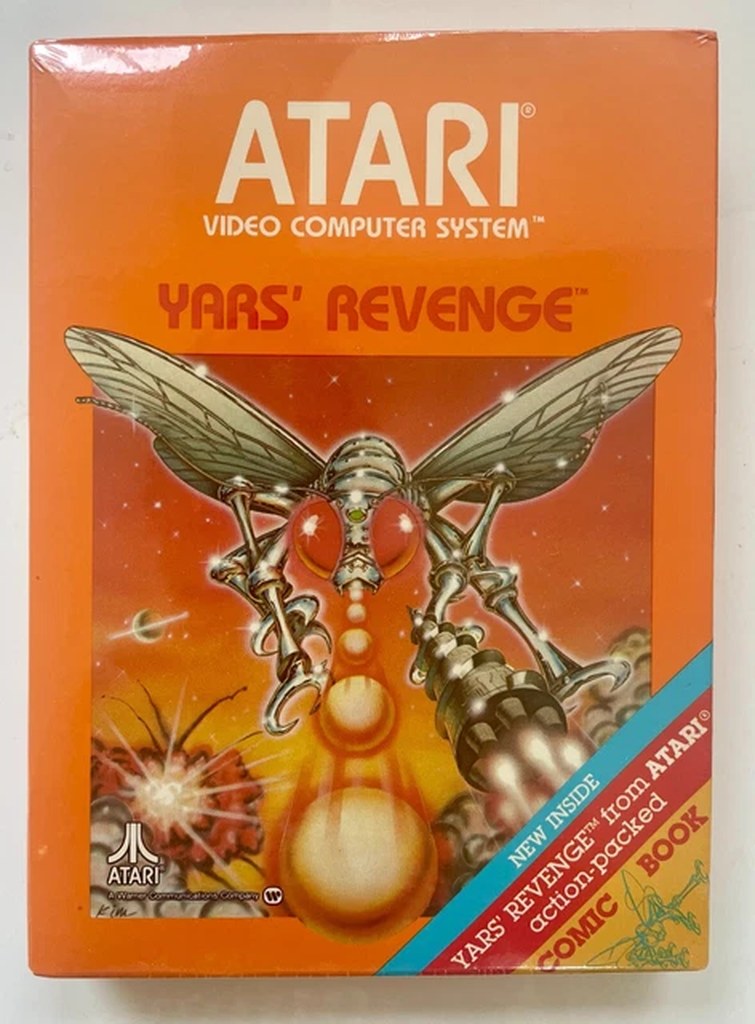
The premise comes gift-wrapped in fiction: the manual included a little comic book explaining that the Yars are mutated houseflies, evolved in space, at war with the Qotile, and named — in a flourish of office humour — after Ray Kassar, Atari’s chief executive, spelled almost backwards (Razak backwards, Warshaw’s naming joke, gives the Yars their razak solar system mythology). Atari even had a backstory for the creature. What matters is that Warshaw, given the job of adapting the arcade game Star Castle to a machine that could not really do Star Castle, chose to invent instead of imitate, and produced something stranger and better than the assignment.
The duel at the centre of it
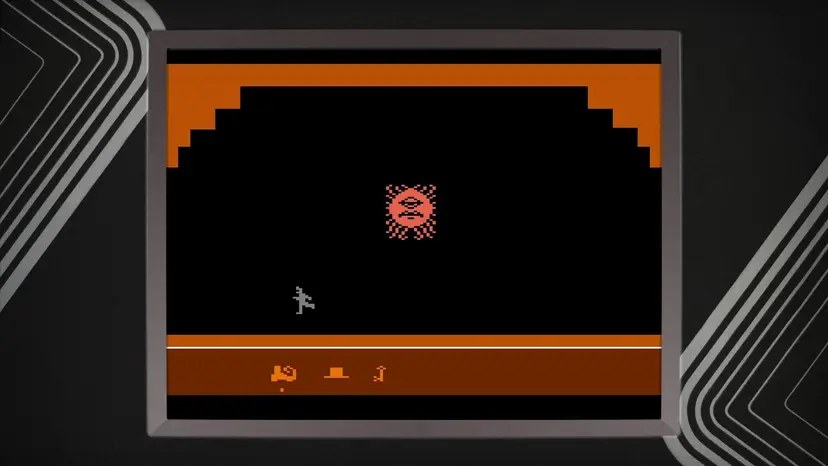
Strip away the fiction and Yar’s Revenge is a duel with a rhythm you can feel in your hands. On the right of the screen sits the Qotile behind its rotating shield. On the left, you. Between you lies the neutral zone, the shimmering vertical band generated, famously, from the game’s own program code displayed as interference — Warshaw turned a hardware quirk into the most recognisable visual on the system, a stripe of psychedelic static that functions as the arena’s safe ground and its rules boundary in one.
The loop runs like this. You dart in and nibble the shield, cell by cell, or shoot it away more slowly, while the Qotile’s guided missile — the Destroyer — hunts you with increasing intelligence. Inside the neutral zone the missile cannot kill you, but neither can you fire. Once you have eaten enough shield, or touched the Qotile itself, the Zorlon Cannon appears on the left edge; you must fly back and touch it to arm it, then get clear and fire it across the screen, steering its shot with your own position, into the exposed Qotile. Meanwhile the Qotile periodically transforms into a Swirl and launches itself at you in a spinning attack that ignores the neutral zone entirely. One cannon hit ends the round. One mistake ends you.
Every element pushes against another. Eating is close work and dangerous; shooting is safe and slow. The neutral zone protects you and disarms you. The cannon is devastating and requires you to abandon cover, arm it in the open, and time a shot while the Swirl counts down. It is a tiny system with no wasted parts, and it generates the kind of near-miss stories players usually associate with much later games.
Warshaw’s touch
Warshaw made three famous 2600 games in an extraordinary burst — Yar’s Revenge, Raiders of the Lost Ark, and E.T. — and Yar’s is the one where his sensibility is purest. He liked games with an internal logic you discover by playing rather than by reading, and Yar’s Revenge teaches almost everything through consequence. Nobody tells you the missile cannot enter the neutral zone; you survive once by accident and learn forever. Nobody explains that nibbling charges your cannon faster than shooting; you notice. Even the game’s famous ghost — the vertical line where the Qotile’s shot originates, and the safe spot Warshaw confirmed sits along it — feels like a secret the machine itself is keeping.
The variations multiply the duel rather than padding it. Later game selections make the shield rotate faster, the Swirl more frequent and more cunning, and reward the ultimate test: hitting the Swirl in mid-flight with the Zorlon Cannon, an achievement the manual wraps in mystique as the way to truly master the game, complete with the designer’s initials appearing as a reward for the feat under the right conditions — another early signature hidden in play, from the same era as Robinett’s secret room.
Look and sound
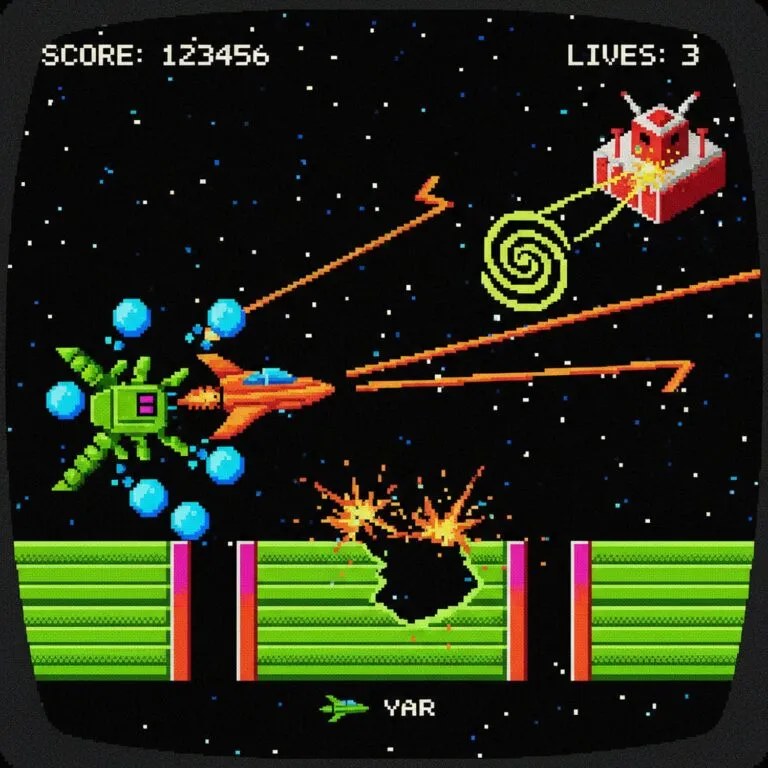
The 2600 is a machine of compromises, and Yar’s Revenge wears its compromises as style. The Yar itself is a genuinely characterful sprite — winged, segmented, unmistakably an insect — animated with a flutter that sells the fantasy despite the resolution. The shield pulses between patterns, solid and swirling. The neutral zone’s static roar is accompanied by a constant low hum and buzz that some players find hypnotic and others find like a fridge dreaming, but which gives the game an audio identity unlike anything else on the system; you can identify Yar’s Revenge from the next room. In an era of beeps, atmosphere was a flex.
How it plays today
New players should expect ten minutes of honest confusion. The manual — easily found, and worth reading as a period piece in itself — explains the loop, and once the loop clicks, the game opens up into one of the most replayable duels on the machine. Rounds are short, escalation is crisp, and the risk arithmetic of nibbling one more shield cell while the missile closes in never loses its edge. Its abstractions are total, which paradoxically protects it from ageing: there is no failed realism here, only a strange sport, perfectly kept.
It helps that the game has stakes in gaming history you can actually feel rather than merely recite. This was Atari’s in-house development at its most confident and eccentric, the commercial peak of the original-title 2600, and proof that the audience of 1982 would embrace a game that looked like nothing on Earth if it played like a dream. The later E.T. saga has overshadowed Warshaw’s reputation in the popular telling; Yar’s Revenge is the correction, and it fits in the same cartridge slot.
The HSWWSH moment
One more piece of Warshaw lore belongs in any full account, because it shows the designer’s mind at its most playful. Hitting the Swirl in mid-air with the Zorlon Cannon at exactly the right moment does something remarkable: the game pauses, the screen displays the letters HSWWSH — Warshaw’s initials, forward and reversed — and play resumes with you having earned one of the most obscure achievements of the cartridge era. It is part signature, part dare, and part reward for the single hardest shot in the game, and players hunted it for years on the strength of playground rumour before it was widely documented. Together with Robinett’s room in Adventure, it marks the moment game designers stopped being anonymous even inside their own games — they signed the work in the only place they fully controlled, which was inside the play itself. That is a very Yar’s Revenge idea: the credits are a gameplay mechanic.
Verdict
Yar’s Revenge is the 2600’s weirdest masterpiece because its weirdness is functional: every strange rule sharpens the duel, every hardware limitation became a feature, and the whole thing runs on a loop tight enough to carry the best-selling original title on the system. Nibble the shield. Mind the Swirl. And when the cannon shot flies, remember a mutated housefly taught the industry that original could outsell familiar.