
At a glance: 3D Defender · ZX81 · J. K. Greye Software, 1982 · 3D shooter · Score: 8.0/10
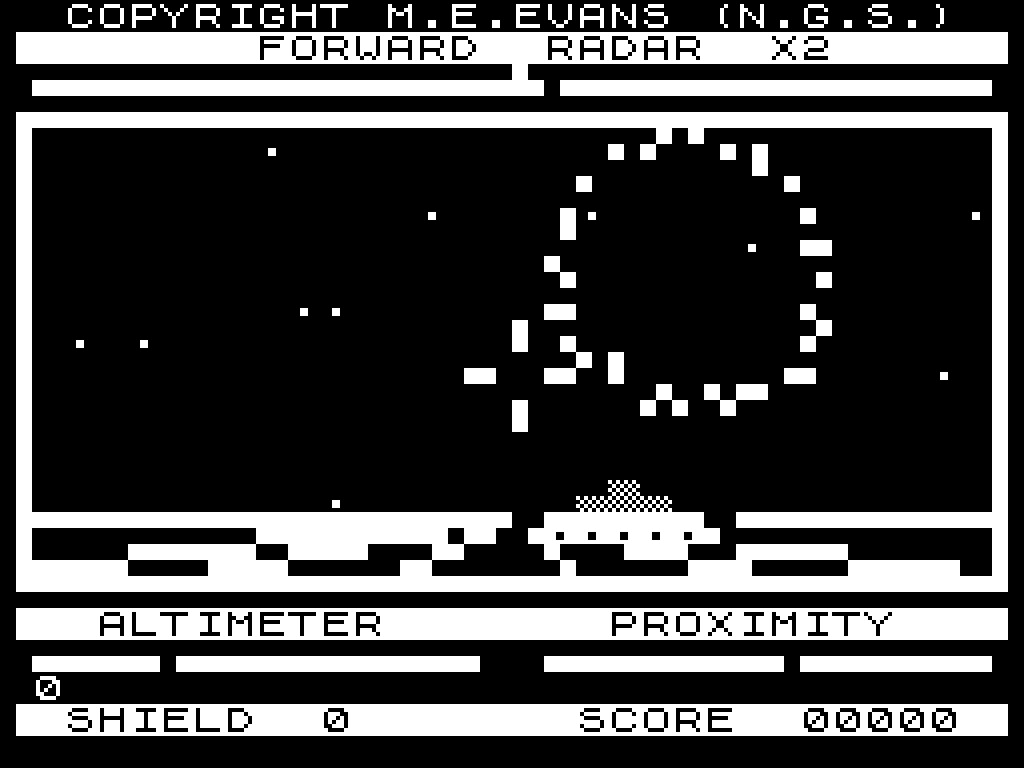
Having taught the ZX81 to be frightening, Malcolm Evans and J. K. Greye taught it to fight. 3D Defender — designed by Greye, programmed by Evans, published by J. K. Greye Software and reissued under Evans’s own New Generation Software — applies the same first-person block-graphics engine that made 3D Monster Maze immortal to the opposite problem: not escaping a monster in a maze, but defending against attack in open space. Where Monster Maze looks down corridors, Defender looks out across a void. The walls come away, the dinosaur goes home, and what remains is the pure Evans trick of 1981-82 — a convincing three-dimensional world assembled from the ZX81’s character blocks, on a machine with no graphics hardware at all.
The pairing is the point. Greye’s tiny label released the two games as its twin 3D flagships — of the six Games Tapes the company published for the ZX81, the two in 3D were the famous ones — and together they mapped the territory Evans would spend his career exploring: perspective as a feature a £70 computer could sell. Monster Maze weaponises the view for dread; Defender weaponises it for action, putting the player in the gunner’s seat of the era’s other great obsession, the Defender-style defence of a position against waves of attackers. Britain in 1982 understood both assignments instantly, because the arcade had already taught it the shapes: protect what is yours, shoot what comes for it, and do it in a space that feels like a space.
Same engine, opposite emotion
The technical continuity is the fascination. Evans built his 3D display from the ZX81’s semigraphics — the quarter-block characters that were the machine’s entire visual vocabulary — and the same code philosophy that drew Monster Maze’s corridors draws Defender’s open field: geometry honest enough for the brain to inhabit. In the maze, restricted sightlines do the frightening; here, the long view does the thrilling, because a first-person shooter lives on judging distance, and distance is exactly what Evans’s perspective sells. Targets approach, grow, and must be dealt with in the order their approach dictates. It is the discipline of every cockpit shooter since, being invented in blocks, in silence, by an aerospace engineer who had owned his computer for a matter of months.
That biography remains the best review the game ever got. Evans was a microprocessor scientist at Sperry Gyroscope in Bristol — aircraft design, then the chips inside serious machines — who received a ZX81 as a birthday present in April 1981 and, within the year, had written the two best 3D games the platform would ever see. 3D Defender is the second of them, and it shows the confidence of a programmer who has stopped testing the machine and started directing it: the presentation, the pacing and the New Generation reissue all belong to a man founding a company on the strength of a view down a corridor. New Generation would go on to define early Spectrum 3D — 3D Tunnel, Escape, Corridors of Genon, Trashman’s sideways charm — but the founding documents are these two ZX81 cassettes, Greye above the door.
Monster Maze used Evans’s 3D to make you run. Defender used the same 3D to make you stand and fight. Two cassettes, one engine, and the whole future of British 3D gaming in embryo.
The other Evans
Why does Defender sit in its sibling’s shadow? Partly timing — Monster Maze was first, and first is a superpower in memory. Partly theme: horror ages into reverence more readily than defence games, which every era remakes. But played back to back, Defender is no footnote. It is the proof that Evans’s breakthrough was a technique, not an accident — that the perspective engine could serve action as well as atmosphere — and it is, on its own terms, one of the most technically remarkable shooters on the machine: a first-person game, in 1982, on hardware whose designers never imagined it hosting one.

It is also, quietly, a document of a label system that vanished almost immediately. J. K. Greye Software’s six tapes, the Greye-to-New-Generation handover, the same game wearing two publishers’ inlays — the early ZX81 scene ran on these small arrangements, enthusiasts formalising into companies in real time. The Libretro archives preserve both inlays, Greye and New Generation, which is the whole transition in two pictures: a designer’s label becoming a programmer’s empire.
Six tapes and a revolution
The numbers of the Greye operation are worth dwelling on, because they measure how small the world was in which Evans’s revolution happened. J. K. Greye Software published six Games Tapes for the ZX81 in total. Two of them were in 3D — Monster Maze and Defender, both designed by Greye and programmed by Evans — and those two were enough to make the label immortal and to launch its programmer’s own company. New Generation Software, the firm Evans founded off the back of the maze game, reissued both titles under its own inlays, which is why the archives preserve Defender wearing two publishers: the designer’s label that commissioned it and the programmer’s empire that it helped to found. The handover is the British industry’s founding pattern in miniature — enthusiast publishes engineer, engineer becomes the company — repeated that year in a dozen towns.
What Evans did next confirms Defender’s place in the sequence rather than diminishing it. New Generation became, as the histories put it, a well-known firm on the Sinclair platform and a pioneer of 3D gaming across the ZX81 and the Spectrum: 3D Tunnel’s swooping perspective, Escape, Corridors of Genon, and the immortal Trashman, in which the same mind that built the maze turned to comedy and bin rounds. The thread from the corridors of 1981 runs through all of it. Defender is the thread’s second link — the game that proved the corridor could open into a battlefield, that the perspective engine had a second emotion in it, and that Evans was not a man with one idea but a man with a method. Methods scale. This one scaled to a company, then to an era.
Playing it in 2026
Defender survives in both its inlays — Greye and New Generation — in the standard archives, and the double survival is the correct way to meet it: the same program, two covers, an industry changing hands between them. In emulation it remains what it was, a first-person shooter of remarkable confidence on hardware with no right to one, and the back-to-back session with Monster Maze that this package recommends is the single most instructive hour the ZX81 offers. First the corridor, then the open field. First fear, then fight. Evans’s method, whole.
Verdict
3D Defender is the essential companion to 3D Monster Maze: the same revolutionary engine turned from dread to action, by the same aerospace-engineer-turned-games-designer, in the same extraordinary twelve months. It lacks its sibling’s singular terror and historical firsts, and compensates with proof of range — the demonstration that British home-computer 3D was a method, not a miracle. Every ZX81 shelf needs both Evans cassettes. This is the one with its fists up.
Score: 8.0/10 — Evans’s engine, second verse: first-person action from the man who invented ZX81 3D.