
At a glance: Catacombs · ZX81 · J. K. Greye Software, 1981 · Dungeon role-playing · Score: 7.5/10
Before the mazes went 3D, J. K. Greye sent players underground in the older fashion: from above, in the dark, with a strength score and a bag for the gold. Catacombs, published by J. K. Greye Software in 1981, is one of the earliest British dungeon games — classified in the modern catalogues, correctly, as a role-playing game — and its screen tells the whole design at a glance. At the top, two numbers keep your accounts: STRENGTH and GOLD. Below them, the catacombs themselves are drawn only where you have been: black chambers and passages standing out of an unexplored white void, the mapped world growing room by room as you push into the dark. Fog of war, in 1981, in character blocks, on the first label Malcolm Evans ever worked for.
The Greye context gives Catacombs its particular historical charge. This is the same tiny company — six ZX81 Games Tapes in all — that would publish 3D Monster Maze and 3D Defender, and Catacombs shows the label before the revolution: a dungeon crawler in the direct line of the mainframe and hobbyist tradition, where the computer keeps your statistics and deals you a labyrinth, and the adventure is the arithmetic of survival. Strength is your life; spend it in fights and misadventures and the expedition ends. Gold is your score and your motive; the deeper and richer the haul, the better the run. Between the two numbers sits the entire moral machinery of the dungeon genre, already complete, already legible, in the ZX81’s first year.

Mapped in black, feared in white
The visual design deserves more credit than its simplicity suggests. Most maze games of the era show you the labyrinth; Catacombs shows you your knowledge of the labyrinth. The unexplored void is not empty background but the game’s subject — every white expanse is a question, and the black geometry spreading from your position is the answer accumulating. It is the presentation Rogue had used on American terminals the year before and that British home computers would spend the decade relearning: the dungeon as a place you earn, room by room. On the ZX81’s character display the effect is stark to the point of elegance — a black map eating a white page — and it costs nothing in performance, which in 16K is another way of saying it was the right idea at the right price.
The play is the early dungeon loop in its purest form: explore, encounter, risk strength for gold, judge how deep is deep enough, and live with the judgement. There are no graphics to admire beyond the map and no parser to negotiate; the keyboard walks you and the numbers judge you. Modern players, raised on Diablo’s fountains of loot, will find the economy here almost monastic — and that austerity is the appeal. Catacombs is a game about a depleting number and a growing one, and the entire drama of dungeon crawling, stripped of everything the ZX81 could not afford, turns out to live comfortably inside that single tension.
Strength down, gold up, and the black map spreading into the white. Catacombs reduces the dungeon to two numbers and a growing shadow — and the dungeon survives the reduction beautifully.
Greye before the storm
Within a year of Catacombs, Greye’s label would be famous for something else entirely: the first-person revolution of Monster Maze, drawn by the same block graphics in a different geometry. The contrast is the history of early British gaming in miniature — the top-down dungeon of the hobbyist tradition on one cassette, the first-person future on the next — and Catacombs holds its end up honourably. It is also a reminder that the ZX81’s first-year catalogue was broader than its obituaries suggest: while the arcade conversions grabbed the attention, a quiet tradition of dungeon and strategy games was already running on the machine, with statistics, persistence of knowledge, and scores that meant something.

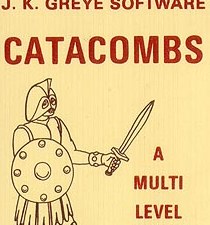
For collectors, the Greye inlay makes the tape a shelf-worthy object in itself; for players, the modern route is emulation, where the game’s sessions — brisk, binary, unforgiving — suit contemporary habits better than many of its longer-winded contemporaries. Either way, the catacombs are still down there: two numbers, a black map, and a white page of unknown.
Greye’s six tapes, and the dungeon’s family tree
Catacombs gains depth when it is placed on its label’s full shelf. J. K. Greye Software published six Games Tapes for the ZX81 — a catalogue small enough to hold in one hand — of which the two 3D titles became famous and the rest, Catacombs among them, became the connoisseur’s layer. That shape, a tiny label with a balanced list — dungeons here, mazes there, the future arriving in first person — is characteristic of the machine’s first year, when the distance between a company’s whole output and a single collector’s shelf was no distance at all. To own the Greye catalogue was to own a cross-section of what the ZX81 could be, and Catacombs is the shelf’s role-playing representative: the tape that proved the dungeon, as a form, had reached the cheapest computer in the country within months of its launch.
The family tree above it is worth tracing, because Catacombs is a junction in it. The dungeon game descends from the mainframe and terminal tradition — from the PLATO systems and the first Roguelikes, where a character in a maze of symbols gathered treasure against statistics — and it would flower on home computers into the great British role-playing lineage of the later decade. The ZX81’s position at the tree’s British root is often missed, because the machine is remembered for mazes you look through rather than down at. Catacombs is the counter-exhibit: overhead, statistical, mapped by exploration, with strength spent and gold gathered, in the direct grammar of the dungeon as the hobbyist world had defined it. That the same label then published the first-person revolution does not diminish the older game. It makes Greye’s six tapes the whole argument, both sides, in one catalogue.
Playing it in 2026
Catacombs survives in the archives in its Greye inlay, and its sessions suit the modern retro diet unusually well: brisk expeditions, binary outcomes, a map that is different every time you dare it. New delvers should keep a pencil handy — the game maps knowledge, and so should you — and should treat the first runs as surveys, strength spent on information rather than gold. What looks stark in a screenshot becomes, in motion, the dungeon genre’s essential rhythm, and there are worse ways to spend an evening than discovering that a 1981 cassette in a six-tape catalogue already knew it.
Verdict
Catacombs is the ZX81’s dungeon in its first, purest form: strength against gold, knowledge against darkness, from the label that was about to change everything with 3D Monster Maze. It lacks its stablemate’s fame and its fireworks, and it does not need them — as an early British role-playing game, playable and starkly elegant, it earns its place in the ground floor of the genre.
Score: 7.5/10 — Strength, gold and a map you earn: Greye’s dungeon before the 3D storm.