
It should not have worked. A turn-based war game — hexes-and-counters territory, the driest genre in the hobby — dressed in primary colours, sold to children, on a handheld, in 2001. Instead, Advance Wars became one of the most beloved strategy games ever made, a design so clean and so moreish that ‘just one more turn’ became its players’ shared confession. Developed by Intelligent Systems and released in the West in 2001 (the series had lived in Japan since the Famicom era; this was its English-language debut), Advance Wars is the Game Boy Advance’s defining strategy title, and its cheerful surface hides one of the deepest tactical engines on any Nintendo system.

War, made readable at a glance
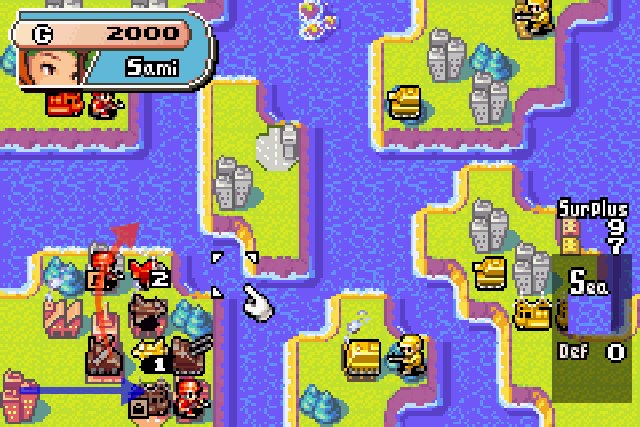
Advance Wars’ first triumph is clarity. Two to four armies fight on grid maps where every unit — infantry, tanks, artillery, rockets, fighters, bombers, battleships and more — can be understood at a glance: what it moves, what it hits, what hurts it. Terrain matters in ways a child can learn and an adult can spend years mastering: forests hide units from indirect fire, mountains extend vision and defence, cities provide income and repairs, and Fog of War maps turn scouting into a game of its own. Combat is deterministic enough to plan around and variable enough — damage depends on health, terrain and match-ups — to reward thinking in percentages rather than certainties. There are no dice rolls to blame. When your tank line collapses, it is because you placed it badly, and the game makes sure you understand why.
A campaign that teaches like a friend
The campaign is one of the great tutorials in games, disguised as a story. Under the patient (and famously thorough) guidance of Nell, Orange Star’s commander, missions introduce one idea at a time — capturing properties, indirect fire, air power, naval units, supply, CO Powers — each lesson immediately tested in a real battle. The plot, in which young commander Andy and his allies Max and Sami defend their homeland against the invading Blue Moon and the larger conspiracy behind it, is Saturday-morning fare, and all the better for it: the tone keeps the game welcoming while the missions grow quietly ruthless. Later battles, against rival commanders with their own broken-feeling advantages, will teach you more about strategy than most dedicated ‘hardcore’ titles manage.

The Commanding Officers are the spice. Each CO has passive strengths and weaknesses — Max’s direct units hit harder and his indirect units suffer; Sami’s infantry capture at speed; Grit’s artillery reaches absurd ranges while his tanks wilt — plus a CO Power, a meter-charged super-move that can swing a battle in a single turn: healing waves, lightning strikes, mass damage, double turns. Powers create the game’s drama and its arguments. Used well, they feel earned; used against you, they feel outrageous, which is exactly the emotional register a great multiplayer game wants.
Built for pockets and playgrounds alike
As a handheld package, Advance Wars is close to perfect. Battles save anywhere, turns take minutes, and the whole game is readable in sunlight on an unlit screen — a real design constraint in 2001 that shaped its bold, saturated art. Beyond the campaign there is a War Room of challenge maps scored on speed, power and technique; a Design mode for building your own maps; and multiplayer that supports up to four players — including, gloriously, pass-the-handheld play on a single cartridge, which made it a schoolyard institution. The presentation is all charm: bouncy unit animations, battles staged as little animated duels, and a soundtrack of CO-specific themes that players can still hum on demand.
The small print
Two caveats, both mild. The AI, while competent, can be baited — it loves attacking transport and indirect units in ways a human would not, and veteran players will exploit its habits on replay. And the campaign’s difficulty curve has one or two famous spikes, missions where a first-time player may stall until they learn the specific trick the map is teaching. Neither dents the whole. It is also worth saying plainly that this is a game about war rendered entirely without blood or consequence — a deliberate, charming abstraction that some players bounce off. Those who accept the toy-soldier framing get one of the purest strategy designs ever shipped.
Why it endures (and a note on its family)
Advance Wars arrived in the West at a strange moment — its North American launch fell in September 2001, and its cheerful toy-soldier framing arguably helped a war game land in a season when war had stopped feeling abstract. What carried it was not timing but design honesty: everything about Advance Wars is knowable. Damage formulas can be learned, AI habits can be studied, maps can be solved and then solved faster. That transparency is why its community produced decades of high-level play, fan-made map editors and challenge runs, and why its 2023 remake (Re-Boot Camp, which bundles this game with its sequel) found an audience waiting. This review covers the GBA original, which remains remarkable for how little it needs modernising: the remake’s existence is best read as a compliment to a design that was already finished.
A word, too, for the campaign’s structure as a piece of teaching. Modern strategy games bury players in tooltips; Advance Wars embeds its curriculum in characters. Nell’s briefings, the rival COs who each embody one lesson (fight Grit and you will learn indirect fire or die), and the unlockable challenge maps all trust the player to be cleverer at the end than at the start. By the final missions — multi-front wars against the true villain, Sturm, whose CO Power can feel genuinely unfair until you learn to plan around its meter — the game has quietly turned a child with a new handheld into a competent tactician. Few games teach this well. None make it look this friendly.
For players choosing where to start the series today, this first GBA game remains the gentlest on-ramp: its sequel, Black Hole Rising, is bigger and sterner, and the DS entries add dual-screen complications and new economies. The original’s campaign, War Room and design tools are a complete education in themselves, and its scoring systems — ranks for every mission, medals for the War Room — give perfectionists months of targets. It is no exaggeration to call it one of the most replayable cartridges on the system: forty-plus hours hides easily inside its bright little maps, and most of them will be spent saying the series’ unofficial motto. Just one more turn.
There is a final, underrated pleasure in Advance Wars that deserves naming before the verdict: it is a wonderful game to lose at. Because every outcome is legible, defeat arrives as information rather than insult — you can point to the exact turn the front collapsed, the capture you greedily skipped, the artillery left one forest too shallow. Missions invite immediate, informed retries, and the score screen grades the attempt rather than mocking it. That emotional design — stern systems, kind presentation — is the real reason a war game became a childhood favourite for thousands of players who had never touched a strategy title before, and the reason its lessons in planning, patience and percentages quietly followed them into other games and, if the community’s jokes are to be believed, into their working lives.
Verdict
Advance Wars is a masterpiece of legible depth: rules a newcomer learns in an afternoon, arranged into a system that still rewards mastery decades later, wrapped in colour and character and built perfectly for its machine. It brought a whole genre to a new audience and remains the standard against which handheld strategy is judged. Essential is an overused word. Here, it fits.
Score: 9.0/10