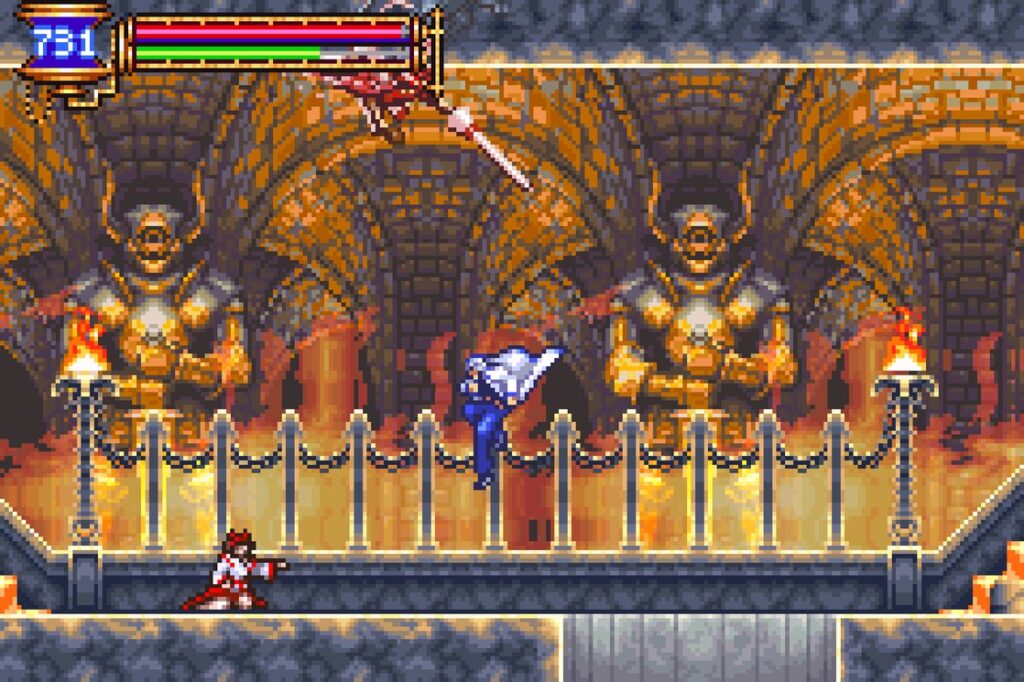
Three Castlevania games came to the Game Boy Advance, and the third is the one that belongs in the all-time conversation. Castlevania: Aria of Sorrow, released in 2003 under producer Koji Igarashi, took the Symphony of the Night formula — a vast explorable castle, RPG progression, hundreds of abilities — and added one of the great systems in the genre: the souls of the monsters you kill become your weapons, your tools and your build. Add a story with genuine audacity — Dracula’s castle, in the year 2035, and a hero who is far more than he appears — and you have the finest Castlevania on any handheld, and arguably the series’ portable peak.

2035: Dracula is dead. So why is his castle here?
The premise remains delicious. Dracula was finally, permanently destroyed in 1999. Thirty-six years later, exchange student Soma Cruz visits a shrine to watch a solar eclipse — and wakes inside Dracula’s castle, sealed within the eclipse itself. A mysterious man, Genya Arikado, tells him to reach the throne room. A cult leader wants to inherit Dracula’s power. And Soma discovers he can absorb the souls of the castle’s monsters — the Power of Dominance — a gift that should belong to exactly one being. Aria’s story plays fair with its twists, treats its cast with unusual warmth (hammer-wielding shopkeeper, amnesiac soldier, an old friend of the Belmont line), and builds to revelations that reframe the entire series. For a GBA cartridge, it is remarkably confident storytelling, and its sequel-hook ending has fuelled fan debate for two decades.
Every monster is a move waiting to happen
The Tactical Soul system is the engine of the whole game. Nearly every enemy can, on defeat, surrender its soul: red Bullet souls become your sub-weapon-style attacks, blue Guardian souls provide shields, summons and transformations while held, yellow Enchant souls grant passive boosts you simply equip, and rare Ability souls permanently expand your movement — double jump, slide, backdash and better. There are over a hundred to collect, and they compose into builds: a Soma who fights behind a summoned demon and a wall of enchantments plays nothing like one built for raw weapon damage. Grinding for a rare drop is the system’s one tax — some souls are stubborn — but the castle is such good company that the grind rarely feels like punishment, and Soul Eater-style luck gear exists for the determined collector.

Around that system, the castle itself is superbly built: a single interlocking map of distinct districts — the waterlogged Underground Reservoir, the clockwork Chapel, the floating gardens, the forbidden Arena — each gated by abilities in classic style but paced so briskly that Aria feels like Symphony distilled rather than shrunk. Weapons range from knives to the legendary Claimh Solais, armour and accessories meaningfully shift your numbers, and Michiru Yamane’s score gives the whole castle a melancholy grandeur that the GBA’s speakers strain, honourably, to contain. Visually it is the leap the earlier GBA entries promised: where Circle of the Moon was famously murky (a real problem on the unlit original screen), Aria is bright, detailed and readable — bigger sprites, richer backgrounds, bosses with genuine spectacle.
Bosses, secrets and the true ending
Aria understands boss design: Death, Legion (a writhing sphere of bodies that must be stripped away), the Headhunter, and a final act that only opens fully to players who equip three specific souls — discoverable through the castle’s library of monster lore — for the ‘true’ route and its extra areas and ending. It is the good kind of secret: hinted, fair, and transformative once found. A Boss Rush mode, a hard mode, and an unlockable playable character with an entirely different, whip-and-subweapon moveset (the series’ past reaching into its future) round out a package with far more in it than its roughly ten-hour first run suggests.
Aria in the series, and on the shelf
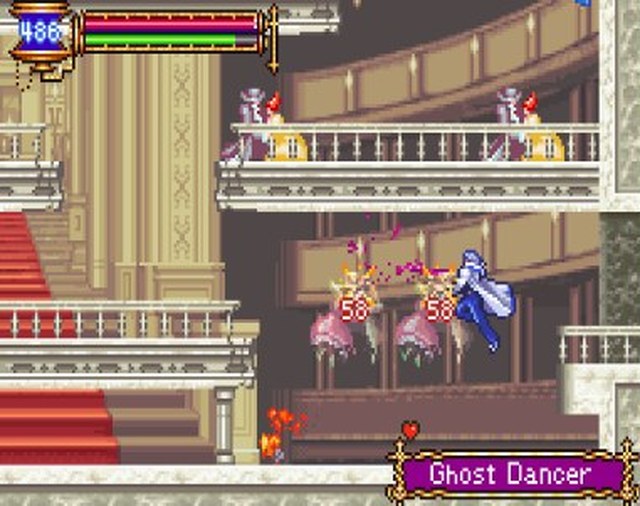
Context sharpens Aria’s achievement. Its GBA predecessors were learning experiences: Circle of the Moon (2001) was a strong but visually murky launch title whose card-based ability system split opinion, and Harmony of Dissonance (2002) brightened the picture at the cost of a widely criticised soundtrack. Aria took Harmony’s readability, restored musical ambition, replaced the card system with the far more generous Tactical Souls, and wrapped it in the series’ best portable story. It is the moment Igarashi’s handheld Castlevania fully found itself — the direct ancestor of the DS trilogy that followed, whose first entry, Dawn of Sorrow, is quite literally Aria’s sequel, continuing Soma’s story. Playing Aria first makes Dawn better; playing Aria alone loses nothing.
Practically speaking, it is also the most replayable of the GBA three. Beyond the true-ending route, there is the pleasure of the hunt itself: completing the soul collection, experimenting with builds (a luck-stacked farmer, a glass-cannon swordsman, a summoner hiding behind guardians), and the New Game options that let veterans re-run the castle with their collection intact. The castle rewards memory. Shortcuts, breakable walls and out-of-the-way chambers become familiar like a neighbourhood, and the map’s clean logic — every district distinct, every gate honestly signposted by the ability it needs — is a quiet rebuke to lazier Metroidvanias. Aria respects the player’s intelligence and their time simultaneously, a balance the genre still struggles to strike.
Two smaller virtues complete the picture. The first is pacing of discovery: Aria doles out its movement abilities — the slide, the double jump’s cousins, the water-walking and the great bat transformation of its late game — at a rhythm that keeps the castle perpetually reopening, so backtracking feels like promotion rather than repetition. The second is its bestiary. Aria’s enemy roster raids world folklore far beyond the usual skeletons and bats: Valkyries, Chronomages, flesh golems, the eerie Stolas, catoblepas, and a haunted armoury of possessed weapons, each with a soul worth farming and a compendium entry worth reading. The castle feels curated, like a museum of monsters that happens to be trying to kill you. Add Hammer’s shop (stocked, delightfully, by what you sell him), the save-point placement that respects your evenings, and a soundtrack that players still rank among Yamane’s finest, and Aria’s completeness becomes almost stubborn: it is as if Igarashi’s team made a checklist of everything a portable Castlevania could be, and then refused to ship until every box was ticked.
New players sometimes ask whether to start here or with Symphony of the Night, and the honest answer is that Aria is the more welcoming masterpiece: shorter, clearer, kinder with its saves and signposting, and built around a collection system that turns every new room into a small lottery of possibility. Start here, and Symphony becomes a glorious, sprawling second course. Start with Symphony, and Aria becomes its perfect pocket digest. Either order ends in the same place — with the realisation that the ‘Metroidvania’ label undersells what these games are at their best: RPGs in which the character sheet is a castle, and the castle, in Aria’s case, is the finest one ever folded into a handheld cartridge.
Verdict
Castlevania: Aria of Sorrow is the complete package — the series’ boldest story, its most flexible ability system, a castle worth memorising and a hero worth following into a sequel. It fixed every complaint aimed at its GBA predecessors and set a standard the DS sequels themselves had to chase. If you play one Castlevania on the Game Boy Advance, play this one. If you play one Castlevania anywhere, you could still do far worse.
Score: 9.5/10