
At a glance: Alone in the Dark · 3DO · Infogrames, 1994 · Survival horror · Score: 8.0/10
Before Resident Evil, before Silent Hill, there was a house in Louisiana, a suicide in the attic, and a detective who should never have gone inside. Alone in the Dark created survival horror in 1992 on PC, and the 3DO version of 1994 is the finest console edition of that founding text: the hand-painted mansion of Derceto, the polygonal pioneers Edward Carnby and Emily Hartwood, and a Lovecraftian mystery told through fixed camera angles, scarce resources and nerve-shredding silence. Playing it now is an archaeology dig where the artefacts still work — and still bite.
The premise is pulp perfection. Antique dealer Jeremy Hartwood has hanged himself in the attic of Derceto, his mansion thick with rumours of occult dealing. You play either his niece Emily, come to settle the estate, or Edward Carnby, a private detective hired to retrieve a piano — a difference that changes the introduction, some item placement and little else, in the way of early-nineties protagonists. The front door locks behind you. The floorboards start to complain. And within minutes, something comes through the window that should not exist.
The grammar of fear, invented live
Everything the genre became is here in embryo. The camera cuts between fixed, theatrical angles chosen to conceal as much as reveal — you hear rooms before you see them. Combat is deliberately awkward: a rifle, a revolver, a sword, each operated through a stance system that makes fighting a commitment rather than a reflex, against enemies who often outmatch the arsenal. Resources — bullets, oil for the lamp, first-aid — are finite and hidden in a house that must be searched drawer by drawer. Death is cheap and information is the real currency: most monsters have a trick, a weakness, or a door you can simply close.
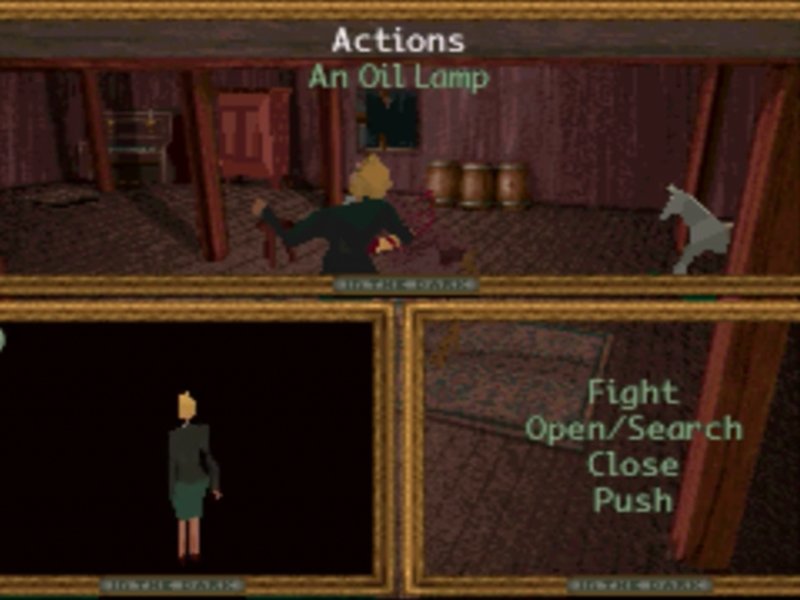
The house itself is the masterpiece. Derceto is a compact, learnable building — attic to cellar, library to dance hall — whose geography becomes the game’s true map, and its pre-rendered rooms, painted in rich storybook colour, gave 1994 players a sense of place no texture-mapped corridor could match. Against those backdrops the characters move as early real-time polygons, all angles and elbows, jerky and unmistakably alive. The contrast — flat painted world, solid intruders — should break the spell. Instead it created the genre’s signature look for a decade: the polygonal figure alone in the beautiful, watching room.
Lovecraft by way of the library
The story is told in books. Derceto’s shelves hold the plot: journals, grimoires and letters that build the house’s history of piracy, ritual and the thing beneath the foundations, in prose that trusts the player to read. This was Infogrames’ European sensibility at its best — literary, allusive, unbothered by pacing fashions — and it gives the game a density its imitators rarely matched. The supernatural here has footnotes. Puzzles grow from the lore: the library’s dangers are answered by its books, the rituals below the house by the rituals described above it.
Every survival horror game since has lived in Derceto’s house. The rent is still due to this one.
The 3DO edition, and the honest faults
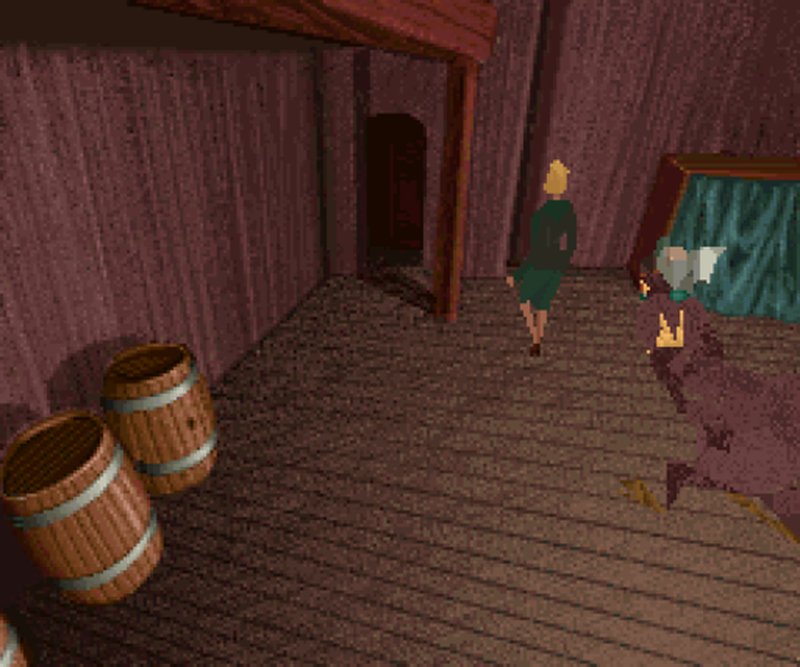
This conversion treats the original with respect. The visuals are the PC game’s at their best, the redrawn interface suits a controller, and CD audio lifts the score and effects — the famous creaks, crashes and sparse piano dread — into something close to definitive. Loading between rooms is brisk. For a console audience in 1994, this was the complete experience of a landmark, and it remains the most comfortable period way to play it on a television.
The faults are the original’s, faithfully preserved. The controls were already eccentric in 1992 — tank movement, stances, a run command with a mind of its own — and the pad does them no favours. Some puzzle logic is pure moonshine, and trial-and-error deaths around the house’s traps will spend a modern player’s patience. The famous opening attic sequence can kill a newcomer in under a minute, which was a statement of intent then and a barrier now.
And yet. The atmosphere has not dated, because it was never built from technology — it was built from framing, scarcity and writing. When the lights fail in the library and something begins, patiently, to move between the shelves, Alone in the Dark stops feeling like an ancestor and starts feeling like what it is: a great horror game that happens to have invented its genre as a side effect.
The craft of the scare
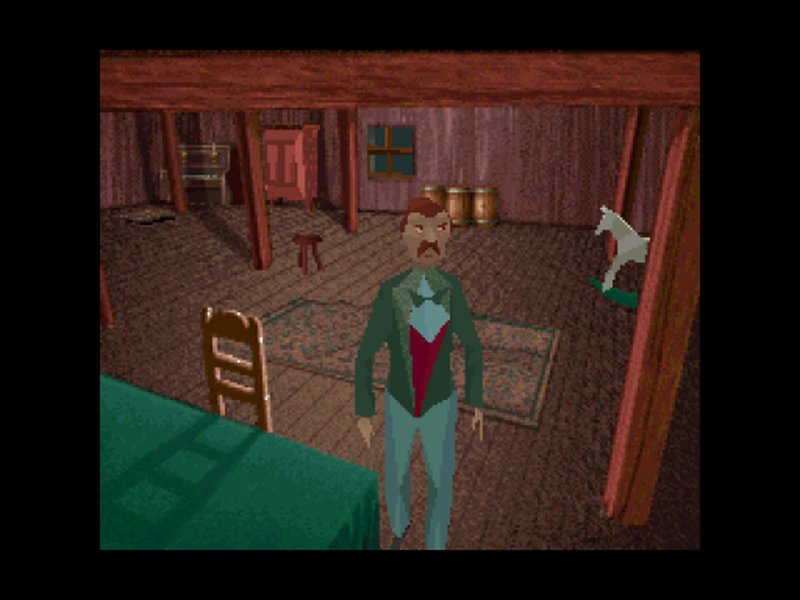
What repays study, three decades on, is how deliberately the scares are engineered. The famous first monster arrives through the attic window within minutes — the game’s thesis statement, delivered before the player has learned the controls, let alone the house. From there the pacing alternates with a novelist’s patience: long, quiet searches through lamplit rooms; a corridor that was safe an hour ago and is not now; the library, where the game trusts a locked door and a sound to do the work of a dozen jump scares. The fixed cameras are the director’s hand — every angle a decision about what the player may not see yet. Resident Evil would industrialise this grammar four years later with better technology and a bigger budget. The grammar itself, the vocabulary of dread, is Derceto’s invention.
The two protagonists offer a small but real replay value that the era rarely bothered with: Emily and Carnby enter the same house through different doors of the plot, and while the mansion’s spine is shared, item placement and several encounters differ enough that a second run feels like a new investigation of the same crime scene. It is a modest thing, but it signals the game’s respect for its own fiction — the house does not care which of you it kills.
And the influence audit is almost absurd to recite: the fixed cameras, the limited inventory, the documents-as-narrative, the mansion-as-map, the puzzle-box bosses, the resource famine — an entire genre’s commandments, written in one house in 1992 and carried to console players most completely by this disc. To play Alone in the Dark on 3DO is to read the genre’s first draft in its best period edition, and to discover that the draft is also, simply, a fine and frightening game.
Playing it in 2026
Practical notes for the modern visitor: play on the 3DO if you can, in the dark, with the sound up — the creaks are the game. Save often and in rotation, because the house’s traps do not believe in checkpoints. Read everything; the books are not flavour, they are equipment. And choose Carnby for a first run — the detective’s slightly hardier introduction is the game’s own easy mode, such as it is. Emily’s route, sharper and stranger, is the connoisseur’s second pass through the same haunted rooms.
The sound of the house
One element of the 3DO edition deserves its own sentence of praise: the audio. Derceto’s score is sparse, funereal piano and sudden orchestral violence, and on CD it breathes in a way the PC’s sound-card era could not reproduce — while the effects, the creaking boards and distant crashes that tell you where the house is awake, become the game’s true radar. Play it through good speakers and the mansion acquires a second, invisible architecture made of noise. Many horror games since have spent fortunes learning what this one knew with a piano and a floorboard.
Verdict
Alone in the Dark on 3DO is a museum piece that still draws blood: the founding survival horror, in its best console edition, with its house of dread intact. Newcomers should expect period controls and period cruelty — and one of the most influential atmospheres in games. Score: 8.0/10