
At a glance: Antic and ANALOG Computing · Atari 400/800 · 1981–1990 · Feature
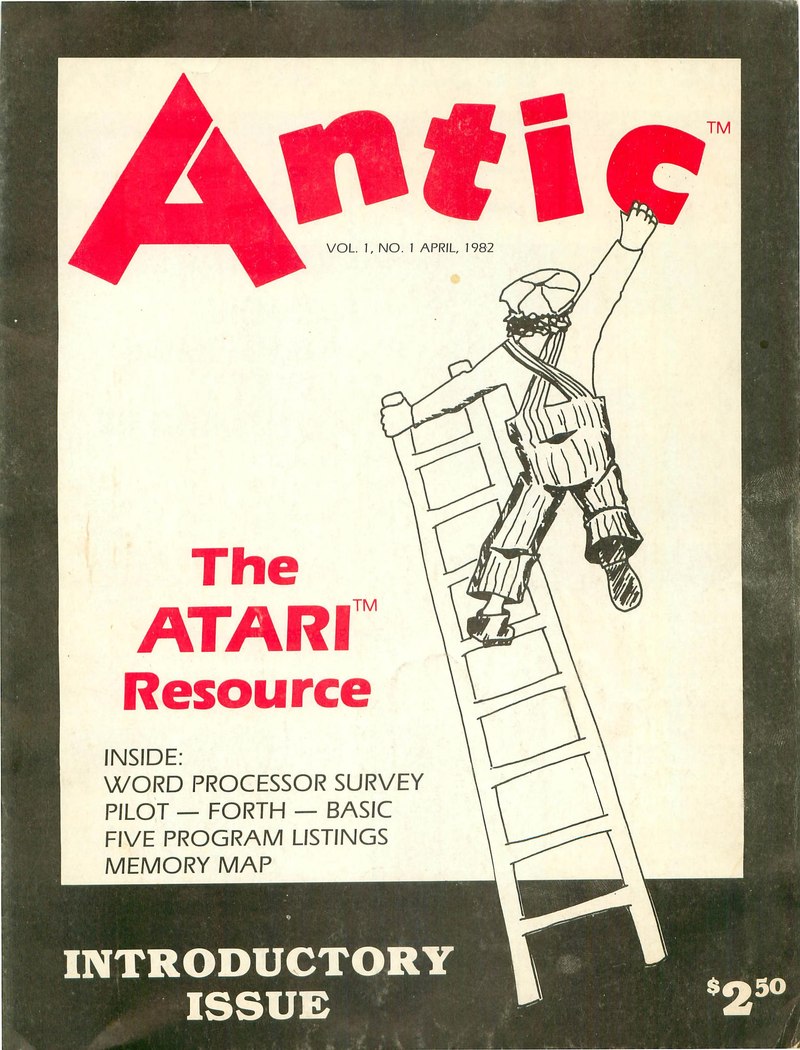
Before the web, before the BBS in every town, an Atari owner’s university arrived monthly in the mailbox, printed on paper. Two magazines defined the Atari 8-bit’s culture between them: ANALOG Computing, founded in 1981, and Antic, launched in April 1982 by Jim Capparell, who would become one of the platform’s great champions. Between newsstand and subscription they taught a generation of owners to program — not with lectures, but with listings: pages of BASIC and machine code to be typed in by hand, debugged by eye, and understood, line by line, because understanding was the only way the game at the end would ever run.
The type-in listing is hard to explain to anyone who has only ever downloaded software. You spread the magazine beside the keyboard — an 800XL’s, if you were lucky; a 400’s membrane, if you were not — and you copied, character for character, columns of DATA statements and cryptic abbreviations, for an hour or an evening. Then you ran it, and it crashed, and the real education began. Both magazines understood this ritual and engineered for it: Antic’s famous TYPO (and later TYPO II) checksum program printed a table of codes for each listing, so a typo could be found by comparing numbers line by line. Debugging somebody else’s code, at thirteen, with a checksum table as your only tool, is a computer science education that bootcamps still struggle to match.

Two magazines, two temperaments
ANALOG Computing — the name stood for ‘Atari Newsletter And Lots Of Games’ — arrived first and leaned technical: deeper hardware coverage, machine-language tutorials, sophisticated utilities and games that assumed an ambitious reader. Antic was the populist: brighter, broader, friendlier to the beginner, with Capparell’s evangelical editorials, the famous annual issues, and a letters culture that made readers into a community. Most serious Atari households took one; many took both, and the rivalry between the two newsstand neighbours was the friendliest in publishing — together they simply were the Atari press.
The content mix is worth remembering, because nothing like it exists now. A single issue might carry a full arcade-quality game in machine code (printed as hundreds of DATA numbers, a small act of insanity and faith), a BASIC game for the beginners, a disk utility, a hardware project involving a soldering iron, reviews of the month’s commercial releases, an adventure-game column, reader programs too small for full articles, and an editorial about the future of the platform. The magazines assumed their readers were creators who also played — the correct assumption, as the platform’s own history proved: commercial careers across the industry began as names in Antic and ANALOG contributor boxes.
What the listings taught
Open a surviving issue today — the full runs are scanned and searchable in the Internet Archive, which is where our cover images come from — and the pedagogy is unmistakable. The listings were annotated like lessons, because they were: a game would arrive with a guided tour of its own code, explaining the display-list trick in line 120 and the player-missile shortcut in the DATA block, turning one evening’s typing into three transferable techniques. The magazines assumed a curriculum across issues, too: BASIC first, then the memory map, then machine language for the graduates, with assembly tutorials that treated the 6502 as a friend the reader simply had not met yet. Owners who started with Antic’s gentlest type-ins in 1983 were, by 1986, writing in to correct the tutorials.
The culture pages did equal work. Reader letters argued about the XL’s OS revisions and the 1050’s moods like parish politics; the annual April silliness and the Christmas buyers’ guides marked the community’s calendar; and the type-in contests made celebrities of schoolchildren, whose names appeared in print above their own working games — an honour no modern platform quite replicates, because no modern platform needs its users to be authors. That need was the Atari 8-bit’s secret curriculum, and these two magazines were its faculty. When the platform’s commercial centre collapsed after 1984, it was the magazine-trained readers — programmers, writers, sysops — who carried the scene through the decade on user groups, bulletin boards and PD libraries.
Ink, disks and risks
Neither magazine had a smooth ride, and their scars are part of the record. Antic’s publisher bet the company on the platform and then had to diversify or die as Atari’s fortunes fell; the magazine absorbed the ST audience, spun off a dedicated ST title, and outlived almost every rival by becoming indispensable rather than merely popular. ANALOG, the upstart from Massachusetts, fought the small publisher’s eternal war — newsstand economics, paper costs, the postal service — and responded with the disk editions and contest culture that made its readers stakeholders rather than subscribers. Both titles published through the platform’s worst years, when their ad pages thinned to a pamphlet and their listings carried the scene almost alone. Loyalty of that order is not bought; it is banked, month by month, in working programs. When owners tell you the magazines saved the platform, this is the arithmetic they mean.
Reading them now
The practical pleasure for today’s owner is that the magazines never really went away. Complete runs sit in public archives, lovingly scanned — the covers in this article are drawn from those scans, blemishes and newsstand stickers intact, because that is what the artefacts look like — and the listings still run, typed afresh by each new generation of owners proving to themselves that the old machine still keeps its promises. There are worse ways to spend a winter than working through Antic’s first year with an emulator open beside the PDF: the word processor survey will not change your life, but the memory map might, and the five program listings will teach you more about how your Atari thinks than a month of videos. The faculty has retired. The school is still open.
And the winners are…
One tradition deserves preservation in amber: the annual awards and readers’ polls, where the magazines handed the platform its own mirror. Developers campaigned; readers wrote in by the thousand; and the results — game of the year, best utility, the type-in of the season — gave the scene a canon argued from evidence rather than marketing. When this site’s build-up program goes hunting for a system’s character, it is, consciously or not, walking in those polls’ footsteps.
The ecosystem they built
Around the magazines grew an entire infrastructure. Antic’s publishing arm sold disks of the month’s programs for owners whose typing stamina failed; its catalogue and the APX tradition it inherited kept user software circulating. The magazines ran programming contests, published the winners, and reviewed the commercial scene with a specificity no generalist magazine could match — they knew exactly what a GTIA graphics mode could and could not do, and graded accordingly. When the ST arrived mid-decade, both magazines adapted (Antic launching its sister ST publication, STart) while keeping faith with the 8-bit readership that larger publishers were abandoning.

Antic and ANALOG did not just cover the Atari 8-bit scene. In large part, they were the scene — its school, its post office and its hall of fame.
The end came with the platform’s long twilight: ANALOG published its last issue in 1989, Antic followed in 1990, outliving almost every rival from the home computer press’s golden age. Their combined runs — Antic’s nine volumes, ANALOG’s seventy-nine issues — are now scanned and archived online, listings and all, and modern Atari owners still type from them. The remarkable thing is how current the best of it feels: the tutorials assume intelligence, the games respect the hardware, and the whole enterprise treats programming not as a profession’s secret but as the natural second language of anyone who owned the machine. The magazines are gone. The readers they manufactured run the industry now.