
At a glance: Lucasfilm Games · Atari 400/800 · Lucasfilm Computer Division & Atari, 1982–1985 · Feature
Every great studio has a birthplace, and Lucasfilm Games’ is not a film lot in California. It is a computer — the Atari 800. When George Lucas decided in 1982 that his company should make video games, he did not start by hiring game designers, because in 1982 there was barely an industry to hire them from. He started with a deal: Atari, then the giant of the business, would put up the money and the partnership, Lucasfilm would supply the research culture of its Computer Division, and the first games would be built for Atari’s 8-bit computers. The studio that became LucasArts — Monkey Island, X-Wing, a dozen classics deep — began life writing fractal mathematics for a beige computer from 1979.
The arrangement made sense from both ends. Atari got first claim on games from the Star Wars company — though, in one of history’s great ironies, not Star Wars games: the licence for those sat elsewhere, which is why Lucasfilm’s first titles are original worlds. Lucasfilm got something rarer: time and permission to experiment. The Games Group, formed inside the Computer Division in 1982 and led initially by Peter Langston, a researcher recruited from Bell Labs, was staffed like a laboratory — programmers with graphics-research backgrounds, among them Loren Carpenter, whose speciality was drawing landscapes with fractal geometry, and David Fox, who would direct the first productions.
A lab, not a factory
The culture shock was the point. The early Lucasfilm team worked in the Computer Division’s research environment, down the corridor from the people inventing computer animation and digital editing, and the Atari partnership gave them a target machine with real graphics hardware and an audience of enthusiasts. The two flagship projects that emerged — David Fox’s Rescue on Fractalus! and the one-on-one sports game Ballblazer, led by David Levine — were both built around technology first: Carpenter’s fractal terrain generator, which could draw a convincing mountain range from an equation, and Ballblazer’s smooth first-person arena, its music generated by algorithm as you played.

Atari understood what it had. In May 1984 the two games were unveiled to the press as the spearhead of the Atari relationship, and the reaction was electric — journalists who had seen everything the young industry had produced had not seen terrain like Fractalus, or a sports game moving like Ballblazer. The future seemed scheduled: cartridges and disks for the 8-bit line, the partnership deepening, Lucasfilm as Atari’s prestige studio.
The crash reroutes history
Then the floor fell out of the industry. The North American video game crash of 1983–84 gutted Atari; Warner Communications sold the consumer division in the summer of 1984, and the new Atari under Jack Tramiel was a different, colder partner with different priorities. The two finished games — the crown jewels of the old regime — ended up published not by Atari at all, but by Epyx, in 1985, for the Atari 8-bit and its rivals. Pirated copies of the Lucasfilm prototypes, leaked from preview disks, had already circulated on bulletin boards for months — the famous story of ‘Behind Jaggi Lines’, the bootleg Fractalus, spreading through the community while the official release waited on corporate wreckage.
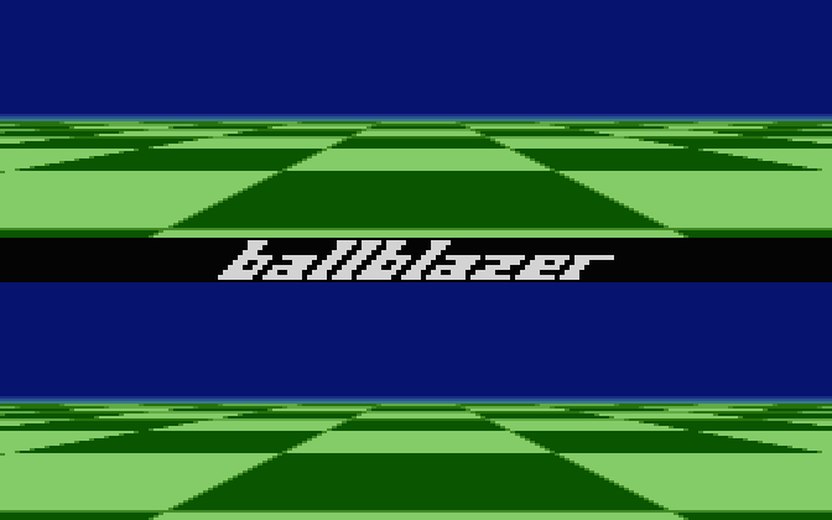
Lucasfilm Games was founded to make Atari games. The crash made it an independent instead — and the Atari 8-bit kept the masterpieces the partnership produced.
What survived the crash was the team and the method. Two more Atari 8-bit releases followed on Epyx in 1985 — Charlie Kellner’s The Eidolon and Noah Falstein’s Koronis Rift, completing a fractal trilogy of startling ambition — and then the group’s centre of gravity shifted: to the Commodore 64 with Habitat, the pioneering online world built with Quantum Link, to the point-and-click adventures that would define the studio, to Maniac Mansion and beyond. Steve Arnold, who took over the games division’s management in the mid-80s, professionalised what the lab had started; within a decade the tiny Atari-focused skunkworks had become LucasArts, the most admired adventure studio in the world.

The technology was the message
It is worth pausing on why the Atari 800, specifically, shaped what the lab produced. Carpenter’s fractal engine needed a machine with a fast processor, flexible colour hardware and enough memory to breathe — and the 800, designed by Jay Miner’s team with custom display silicon, was the most capable home computer in America when the partnership was signed. The Games Group’s research culture met hardware that rewarded research: Fractalus’s mountains are a paper about fractal geometry that you can fly through, and Ballblazer’s playfield — a chequered plane rushing under a split-screen camera, with music composed by algorithm in Peter Langston’s pioneering work on procedural audio — is a laboratory demonstration that happens to be a superb sports game. Neither project reads as a ‘product’ in the 1982 sense. Both read as questions — what else can a computer at home do? — asked by people with film-studio resources and a mathematician’s toolkit.
The human organisation mattered as much. Inside the Computer Division, the games people shared oxygen with the future of cinema itself: the Graphics Group that would become Pixar was developing the Pixar Image Computer in the same corporate body, and the division’s digital editing and sound projects were rewriting film production down the hall. Games at Lucasfilm were never a merchandising afterthought; they were one front of a single campaign to teach computers to tell stories. The Atari partnership gave that campaign its first public victories — and, when the partnership collapsed, its first war stories, which the team carried into every negotiation for the next thirty years.
The leak that made history
No account of the partnership is complete without its farce, because the farce shaped the industry. Review copies of the two games, sent to journalists under embargo, escaped into the pirate networks that served every 8-bit platform — and the Atari 8-bit’s own BBS scene moved fast. Lucasfilm, a company built on controlling its creations absolutely, watched its first products spread for free months before launch and drew the conclusions in the hardest available ink: the home-computer business, as then organised, could not protect software. The lesson pushed the Games Group’s business gurus towards platforms and deals with tighter control, and it is one reason the division’s later masterpieces arrived on disk-based computers with manuals the size of novellas and copy protection woven into the fiction. Piracy did not kill the Atari partnership — Atari’s own collapse did that — but it ended the innocence of everyone involved, on all sides, permanently. Every anti-piracy argument since has been a footnote to the summer of 1984.
The people, afterwards
Follow the credits forward and the Atari lab reads like a founding faculty. David Fox went on to anchor Lucasfilm’s adventure era; Noah Falstein’s design career carried the lab’s habits into decades of classics; Loren Carpenter’s fractals grew into the rendering research that made modern cinema’s landscapes; Peter Langston’s procedural experiments seeded ideas in music and AI that are still flowering. Even the business staff’s war stories — the piracy, the collapse, the pirate-leak summer — became the industry’s institutional memory, retold in every production office the alumni passed through. The partnership itself lasted barely two years. The people it assembled lasted, and everything they made afterwards has Atari dust on it somewhere.
Why the Atari years matter
It is tempting to treat the Atari period as a prologue, four games before the real story. Play them and the temptation dies. Rescue on Fractalus!, Ballblazer, The Eidolon and Koronis Rift contain the studio’s entire future in embryo: technology built to serve wonder, worlds treated as characters, systems that generate stories rather than scripting them, and a house style of polish that began with a title screen. They were also, not incidentally, among the finest games on the platform that hosted the lab. Lucasfilm Games grew up to change the medium. It learned to walk on an Atari 800 — and the walking, it turns out, was already a kind of flight.