
At a glance: Arkanoid II: Revenge of Doh · Apple IIGS · Taito, 1989 · Breakout action · Score: 8.0/10
Every games library needs its perfect ten-minute game, and the IIGS’s is Arkanoid II. Taito’s sequel to the definitive brick-breaker took the original’s purity — paddle, ball, wall, repeat — and applied the arcade sequel’s whole toolkit: dozens of new wall layouts, a menagerie of drifting aliens, power capsules that stretch the paddle, split the ball in three, arm it with lasers or slow it to a manageable glide, and at the end of thirty-odd stages, the return of Doh himself, the floating head who has been personally offended by your paddle work. The IIGS conversion, arriving in 1989, is one of the platform’s most polished arcade ports.
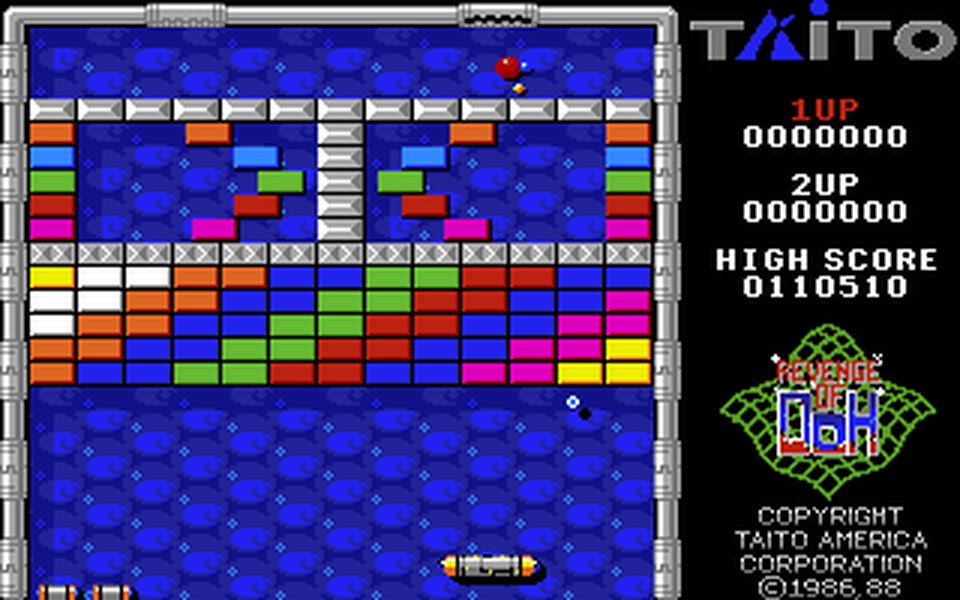
The first thing you notice is how right it feels. Arkanoid lives or dies on paddle response, and the GS version — mouse in hand, as the arcade’s spinner intended in spirit — is precise, fast and utterly without lag or judder. The ball physics are honest, the angles readable, the speed ramp well judged: early stages teach, middle stages test, and the late game is a glorious panic of triple balls, laser fire and bricks that need two hits apologising for nothing. The super-hi-res presentation is crisp, colourful arcade work, with backgrounds that give each sector of Doh’s dimension its own flavour.
More of everything, in the right proportions
Revenge of Doh’s design intelligence is in its additions. The power-up system transforms the genre’s rhythm: catching a capsule is a decision taken at speed — chase the laser capsule and risk the angle, or hold position and guarantee the return? The multi-ball capsule is controlled chaos that can clear a stage in seconds or cost you two lives in one. New brick types — silver bricks needing multiple hits, gold bricks that simply refuse — force route-planning through each wall, and the floating enemies, a nuisance in the original, here become genuine tactical actors, deflecting the ball into angles no wall would produce.
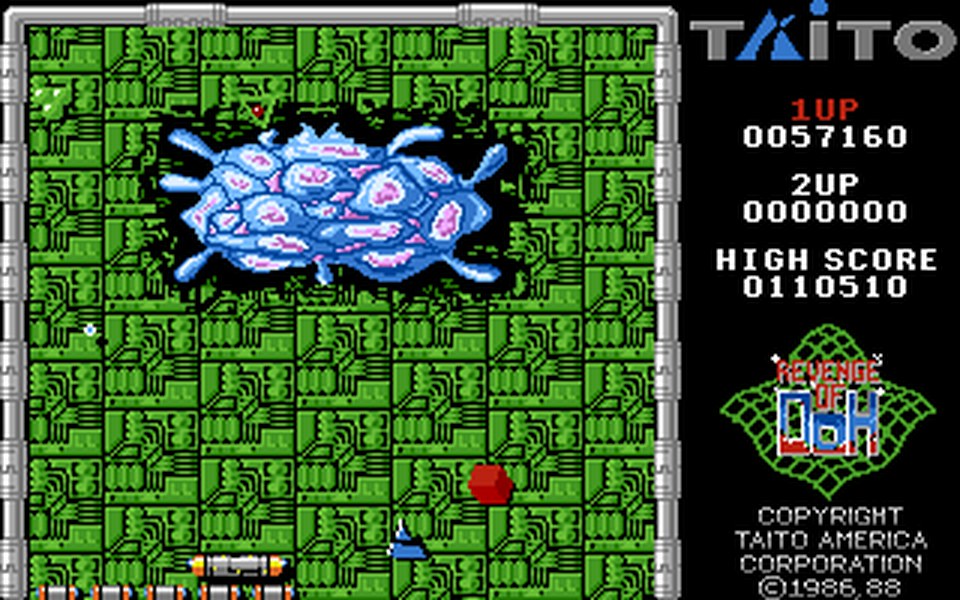
The structure wraps it in a proper campaign. Stages branch in places, the difficulty curve is a steady tightening rather than a wall, and Doh’s final confrontation is a fittingly absurd piece of theatre: the genre’s first boss fight, essentially, conducted with a paddle. Between the stage count, the scoring system and the continue structure, this is a complete arcade game at home, not a demo of one — and the GS version keeps the arcade’s content intact.
The GS difference
Set this beside the other home Arkanoid IIs of the day and the IIGS version’s quality sharpens. The 8-bit conversions were brave approximations; the GS plays in the arcade’s own league — big sprites, full colour, smooth motion, and sound with real punch through the Ensoniq chip, the brick-pings and capsule chimes pitched exactly where forty years of muscle memory expects them. It also loads fast and supports the machine properly, small mercies that IIGS owners of the era did not take for granted from arcade licences.
Revenge of Doh on the IIGS is the brick-breaker perfected: precise mouse control, a full arcade campaign, and power-up chaos in perfect proportion.
Criticisms are the genre’s own. Breakout games are repetitive by design; Arkanoid II’s answer is variety of layout rather than variety of activity, and players who bounce off the form will bounce off this too, however polished. The difficulty of the final stretch is also authentically arcade — which is to say, designed to eat credits that the home version mercifully does not demand. Neither point dents the essential judgement: within its genre, this is close to flawless execution.

The ten-minute test, and the ten-hour one
Arkanoid II’s deepest virtue is that it respects both ends of a player’s commitment. As a ten-minute game it is perfect: instant action, immediate jeopardy, a score to chase and a wall to resent. But the campaign structure rewards the long session too, because its stages are arranged as a curriculum in the game’s own physics — walls that teach you the laser’s value, walls that punish the multi-ball’s chaos, walls whose last brick hides in the one place your angle geometry cannot reach without a bank shot off a drifting alien. Veterans develop favourite stages and superstitions about capsules; the game’s high-score culture on the GS was real, and the design earns it.
It is worth pausing on the mouse question, because it decides the version’s quality. The arcade’s spinner gave Arkanoid a one-to-one analogue feel that joysticks never matched; the IIGS’s mouse — standard equipment, precise, and already on the desk — is the spinner’s true heir, and this conversion uses it beautifully. Paddle speed maps to hand speed with no acceleration curve to fight, so the desperate full-width save and the delicate one-pixel nudge are the same gesture at different scales. Players who meet Arkanoid II first on a system that forced it onto a digital pad should play it here, with the input it was designed around, and feel the difference in their first stage.
A note on the name on the box
Revenge of Doh also carries a small historical distinction for the platform: it was among the last Taito licences to reach the GS while the machine still had a genuine retail presence, and it arrived complete rather than cut down — a courtesy not every late licence extended. The game’s longevity in the community has matched its quality; it remains a fixture of IIGS high-score challenges and a first recommendation when a new owner asks what to load after the flagship titles. There are richer games in this library, and deeper ones, but there is none more purely playable — none where the distance between picking it up and having a wonderful ten minutes is shorter. That is the arcade ideal, and the IIGS, for once, got it undiluted.
The verdict
Arkanoid II: Revenge of Doh is the IIGS’s essential arcade game — the one you load to show that the machine could do the coin-op experience whole, with nothing lost in translation. Precision control, a full campaign, and the best brick-breaking of its generation. Doh has never been avenged more enjoyably.
And a final practical note for today’s players: Arkanoid II is one of the most frictionless classics in the library to actually run. It behaves under System 6, loads swiftly from modern storage, asks nothing of exotic hardware, and its mouse control means an emulator session feels faithful rather than approximate — though real hardware, a real mouse and the Ensoniq’s voice remain the deluxe edition. It is also the rare game whose sequel-proof design needs no nostalgia to prop it up: hand it to a player who has never seen a brick-breaker and the teaching is instant, the hook immediate, the first lost ball a personal insult they will spend an hour avenging. Doh’s revenge, it turns out, works in both directions.
Short sessions, long shadows: that is the Arkanoid II legacy on this machine, and it is why the game remains fixed in the community’s demonstration rotation decades on. Some classics you study. This one you simply play, again, while the room watches the wall come down.
Score: 8.0/10 — Taito’s sequel in a first-class IIGS conversion: mouse-true paddle control and thirty stages of perfectly tuned brick chaos.