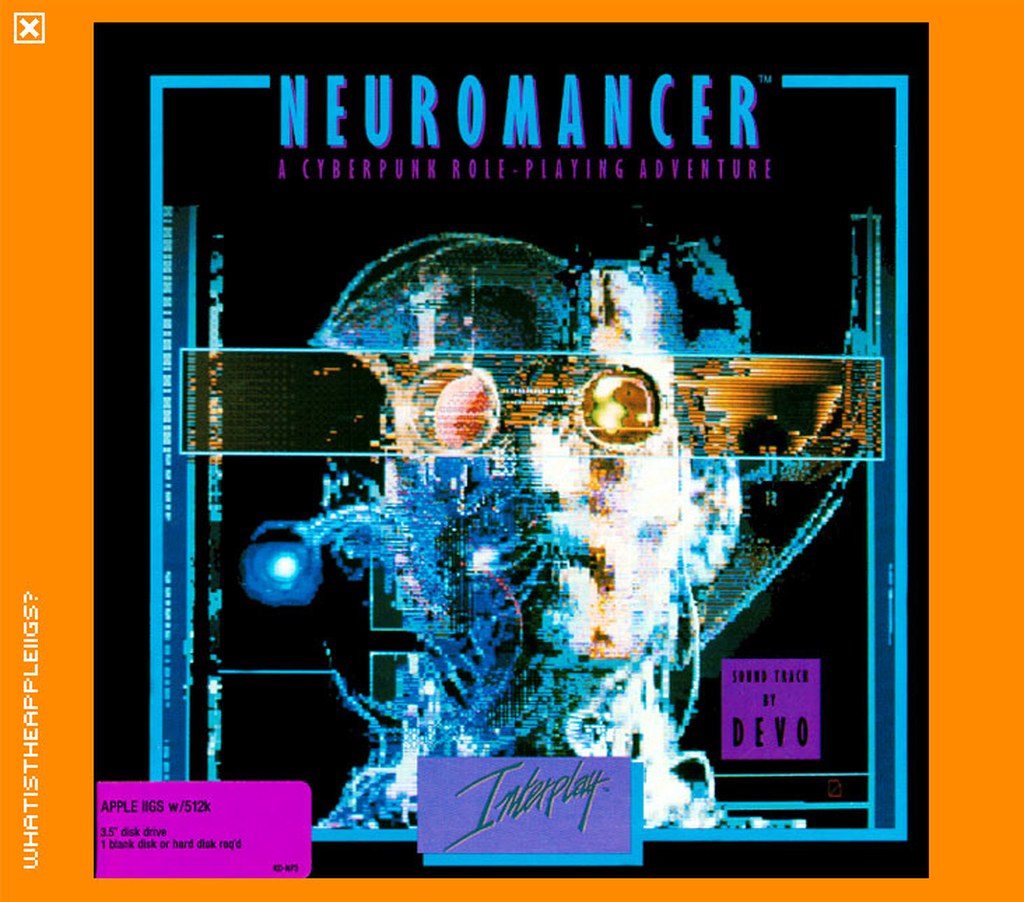
At a glance: Neuromancer · Apple IIGS · Interplay / Activision, 1989 · Cyberpunk role-playing adventure · Score: 8.5/10
Adapting Neuromancer should have been impossible. William Gibson’s novel invented cyberspace as a hallucinatory consensual fiction, and 1988’s computers rendered text at eighty columns. Interplay’s solution — with Timothy Leary, of all people, among the design voices — was one of the great acts of adaptation in games history: shrink the Sprawl to Chiba City’s streets, make the deck-jockey economy the game’s spine, and render cyberspace as a neon chessboard of corporate databases guarded by black ICE. The IIGS version, arriving in 1989, is the adaptation at its most handsome — the definitive way to jack in.
You are a washed-up deck cowboy in 2058, so broke you have pawned your deck, starting the game trying to scrape together the chips to buy it back. The loop that follows is brilliant in its simplicity: hustle money in the physical world — selling organs you may later regret, running errands, playing the bulletin-board economy of rumours and pawnshops — to buy better decks, chips and software, which let you crack richer databases in cyberspace, which funds better gear. Money is experience points. Gibson’s novel is about exactly this economy of desperation, and the game understands it in its bones.
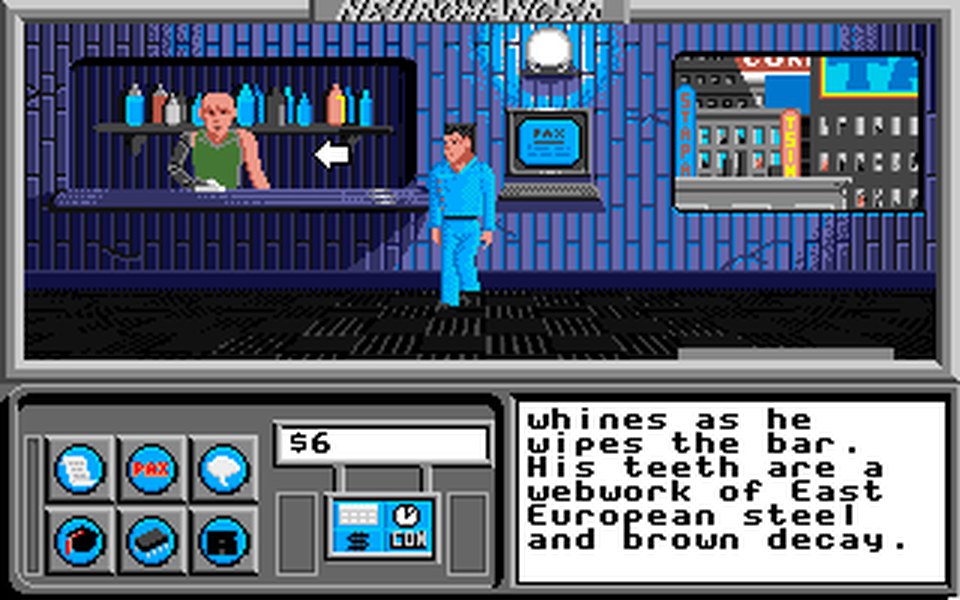
Two worlds, both out to get you
Chiba City itself is a compact masterpiece of atmosphere: a grid of locations — bars, pawnshops, corporate offices, the notorious cheap hotels — each with its own characters, services and small economies, all rendered in the GS version with a richness of colour the earlier versions could not approach. The bulletin board system, the game’s rumour mill and quest log in one, remains a design masterstroke: news, mail, conspiracy and commerce flowing through a single text interface that makes the city feel wired together. Skills are bought as chips and slotted into your head, a character system with Gibsonian bite — upgrade your abilities, but your skull has limited sockets, and every choice is a small self-definition.
And then there is cyberspace. Jack in, and the game becomes a real-time duel on a glowing grid: you manoeuvre your deck’s icon between corporate data fortresses, deploying programs — drills, decoys, viruses with period-perfect names — against ICE that fights back with increasing intelligence and menace. Combat is a resource war fought in seconds: your deck takes damage, your programs burn out, and flatlining in cyberspace has consequences in the meat world that a pawned organ or two suddenly makes very concrete. It is tense, readable, and on the IIGS’s screen, genuinely beautiful — the grid glows the way Gibson said it should.
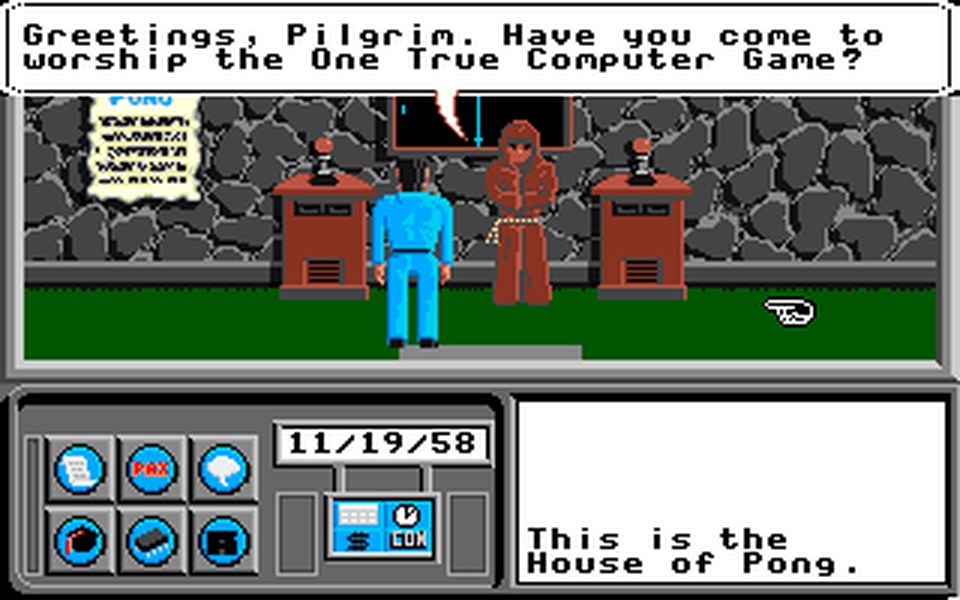
The IIGS edition
Judged against the celebrated C64 original, the IIGS version wins on presentation across the board: cleaner, more colourful street scenes, a more legible cyberspace, and an Ensoniq-fuelled atmosphere that gives the city’s hum and cyberspace’s hum different registers. The game’s famous soundtrack contributions — including the notorious chip-rock rendition associated with the title — survive the translation with their strangeness intact. Load times, the bane of the original’s tape-and-disc economy, are tamed on the GS, and the whole experience moves at the pace the design wanted. This is not a lazy port of a hit; it is the hit, finished.
Neuromancer on the IIGS is the great cyberpunk game in its best eighties edition: hustle in the streets, duel the ICE in the grid, and never sell an organ you cannot spare.
Reservations, for the record: the early game is a poverty simulator of real fidelity, and new cowboys will spend a while poor, confused and reading bulletin boards for salvation — which is arguably the point, but it is a slow burn before the first proper cyberspace run. Some cyberspace encounters late in the game demand preparation that the game only hints at, and a deck built wrong will bounce off the hardest databases until the economy is re-farmed. These are the textures of a substantial RPG, and Neuromancer is substantial: a twenty-hour shadow of the novel, hiding in a 1989 disc box.
A field guide for new cowboys
For players jacking in for the first time, some orientation the game itself is too cool to provide. Your first hours belong to the bulletin boards: read everything, because Neuromancer’s quests, bargains and warnings all surface there before they surface anywhere else, and the cowboy who treats the BBS as flavour text will be poor forever. Buy co-processors and skill chips with intention — your skull’s sockets are the game’s true character sheet, and a build that can talk, pick and decrypt will out-earn a pure hacker in the early economy. And respect cyberspace’s learning curve: the early databases are the tuition, and the ICE that flatlines you at the start is teaching the duel’s grammar — program ranges, deck integrity, when to run — that the endgame assumes you speak fluently.
Finally, a note on the adaptation’s boldest choice: its tone. Gibson’s novel is famously affectless, all chrome and exhaustion, and the game — Leary’s influence showing — warms it with humour, strangeness and a pawnshop pathos that makes its Chiba City feel inhabited rather than rendered. Purists once debated the liberties; time has settled the argument in the game’s favour. This is not the novel with graphics. It is the novel’s world, re-experienced as the thing the novel always implied it could be: a place you could actually be broke, brilliant and in over your head.
Why it still matters here
For the IIGS specifically, Neuromancer holds a particular place: it is the platform’s great literary adaptation, proof that the machine’s audience — older, bookish, keyboard-native — was being served its own kind of blockbuster. The GS library has bigger spectacles, but none with this density of ideas per disc, and none whose world has grown more relevant with every passing decade. The pawned deck, the bought skills, the databases behind their ICE: Gibson’s future arrived roughly on schedule, and this game remains the most playable map of it the eighties produced — in this, its finest eighties edition.
The verdict
Neuromancer is one of the IIGS library’s crown jewels — a licensed adaptation that honours its source by understanding it, a role-playing game built on money and information rather than swords, and in GS form the most atmospheric version of itself. If you play one text-and-graphics RPG on this machine, jack into this one.
Practical counsel for the first run: keep notes. The game’s economy rewards the cowboy who tracks prices, rumours and database behaviours like a trader rather than a tourist, and a page of scribbled BBS intelligence is both period-authentic equipment and the difference between a struggling hustler and Chiba City’s rising power. The notebook is not a crutch. In Neuromancer, information is the character sheet, the inventory and the weapon — and the player who writes it down is playing the game Gibson’s world actually describes.
And the deck, once bought back, is only the beginning of the spending — which is the game’s slyest joke and its truest simulation. Everything in Neuromancer costs, including dignity, and the IIGS version keeps the prices legible and the hustle pleasurable from first pawnshop to final database. Console cowboy, indeed.
Score: 8.5/10 — Interplay’s cyberpunk masterpiece in its finest eighties form: street hustle, skull chips and ICE-breaking on a glowing grid.