
The crash of 1983 did not just kill companies. It buried games — good ones, released into a collapsing market, discounted into bins, and forgotten before word of mouth could save them. The Atari 2600’s hidden gems are disproportionately games from 1983 and 1984, or from small publishers without Activision’s marketing muscle, or arcade conversions that arrived after the arcades’ home audience had drifted to computers. None of the ten below appears in this wave’s review slate, and none duplicates the live shelf — no Frostbite, no Empire Strikes Back. These are the cartridges to hunt after the canon is on your shelf.
1. Beamrider
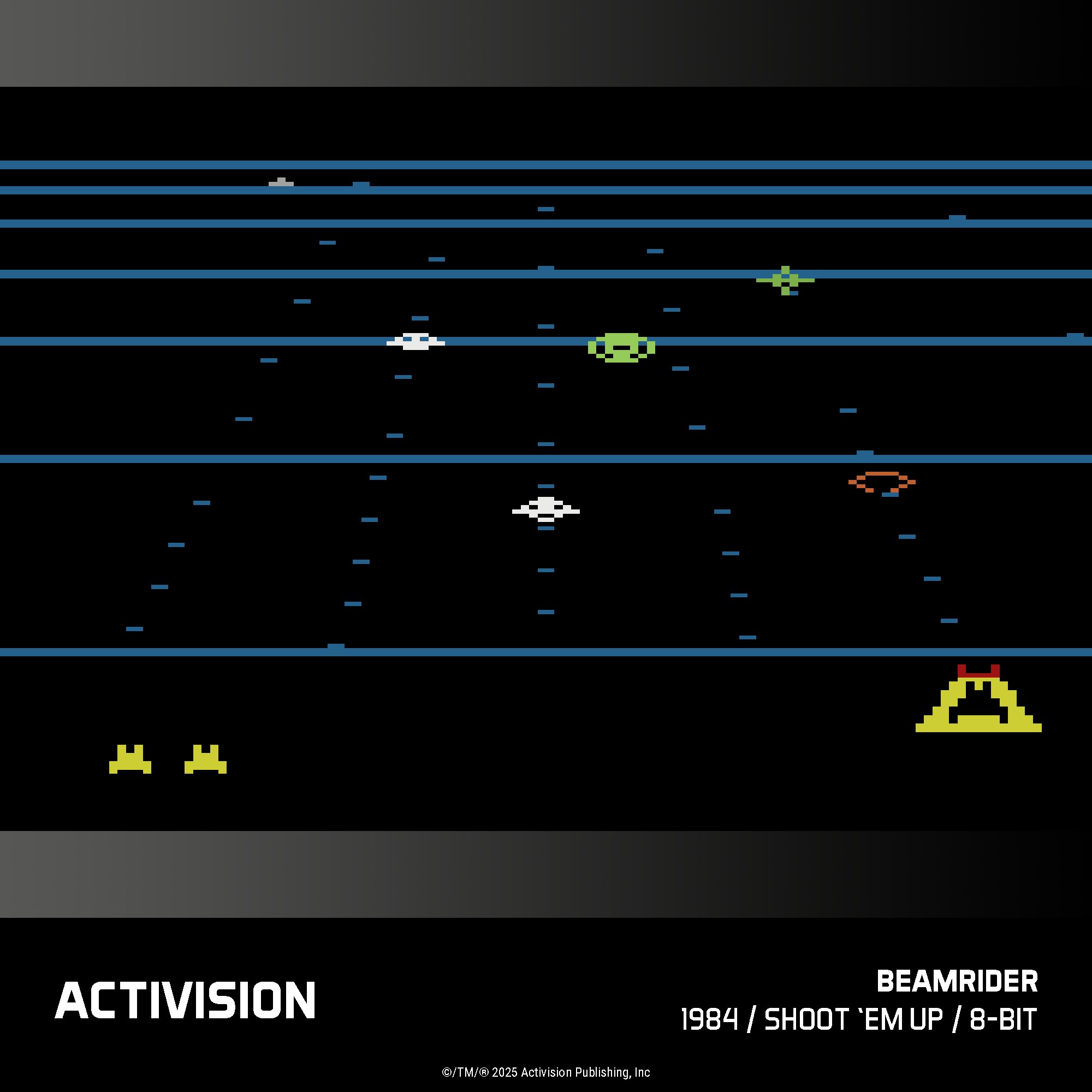
Activision’s own buried treasure, designed by David Rolfe and released in 1983 just as the floor gave way. You defend a grid of beams above the Earth — a pseudo-3D playfield of converging lines that gives the game a striking, Tron-adjacent look — sliding between beams to blast the saucers, debris and hunters pouring down them, with a limited supply of torpedoes for the big threats at each sector’s end. It is fast, handsome and structured like a much later score-attack game, with sectors escalating in enemy variety and spite. On the Intellivision, where it also appeared, it is famous; on the 2600 it arrived too late to become a household name, which is the definition of this list. If you think you know Activision’s catalogue because you know Pitfall! and River Raid, Beamrider is the correction.
2. Tunnel Runner
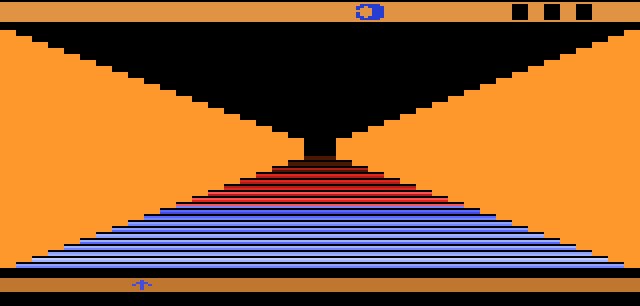
CBS Electronics took the maze game somewhere nobody expected in 1983: inside the maze, in first person, with a map you must earn. You run full 3D-feeling corridors — the 2600 producing a convincing forward view with its usual trickery — hunting for the key and the exit while creatures hunt you, and a press of the button shows an overhead map that is both your salvation and your temptation, because standing still reading a map is how runners die. RAM expansion inside the cartridge helped CBS achieve effects standard 2600 games could not, and the result feels years ahead of the maze pack it joined. Pac-Man taught the world to run mazes from above. Tunnel Runner, almost alone on the system, asked what running one from inside would feel like — and the answer still holds up.
3. Mr. Do!
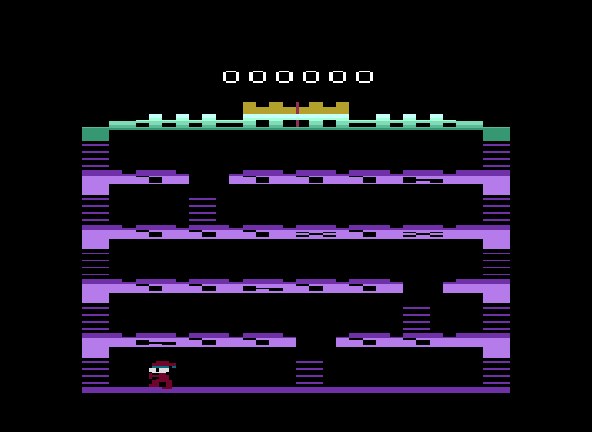
The 2600’s library of arcade conversions is a minefield of disappointment, which makes Coleco’s Mr. Do! such a pleasant shock. The digging, cherry-harvesting, apple-dropping original is all here — tunnel strategy, the extra-life letter targets, enemies that can be crushed, shot with your bouncing power ball, or out-dug — in a conversion that keeps the arcade game’s essential cleverness intact at a fraction of the hardware power. It helps that Mr. Do! was always a thinker’s arcade game, closer in spirit to Dig Dug with a degree, so its pleasures survive the resolution cut better than a pure twitch title’s would. It arrived in 1983, from a publisher better known for its own console, and sank with the market. Dug up now, it is one of the best arcade ports on the machine.
4. Montezuma’s Revenge

Parker Brothers’ 1984 pyramid-crawler is the 2600 making a bid for the future: a flip-screen platform-adventure of connected rooms, keys, doors, torches, ladders, ropes and rolling skulls, in which explorer Panama Joe descends toward Montezuma’s treasure chamber through a tomb that is really one large, interconnected puzzle. Designed by Robert Jaeger, it is a clear ancestor of what would later be called the Metroidvania — exploration gated by tools, geography as the real opponent, secrets in the joins between rooms. The 2600 version necessarily trims the computer original’s scale, but what remains is remarkable for the machine and the year, and it reached so few players in the crash that many 2600 owners have never heard of it. Fix that. This is one of the most historically interesting cartridges on the system.
5. Gremlins

Atari’s own late-era licensed game, released in 1984 when almost nobody was watching, and far better than a crash-year film tie-in had any right to be. It plays in two alternating flavours: catch the falling Mogwai before they reach food and multiply — a Kaboom!-like test of positioning — and then defend against waves of fully fledged Gremlins in a shooter phase, protecting the town as the little monsters descend. The two phases feed each other’s tension, the licence is used with actual wit rather than as box decoration, and the difficulty ramps with conviction. Gremlins the film taught a generation to fear midnight snacks; Gremlins the cartridge is the rare tie-in that found a game inside the premise instead of a poster on a generic shooter.
6. Roc ‘N Rope

Coleco’s conversion of the Konami arcade curiosity, and one of the most original mechanics on this list. You are an archaeologist climbing a cliff face toward a roc’s nest, armed with nothing but a rope you fire diagonally to create climbable lines and a flashlight that briefly stuns the dinosaurs and cavemen patrolling the ledges. There is no jumping and no shooting in the usual sense — only angles, timing and nerve. Getting the geometry of a good rope right while a dinosaur bears down is a pleasure no other 2600 game offers, because no other 2600 game plays anything like it. It was a minor arcade release and an even more minor cartridge, which means most collectors walk straight past it. Their loss, at a very fair price — as gems go, this one is both hidden and cheap.
7. Espial

Tigervision was one of the smallest of the third-party publishers, and Espial, from 1984, is its finest hour: a vertical-scrolling space shooter in the Xevious mould, with your ship working up a scrolling field against waves of enemies and ground targets. Smooth vertical scrolling was a genuine technical flex on the 2600, and Espial wears it well — the action is fast, the patterns are readable, and the game has the relentless forward pressure that defines the genre at its best. Tigervision never had Activision’s shelf presence, and by 1984 distribution itself was collapsing, so Espial’s audience was a fraction of its quality. In a just world this is remembered alongside River Raid in the system’s shooter conversations. It is not River Raid’s equal in design — nothing here claims that — but it is far closer than its obscurity suggests.
8. Marauder
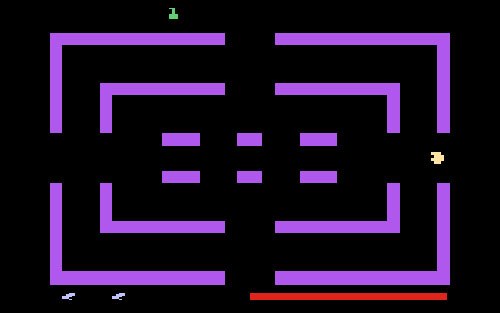
Another Tigervision release, earlier and stranger: a maze shooter in the Berzerk tradition, but with a twist that still feels devious — the maze’s walls and the robots within are only intermittently visible, revealed in flashes, so you navigate half by memory while hostile machines materialise around you. You hunt the power centre at the maze’s heart under time pressure, and the invisibility mechanic turns every room into a small act of faith. Berzerk on the 2600 is excellent and famous; Marauder is its moody cousin, trading the voice and the polish for an atmosphere of genuine uncertainty. Small publisher, small print run, big idea. That is the hidden-gem formula exactly.
9. Fantastic Voyage

Fox Video Games adapted the 1966 film — a miniaturised submarine injected into a patient’s bloodstream — into a 1982 shooter with a premise strong enough to carry the cartridge: you pilot the sub through the vessels, blasting blood clots, bacteria and antibodies, navigating toward the brain to destroy the clot threatening the patient’s life, while the patient’s condition — tracked like a second health bar for the mission itself — deteriorates with your mistakes. Shooting the wrong things harms the patient; the fiction and the mechanics are the same system. Fox’s catalogue is mostly remembered for oddities, and this is its best oddity: a licensed game that found, in an unlikely film, a genuinely original shooter structure about care at gunpoint.
10. Tapper
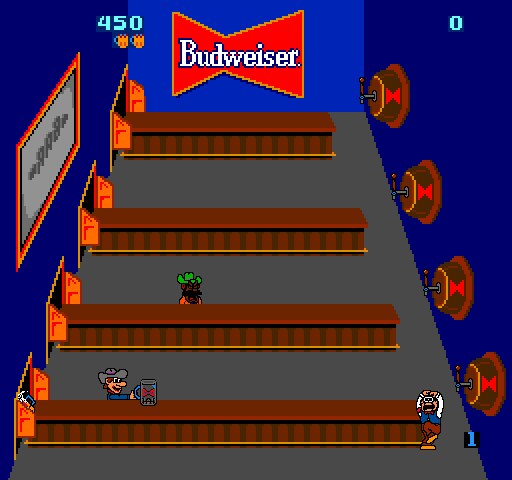
Sega’s home conversion of Bally Midway’s beloved arcade game arrived late in the 2600’s life and deserved a bigger room. You are the bartender, working four bars at once: slide drinks to advancing patrons, sprint to catch the empty glasses they slide back before they shatter, grab the tips, and keep every row served before a thirsty customer reaches you and drags you down the bar. It is a game of pure queue management disguised as slapstick, and its rhythm — serve, catch, move, breathe — survives the journey to the 2600 intact, with the saloon’s charm remarkably present at the resolution. Tapper is not obscure in arcades; it is obscure here, on this cartridge, which too many collectors assume cannot do it justice. It can. Last orders, please — this is the round the list ends on.
How to hunt these in 2026
A practical word for collectors, because hidden gems behave differently in the market from the canon. Most of the ten above remain, by 2600 standards, sensibly priced loose cartridges — the crash that buried them also left large unsold and resold stock circulating for decades — but condition varies enormously, and the small publishers are where label wear, faded end labels and tired contacts concentrate. Test before you treasure: a gem that boots intermittently is usually a cleaning problem, not a dead cartridge, and the 2600’s edge connectors respond well to patient, gentle cleaning. Two of these publishers deserve a specific warning. Tigervision and CBS Electronics cartridges turn up in collections misfiled under the console makers’ names, so second-hand bins reward anyone who knows the names in this list by sight. And for Montezuma’s Revenge in particular, know that multiple versions exist across systems — if you are buying for the 2600, confirm the cartridge is the 2600 edition, because the computer and ColecoVision versions are different objects with different prices. Finally, play them on real evenings, not as checklist items: every game here was designed for the twenty-minute session, the high-score argument and the handover of the joystick. That is how they were buried, and it is how they are best dug up.
A final thought on why this list skews so heavily toward 1983 and 1984. Those were the years when the 2600’s programmers — at Activision, CBS, Tigervision, Parker Brothers, Coleco and Atari itself — had fully mastered the hardware, when the easy clones had been exhausted and designers were reaching for first-person mazes, pyramid adventures, grid shooters and rescue mechanics. In a healthy market, that late flowering is remembered as a golden autumn; the NES era might have arrived to find the 2600 aging gracefully rather than collapsing. Instead the money vanished mid-sentence, distribution collapsed, and the most inventive eighteen months in the machine’s life were remaindered. Every cartridge on this list is a survivor of that specific injustice, which is why playing them feels less like nostalgia and more like restitution.
Ten games, ten different reasons the crash cheated an audience: late releases, small publishers, misunderstood conversions, ideas ahead of their moment. The canon tells you what the 2600 was. The gems tell you what it was becoming.