
Twenty-eight years ago today, on Friday, October 30, 1998, the Department of Death opened for business. LucasArts chose its date with care: Grim Fandango shipped on the weekend of Día de los Muertos, the Mexican Day of the Dead, and it remains the only genuine masterpiece the games industry has ever built from that festival. Its hero is Manuel “Manny” Calavera, a travel agent in the Land of the Dead who sells the recently deceased their onward journeys — an express train for the virtuous, a four-year walk for everyone else — while working off a debt of his own that nobody will explain to him.
What happened next is the strangest double story in the medium’s history. Grim Fandango was crowned Game of the Year in what might be the strongest release year games have ever had, and it was simultaneously filed away as a commercial failure whose name would be used, for a decade, as proof that adventure games were dead. Both halves are true. This is the story of the last great LucasArts adventure: how it was built, why it triumphed, what it cost, and how it came back from the dead itself.
From Bikers to the Land of the Dead
Tim Schafer came to Grim Fandango with the best résumé in the business. He had co-designed Day of the Tentacle, the time-travelling comedy widely held to be LucasArts’ finest hour, and then created Full Throttle, the 1995 biker adventure that became a genuine hit. What few players knew was that the Day of the Dead game was the older idea. Schafer had taken an anthropology class at UC Berkeley and kept up a fascination with folklore ever since, including conversations with the folklorist Alan Dundes. In Aztec belief, the soul spends four years travelling through the underworld before reaching its final rest — and Schafer recognised that a four-year journey, broken into four stages, was an adventure game waiting to be drawn. When he pitched LucasArts his next project, he submitted both concepts at once: the biker game and the dead one. The studio, sensibly enough, picked the one with mainstream appeal.
Full Throttle’s success bought him the second pitch. Development of Grim Fandango began in June 1995, straight after the bikers shipped, on a budget Schafer has put at $3 million — serious money for an adventure game, and a sign of how completely LucasArts still believed in the genre it had defined. The working titles tell you how strange the thing LucasArts had greenlit really was: at various points it was nearly called Deeds of the Dead (an early version had Manny selling real estate rather than travel), The Long Siesta, or Dirt Nap.
One complaint from Full Throttle shaped everything. Players loved it and finished it in an evening, and said so. Schafer set out to build a game with roughly twice as many puzzles, and that ambition demanded a bigger story to hang them on — which is how a tale of one salesman and one client grew into a four-year epic spanning a continent of the dead, told in four acts that each open on November 2, the Day of the Dead, in four consecutive years.
Building GrimE: LucasArts Leaves SCUMM Behind
Every LucasArts adventure since 1987 had run on SCUMM, the engine behind Maniac Mansion, Monkey Island and everything between. Grim Fandango threw it away. It was the studio’s first adventure since Labyrinth not to use SCUMM, and the replacement — GrimE, built under lead programmer Bret Mogilefsky from the Sith engine that had powered Jedi Knight: Dark Forces II — changed what an adventure game looked like. Characters and usable objects were real-time 3D models, moving through backgrounds that were pre-rendered from 3D sets. Because the backgrounds were themselves models, the team could re-render a room from a more dramatic camera angle instead of having an artist repaint it — cinematography, of a kind the genre had never had.
The scale was new, too: more than 90 sets and 50 characters, with Manny himself built from about 250 polygons, a figure that sounds tiny now and was a serious modelling effort in 1996. GrimE was also scripted in Lua, a then-obscure language Mogilefsky championed — one of the first uses of Lua in games, before it spread to titles like Baldur’s Gate and, eventually, half the industry.
The interface was the boldest break of all. There is no cursor, no verb list, no heads-up display. You steer Manny directly, with keyboard or gamepad, in the tank-control style Resident Evil had made fashionable — and when something nearby matters, Manny turns his head to look at it. His inventory is a piece of theatre: he reaches into his jacket and pulls each object out for your inspection. Reviewers of the day argued about the controls, and some camera angles fought the player, but the intent was unmistakable. LucasArts was not making a cartoon you clicked on any more. It was making a film you walked through.
Noir Among the Calacas

The setting is a complete mythology, assembled with unusual rigour. The dead arrive in the Eighth Underworld, the Land of the Dead, and must reach the Ninth, the Land of Eternal Rest. The journey takes four years on foot — through the Petrified Forest, across the Sea of Lament, past the Edge of the World. A virtuous life earns a better travel package from the Department of Death: a sports car, a luxury cruise, or at the very top, a ticket on the Number Nine, the express train that makes the journey in four minutes instead of four years. The Department’s agents are the grim reapers of legend, recast as salesmen on commission — and Schafer’s key insight was that this most glamorous of jobs is really just punching a clock. Manny, robe and scythe notwithstanding, is a glorified limo driver stuck in a dead-end job in every sense.
The crime plot grew from folklore, too: Schafer had heard the Mexican tale of the dead buried with two bags of gold, one on the chest and one hidden in the coffin, so that if the spirits robbed the first, the second would survive. A criminal element in the afterlife meant film noir — and noir is the game’s second parent. Schafer has named Double Indemnity as the deepest influence, for its weak, ordinary salesman pulled into something rotten, with Raymond Chandler and Dashiell Hammett behind the dialogue. The specific debts are everywhere once you look: Hector LeMans is modelled on Sydney Greenstreet’s Signor Ferrari in Casablanca, right down to the chuckle; two figures in the second year are modelled on the Peter Lorre and Claude Rains roles from the same film; The Maltese Falcon, The Third Man, Key Largo and Chinatown all leave fingerprints, and the sales-floor rivalry that drives the plot owes a nod to Glengarry Glen Ross.
On top of the noir sits the calaca — the grinning skeletal figures of Day of the Dead folk art, which artist Peter Chan and his team turned into the game’s entire population, living in a world that swings between Art Deco skyscrapers and an Aztec temple. Glottis, the hulking demon who drives and wrenches for Manny, carries the influence of Ed “Big Daddy” Roth’s hot-rod art. And holding the two halves together is Peter McConnell’s score: bebop, swing and big-band jazz folded into mariachi and South American folk, recorded with musicians McConnell knew from San Francisco’s Mission District. GameSpot gave it Best PC Music of 1998; it is still regularly named among the finest scores the PC ever produced.
Four Years of Manny Calavera

Year One finds Manny at the bottom of the Department of Death. Whatever debt he is working off, it has cost him his touch: his clients are small-timers who qualify for nothing, while his smirking rival Domino Hurley lands every premium soul who comes through the door. His boss, Don Copal, gives him an ultimatum. So Manny steals a client — Mercedes Colomar, a woman whose life was so spotless that a Number Nine ticket should be hers by rights. The Department’s computer says otherwise: she gets the four-year walk. Convinced the system is rigged, Manny watches her set out on foot alone, and is arrested for his trouble — then sprung by Salvador Limones, a former reaper who now leads the underground Lost Souls Alliance. Sal’s news is worse than Manny imagined: someone inside the Department is stealing Double N tickets from the souls who earned them and funnelling them to Hector LeMans, the Land of the Dead’s crime kingpin, who sells them to the rich at obscene prices. The cheated walk. The buyers ride.

What follows is a chase across four years, and the game uses those years like no adventure before or since. Manny and Glottis race to the port town of Rubacava and miss Meche by hours; so Manny waits — and Year Two opens with him running his own nightclub out of a converted automat in a Rubacava that has grown up around the waiting, only for Meche to slip away in Domino’s company. Year Three takes him to sea and then to a coral-mining plant at the Edge of the World, where Domino has been keeping Meche and Hector’s other victims as slave labour, hidden where no one would ever look. Year Four brings Manny home to an El Marrow renamed Nuevo Marrow, Hector’s corruption now total, for a reckoning involving counterfeit tickets, a greenhouse full of flowers — “sprouting,” death within death, is the Land of the Dead’s one true horror — and a sacrifice from Sal that still lands like a punch.

The ending, in which the tickets are restored to their rightful owners and Manny earns one of his own, is routinely voted among the best the PC has ever produced — GameSpot’s readers put it tenth on their all-time list. It earns its emotion the old-fashioned way: four years of story, spent with the same small cast, in a world that changes around them.
Voices of the Dead
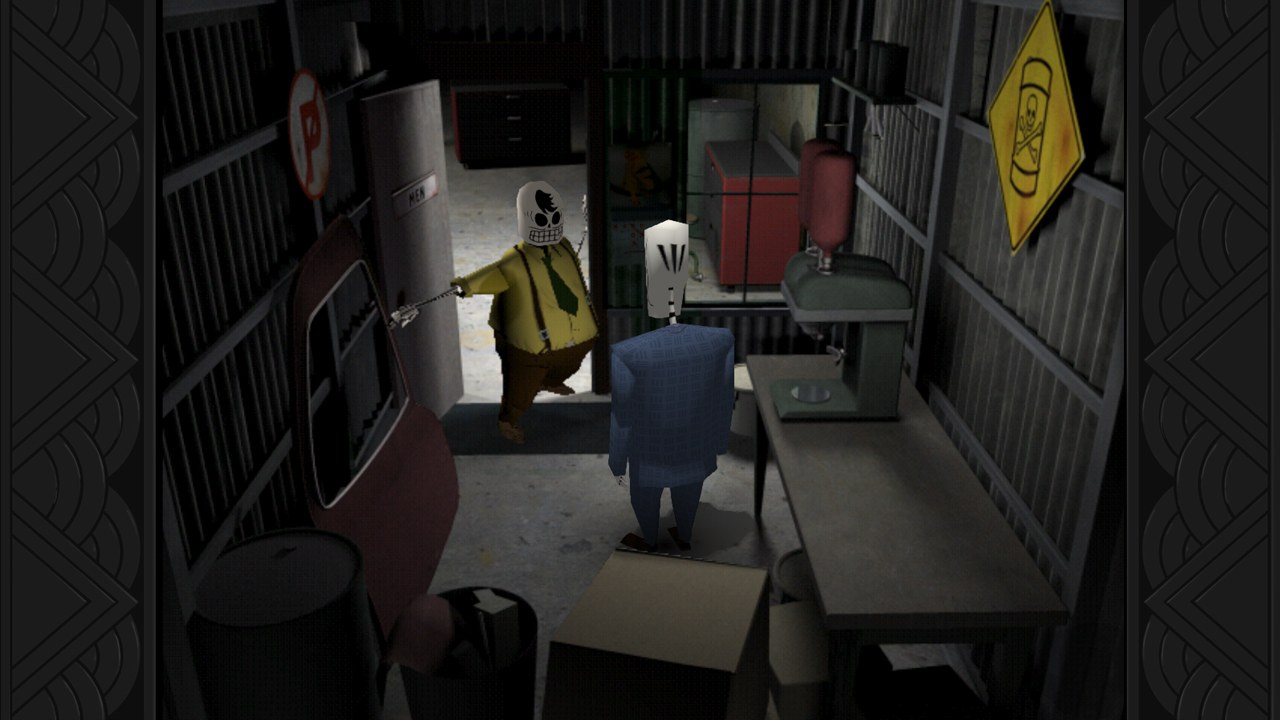
Schafer planned from the start for an all-Latino principal cast, a decision that gives the game a texture no other LucasArts title has. Tony Plana, a native Spanish speaker, voices Manny — and did more than perform the part. Plana fed more natural Spanish phrasing back into the script as recording went on, sharpening the easy Spanglish that runs through the dialogue; Schafer credits him with deepening the character from the page to the booth. Maria Canals-Barrera gives Meche her steel and her guilt in equal measure. Alan Blumenfeld plays Glottis — the enormous, childlike demon driver whose heart is the game’s heart — and Jim Ward voices Hector LeMans, explicitly channelling Greenstreet’s wheeze and chuckle. It remains one of the best-voiced games of its decade, and the cast is a large part of why the Land of the Dead feels lived in rather than decorated.
Game of the Year
The reviews were not merely good; they were coronations. Grim Fandango sits at 94 on Metacritic. IGN scored it 9.4 and called it the best adventure game it had ever seen. GameSpot, at 9.3, went further than anyone: it named Grim Fandango its overall Game of the Year for 1998, together with PC Game of the Year, PC Adventure Game of the Year, Best PC Music and Best PC Graphics for Artistic Design. PC Gamer and IGN both named it the year’s best adventure; Computer Gaming World agreed, in a tie with Sanitarium. At the Academy of Interactive Arts & Sciences awards in 1999 it won PC Adventure Game of the Year and was nominated for Game of the Year outright. The Houston Chronicle named it the best game of 1998 — alongside Half-Life.
That last comparison deserves a beat. Consider what 1998 contained: Half-Life, The Legend of Zelda: Ocarina of Time, Metal Gear Solid, StarCraft, Resident Evil 2, Baldur’s Gate, Thief, Fallout 2 — a year with a credible claim to be the greatest in the medium’s history. In that company, the year’s top honours at a major outlet went to a point-and-click adventure about a dead salesman, with no combat, no fail state, and a hero made of 250 polygons. Adventure Gamers would eventually go further still, naming it the greatest adventure game of all time in 2011, and the Museum of Modern Art moved to preserve it in its permanent collection. The critics had done everything critics can do.
The Till Rang Empty
The customers did something else. Grim Fandango debuted at number six on PC Data’s American sales chart in its first week of November 1998, at an average price of $35 — respectable, for one week. By the second week it had fallen off the chart entirely. In Britain it touched number one in December and slid just as fast. By the end of 1998 it had sold 58,617 copies in the United States, earning $2.33 million; by March 2000 its American total had crept to about 95,000. In the year of Half-Life, those numbers read as a verdict.
The honest picture is more complicated, and worth stating on the record. Schafer has said the game reached roughly 500,000 sales by 2012 — about half of what Full Throttle managed, across fourteen years of long tail. LucasArts maintained at the time that Grim Fandango met its domestic expectations and exceeded them worldwide, and the game had moved into profit by 2000. Dave Grossman, one of the studio’s adventure veterans, summed it up as ambitious and expensive, and unlikely to have made very much back. So: not the legendary bomb of the retelling. But the perception settled instantly and hardened into fact inside the industry — adventure games, and story-first games generally, were a bad bet — and in a business run on perception, the perception was the reality LucasArts acted on.
What Died With It
The consequences arrived in an orderly procession. LucasArts produced one more original adventure, Escape from Monkey Island in 2000, and then the cancellations began — sequels to Sam & Max Hit the Road and Full Throttle both shelved, with the company explaining that it was not the appropriate time to launch a graphic adventure on the PC. The people scattered. Schafer left LucasArts and in 2000 founded Double Fine Productions with much of the Grim Fandango team; their first game was Psychonauts, another beloved commercial disappointment, because the universe has a sense of humour. Other LucasArts adventure alumni founded Telltale Games in 2004, which would eventually bring Sam & Max back in episodic form. The genre itself did not so much die as lose its funding and its shelf space — and Grim Fandango, the best-reviewed adventure ever made, became the tombstone everyone pointed at: proof that even perfection did not sell.
The irony, visible from 2026, is that the tombstone kept being read by new audiences. Adventure games came back — episodically at Telltale, triumphantly with The Walking Dead, and through Kickstarter, where Schafer’s own Double Fine Adventure smashed its funding target in 2012 and helped prove the audience had never left. It had just been waiting for somebody to sell it a ticket again.
The Number Nine Returns
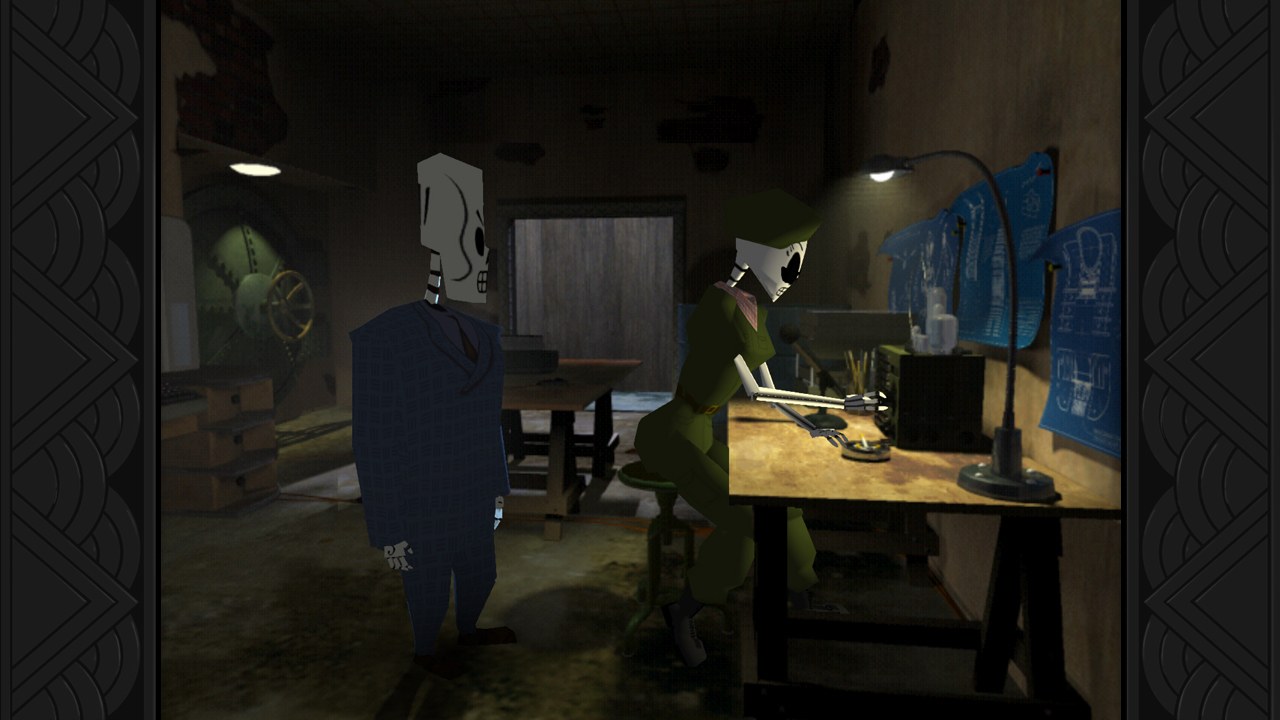
For most of the 2000s, though, Grim Fandango was simply gone: out of print, and increasingly unwilling to run on modern systems, kept alive only by devoted fans and the ResidualVM project. Its resurrection, when it came, arrived by corporate earthquake. Disney bought Lucasfilm in 2012 and closed LucasArts as a developer in 2013, turning it into a licensing operation — and licenses, unlike back catalogues, can be picked up. Double Fine and Sony, whose Adam Boyes had independently been chasing the same rights, discovered they were after the same game and joined forces instead of bidding against each other. On June 9, 2014, at Sony’s E3 press conference, the announcement was made by way of a fan letter from a young girl that Schafer had written himself, asking for his old games back. The crowd understood immediately.
Making the remaster turned out to be a detective story worthy of the game. Much of the original data survived only on Digital Linear Tape backups; former LucasArts sound engineer Jory Prum had kept a working DLT drive and recovered the audio archive, while other files had simply vanished — some, Schafer believes, carried out the door by departing staff years earlier, and the team found itself tracing ex-employees to ask what they had kept. The fans came in from the cold as well: Tobias Pfaff, whose home-made patch had given the original point-and-click controls, contributed the control scheme the remaster uses, and members of the ResidualVM community helped recover and improve assets. Where the original low-resolution art was unreadable — the emblem on a character’s hat, say — the team went back to Peter Chan-era concept art to work out what it was supposed to be.
The philosophy Schafer stated was the Criterion Collection one: fidelity without revision. Grim Fandango Remastered, released on January 27, 2015 for PC, Mac, Linux, PlayStation 4 and Vita, sharpens textures and gives the characters real-time lighting — and lets you flip back to the 1998 presentation at a button press. Peter McConnell’s score was re-orchestrated and performed by the Melbourne Symphony Orchestra. A full developer commentary was recorded. Mobile followed in May 2015, the Switch in November 2018, and the Xbox One finally in October 2020, after Double Fine itself became part of Xbox Game Studios. The reviews, again, were raves — IGN scored the remaster 9.3 — and a game that had spent years as an auction-site trophy was suddenly on everything, permanently.
All Aboard
What survives, twenty-eight years on, is the writing. Grim Fandango is a game about a man who wasted his life and is spending his death making up for it, one client at a time, in an office with a view of nothing. It is about rigged systems and the people who keep them honest from the basement. It is very funny, and then, without warning, it is about goodbyes. The industry spent a decade treating it as a warning; posterity has treated it as a landmark, and posterity is winning.
If you have never taken the journey, there has never been a better weekend to start: the remaster is on every modern platform, Day of the Dead is this Sunday and Monday, and Manny’s office is exactly where he left it. For the production story in full, see our companion piece, A Ticket on the Number Nine: The Making of Grim Fandango — and for the platform that raised it, our history of the DOS era. You will find this and every day’s anniversaries on our This Day in Gaming History page. The Number Nine leaves in four minutes. It has been waiting twenty-eight years. All aboard.