
At a glance: Atari 7800 · Atari 7800 · Buying and setup guide · NTSC and PAL, controllers, flash options, AV mods and what to pay in 2026
The Atari 7800 is the easiest “forgotten console” in the world to start collecting for in 2026 — and the easiest to buy slightly wrong. The machines are plentiful, the great games are (mostly) affordable, and the hardware is robust; but there are two regions, several revisions, three generations of controllers, one non-standard power supply and a modern aftermarket of flash cartridges and video mods that rewards a little homework. This guide is that homework: which 7800 to buy, what to connect it to, how to play the library in 2026, and what a fair price looks like — with the pitfalls marked in the order you’ll meet them.
Step one: choose your region — NTSC or PAL
The 7800 was sold in two television standards, and the choice matters more than with most consoles. An NTSC (North American) machine plays the full library at the full 60Hz the games were written for, and has the widest cartridge compatibility — the complete US catalogue, which is where most of the library lives. A PAL (European) machine runs at 50Hz — many games simply play slower, the era’s usual tax — but it has two charms of its own: the desirable CX78 joypad was the European pack-in, and every PAL console has Asteroids built into its firmware, playable with no cartridge at all. PAL consoles also received a small number of their own late releases. The pragmatic advice: buy the region you live in for hassle-free shopping, unless you are a performance purist, in which case an NTSC machine (plus a display that accepts it) is the connoisseur’s route. Cartridges are not region-locked in the modern sense, but cross-region play can produce timing and display oddities; most collectors end up standardising on one region and importing selectively.

Step two: which console, and what to check
All 7800s share the wedge, the rainbow stripe and the essentials — MARIA inside, full Atari 2600 backwards compatibility, cartridge slot on top. The revisions differ in details collectors care about: early NTSC units carry an expansion port on the side (intended for peripherals that largely never came) and are the most sought-after; later revisions tidy the internals and drop the port. None of this affects ordinary play. What does affect play is condition, so check four things on any machine. First, the power supply: the 7800 uses a 9V PSU with an unusual proprietary connector — an original supply is worth having, modern regulated replacements exist and are the safer daily driver, but never improvise with a random barrel plug. Second, the cartridge slot: 7800 carts should seat with a firm push; a slot that needs wiggling suggests worn contacts, curable with careful cleaning. Third, the switches: Power, Pause, Select and Reset are membrane-era hardware — test them all. Fourth, the picture through RF (see below): a noisy image is usually the cable or the TV, not the console, so don’t condemn a machine on first RF impressions alone.
On price, the 7800 remains one of retro gaming’s honest markets. As a 2026 rule of thumb, expect a tested, working loose console with a controller and power supply to change hands in the rough region of $60–$120 in North America, with early-revision and boxed examples above that and untested “attic finds” — a genuine gamble on the PSU and switches — below it. PAL machines are comparably priced in Europe and often cheaper relative to their charm, because supply was wide and late. If a seller wants collector money, ask for the four checks above, demonstrated.

Step three: controllers — the honest buyer’s guide
The 7800’s controller story has three chapters, and you’ll probably own all three. The Pro-Line joystick, the North American pack-in, is a handsome pistol-grip stick with two buttons — and a reputation, earned over forty years, for hand strain in long sessions. It’s authentic, it’s plentiful, and for short bursts it’s fine. The CX78 joypad, the European pack-in, is the community’s favourite original controller: a two-button pad that’s kinder over an evening and, thanks to imports, increasingly the pad in American collections too. And the sleeper option: the 7800’s ports accept standard 2600-era joysticks for the many games that use one button, which means the entire Atari controller ecosystem — including modern reproductions and arcade-quality custom sticks — is in play. Two special cases. Light-gun games (Alien Brigade, Crossbow and friends) want Atari’s XE light gun and a CRT. And Robotron’s famous twin-stick arrangement is two controllers at once — dedicated couplers exist, and two-player Robotron with each player holding one stick is a rite of passage. Buy order for most people: a CX78 for daily play, keep the Pro-Line for authenticity, add a good 2600 stick for the one-button library.

Step four: getting a picture in 2026
Out of the box, a 7800 speaks RF — the aerial signal of its era. On a period CRT that’s simply correct, and the 7800-on-CRT experience remains the reference: light-gun games work, the picture is as intended, latency is zero. On a modern flat panel, RF through a tuner or a VCR-as-demodulator is possible but rarely flattering. The upgrade ladder, in ascending order of commitment: a good RF setup with clean cabling; a composite video modification, the community’s standard mod, which taps a dramatically cleaner signal from the board; S-video variants for the keen; and at the top, the modern HDMI path via an external scaler (a RetroTINK-class device) fed from a composite or better mod — the route that gets a 7800 onto a big modern screen with its colours intact. The 7800’s palette is vivid and its games are colourful; they repay the effort. If you plan to mod, buy the console first, live with RF briefly, and let a reputable modder do the work unless your soldering is proven — these boards are forty years old and mostly unrepeatable.
Step five: playing the library — cartridges, flash and new hardware
You have three doors into the library, and most collectors use all of them. Door one is original cartridges: the GCC launch classics (Asteroids, Ms. Pac-Man, Galaga, Food Fight, Centipede, Dig Dug, Joust) are common and inexpensive — the finest cost-per-hour in the retro hobby — while the late originals (Ninja Golf, Midnight Mutants, Alien Brigade) and the POKEY-carrying Ballblazer and Commando command real money and are worth it. Door two is flash: modern SD-based cartridges, led by RetroHQ’s 7800 GameDrive and joined by solutions like the Concerto and the Dragonfly, load the library from a card, support homebrew, and — in the GameDrive’s case — even offer RGB video output that leapfrogs the mod ladder entirely. Door three is new releases themselves: the homebrew scene sells brand-new boxed games through AtariAge, and Atari’s own modern revival hardware (the 7800+, launched in 2024) plays original cartridges with HDMI convenience — a legitimate way to run a real library on a modern television without modifying a vintage board.

What to pay for the games themselves
Game pricing follows the system’s two lives. The GCC launch classics are the hobby’s great bargain: loose copies of Asteroids, Centipede, Dig Dug, Joust, Galaga, Xevious, Ms. Pac-Man and Food Fight commonly sit in the $8–$25 band in North America depending on label condition, which means the entire essential shelf can cost less than one hyped cartridge on a fashionable system. The middle library — the solid second-wave titles — runs a little higher. The late originals and the special cartridges are where the market wakes up: Ninja Golf and Midnight Mutants in good loose condition commonly ask $40–$80, Alien Brigade similar, and the POKEY pair (Ballblazer especially, and Commando) sit in the $30–$60 range, with boxed copies of any of them multiplying fast. Homebrew releases are priced as new games, because they are. Treat any of these numbers as a 2026 snapshot, not scripture: test before you pay premium money, value a clean label less than a clean board, and remember the flash cartridge exists precisely to cap the cost of curiosity.
Step six: keeping a forty-year-old console alive
A few stewardship rules will keep a 7800 running for another forty years. Store cartridges label-forward and dry; clean new arrivals’ contacts with isopropyl alcohol and a cotton bud before their first insertion, because most “dead” 7800 games are merely dirty ones. Give the console air — the wedge runs cool by vintage standards, but a stack of hot modern gear is no place for it. Feed it the right power: the original supplies are ageing, and a modern regulated replacement of the correct specification is cheap insurance compared to a board repair. Treat the membrane switches gently, keep the dust cover of history in mind — a simple cloth over the slot works — and resist the urge to blow into cartridges, which mostly moistens the problem. Finally, play it. These machines fail in cupboards more surely than in service; the kindest thing you can do for a 7800 is a weekly lap of Fuji and a round of Galaga.
A word, too, about the modern revival hardware, because buyers ask: Atari’s 7800+ (and its smaller sibling machines in the Plus line) are not emulators-in-a-box curiosities but cartridge-playing consoles with HDMI output and a warranty — for many households in 2026 they are the sensible first 7800, full stop, with an original machine to follow when the collecting instinct matures. The vintage and the revival are complements, not rivals: the Plus plays the library tonight, the original explains why the library matters. Owning both is not excess. Around here, it’s called a starter collection.
Troubleshooting in one paragraph
Rolling or snowy picture on RF: change the channel standard switch, re-tune, and suspect the cable before the console. Black screen with a cartridge: clean the cart, clean the slot, try the built-in test of a PAL machine (no cart — Asteroids should appear) or a known-good game on NTSC. A game that boots but misbehaves with glitched graphics: reseat, re-clean, and try another title to isolate cart from console. Controllers that drift or miss buttons: swap ports to find whether the fault travels with the pad. And the universal rule of vintage hardware — change one thing at a time, and write down what worked. Somewhere, a future owner of your console will thank you.
The first five cartridges
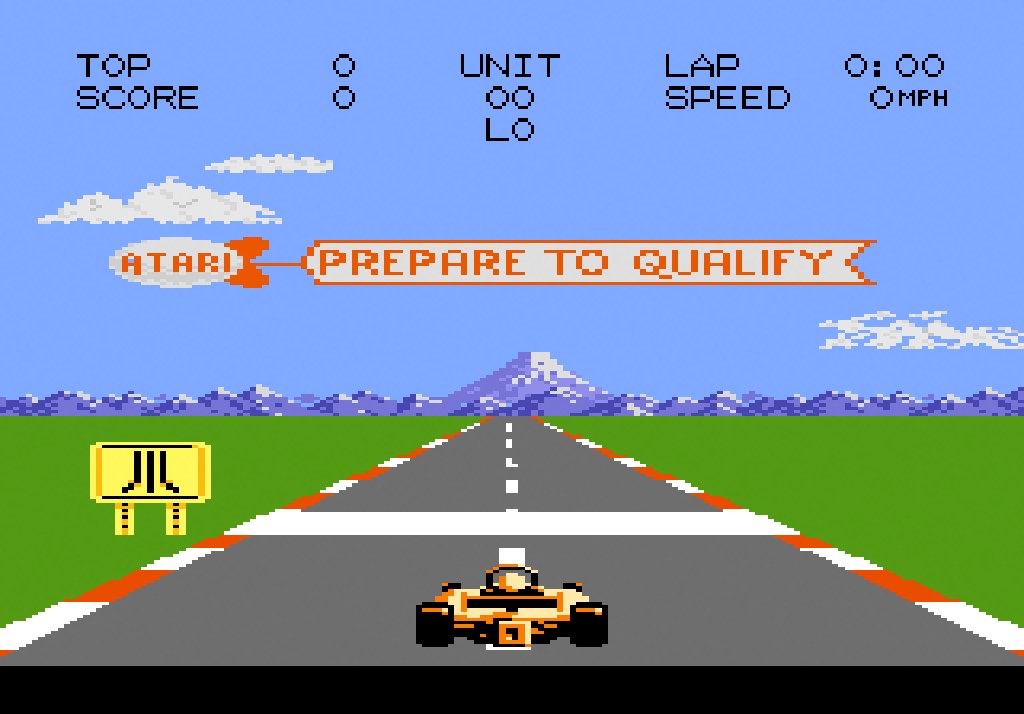
Every guide should end with a shopping list, so here is the consensus one. Pole Position II will likely arrive with the console — it was the pack-in; test the machine with it. Then: Asteroids (or switch on a PAL machine and simply meet it), Ms. Pac-Man, Galaga, Food Fight — the four corners of the launch library — and Ballblazer when a fairly priced copy appears, for the POKEY soundtrack and the best two-player sport on the system. Add Centipede for its two-player mode, Ninja Golf for the story you’ll tell, and one flash solution for everything else, and your 7800 is not a project any more. It’s a library. The console waited two years in a warehouse for its first owners. It can wait a weekend for your cables to arrive. Order the isopropyl while you’re at it — you’ll want it by the second cartridge, and by the twentieth you’ll understand why this unassuming little console keeps outliving its obituaries.