
The Atari 7800’s story is usually told through its famous names — the Galagas and Ms. Pac-Mans, the ports that proved the hardware. But the library has a second shelf: the games the warehouse years, the tiny print runs and the NES-shaped hole in the market buried before they could find their audience. These ten are that shelf. None of them headlines a “best of” list; all of them will make a modern 7800 owner grin, argue, or stay up later than planned. They are also, not coincidentally, the games that show the system’s range — rotating towers, motorcycle racing, car combat, street basketball, a tile puzzle, an Egyptian dogfight, an egg hunt, a dungeon crawl, the greatest twin-stick shooter ever made, and a one-man war. The warehouse kept them. Consider them recovered. A word on method before we start digging: every game here earned its place by being played, argued over and played again — not by rarity, not by price, and not by nostalgia alone. The 7800’s famous ports are reviewed elsewhere in this wave; this list is deliberately the other shelf, the one the console’s strange biography — two launches, one warehouse, a library released in instalments across a decade — kept in shadow. If even three of these are new to you, the digging was worth it. Spades out.
1. Tower Toppler

Known to home-computer owners as Nebulus, Tower Toppler is the rotating tower game: your little green hero climbs a cylindrical fortress that spins as he circles it, riding elevators, dodging bouncing hazards and hunting the door to the next level against a ticking clock. Hewson’s British design translates beautifully to the 7800 — the tower’s rotation is the system’s party trick made playable, every revolution a small optical pleasure. It is precise, tense and utterly unlike anything else in the library. The puzzle-platformer the console’s European years deserved, hiding in plain sight.
Collectors should know it rewards the patient twice over: the early towers teach the rotation’s grammar at walking pace, and the later ones are proper examinations. If the 7800 has a puzzle-platformer crown, this unassuming British import is wearing it.
2. Motor Psycho

Atari’s late motorcycle racer is the Pole Position formula with its leathers on: a behind-the-bike view, four selectable tracks, a full grid of rivals, and a HUD that tells you what your bike is doing in admirably plain terms — STRAIGHTEN, TURN — as the corners arrive. The sense of speed is the real thing, the leaning animation sells every bend, and the difficulty has that late-era bite. It never stood a chance in 1990’s market, which is precisely why it belongs here: a first-rate arcade racer that history simply drove past.
It also has the connoisseur’s virtue of rarity without extortion — uncommon enough to feel like a find, affordable enough to actually play. Check the label, check the price, and if both are right, take the ride.
3. Fatal Run

Post-apocalyptic driving, before it was fashionable: Fatal Run sends you across a ruined America with a vaccine in the boot — the cure for a plague, delivered town by town, while every raider on the road tries to stop the delivery. Between stages you spend your bonus on repairs in little animated shop scenes, watching your car’s damage diagram fill back up. The driving is fast, the machine gun is honest, and the structure — drive, survive, repair, repeat — gives it a campaign shape most 7800 racers never attempted. Mad Max by way of Atari, and all the better for it.
The interludes are the soul of it: your battered car on the shop screen, the damage readout counting your money as you decide what you can afford to fix. Every long drive since — every road-trip game with a repair screen — owes this odd, gritty cartridge a small acknowledgement.
4. Basketbrawl

Street basketball, Atari rules: two-on-two on a cracked outdoor court, with a roster of named characters — Vinnie, Buster, Slash, Bruiser, Biff, Simon — and a rulebook that permits punching your marker, because this is a brawl first and a sport second. The court is watched by glowering spectators, the clock is short, and the whole production has a graffiti-wall swagger (that title screen!) that nothing else in the library attempts. As a two-player game it is pure couch chaos: part Arch Rivals, part playground argument, all 1990.
A footnote for the curious: the game’s characters and court swagger connect it to Atari’s street-sports experiments of the same years, a little family of titles that includes the equally raucous street football of the era. Basketbrawl is the pick of them — the one where the fighting and the sport are in perfect, stupid balance.
5. Klax

“It is the nineties, and there is time for Klax.” Atari Games’ tile-catching puzzler — catch the tumbling tiles on your paddle, stack them in the bin, make Klaxes of three or more in rows, columns and diagonals — reached the 7800 so late that its title screen carries a 1992 copyright: among the last official gasps of the system’s first life. The port is excellent, all conveyor tension and escalating wave goals (“You must get 5 Klaxes… 10,000 points…”), and it gives the library a first-class puzzle game where the shelf was thin. A jewel that arrived after the shop had closed.
That late arrival makes original copies a small treasure hunt of their own. If you find one at a fair price, you are holding the end of the line: the last wave of the 7800’s first life, still shiny. And it plays like the future it came from — proof the old machine had years left in it.
6. Desert Falcon
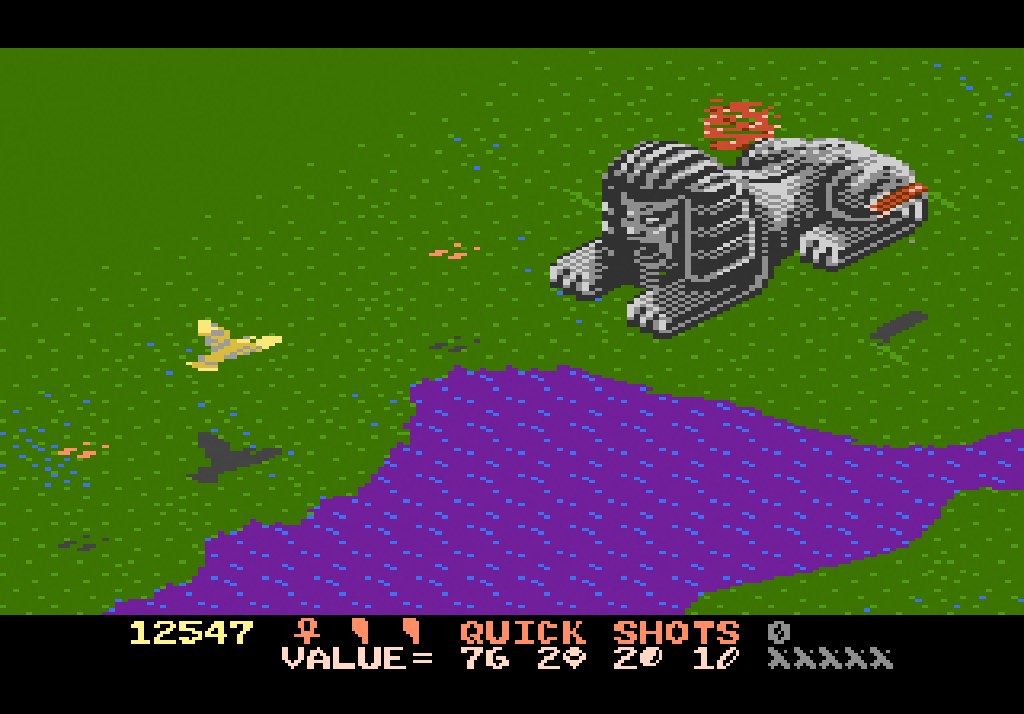
Zaxxon’s grammar over ancient Egypt: Desert Falcon flies you, as the falcon, on an isometric diagonal over deserts, oases and pyramids, hopping and flying between altitudes to collect hieroglyphs, dodge sphinxes and duel the desert’s guardians — up to and including a sphinx the size of a building. It was an early 7800 original (1987) with a designer’s confidence: the three-height flight model is a whole mechanic, the treasures are a whole economy, and the presentation has a storybook strangeness. Sega’s formula, Atari’s mythology, nobody’s clone.
Play tip, earned the hard way: live at the middle height. Low flight is where the treasures and the trouble both live, and the falcon’s hop — that quick, bouncing low gear — is the game’s secret handshake. Master the heights and the desert opens like a book.
7. Crack’ed

The most quietly surreal game in the library: creatures are stealing eggs from nests — in a great tree, in the Rooster Ranch, in the sewers of 42nd Street, in a haunted castle — and you, a crosshair with a conscience, are the eggs’ only defence. Crack’ed is a gallery shooter with a conservationist’s heart, designed by Robert Neve, and its scenes have a picture-book oddness that deepens the longer you look. It rewards accuracy over panic, escalates with real cunning, and is the easiest recommendation in this list to a player who thinks they’ve seen everything the 7800 does.
It is also, quietly, one of the best-looking games in this list — the tree alone, with its nests and its greenery against the sky, could hang in a gallery of 8-bit scene painting. Beauty and egg defence: a combination the 7800 offers nowhere else.
8. Dark Chambers
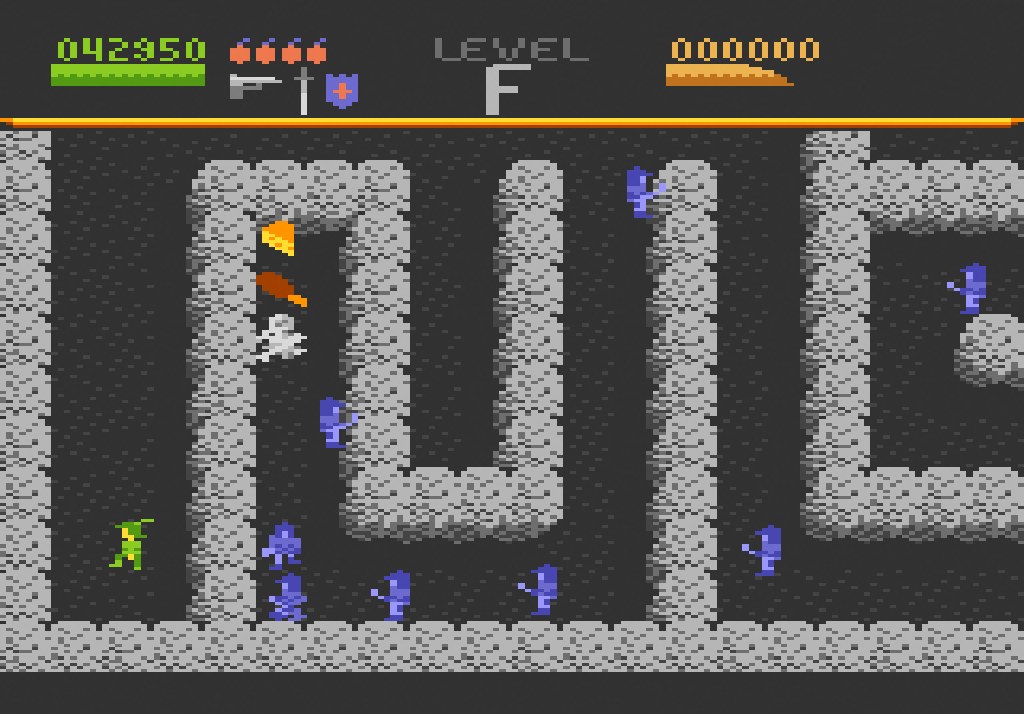
Gauntlet’s DNA, redrawn for the 7800: Dark Chambers sends one or two heroes through 26 lettered levels of top-down dungeon — ghosts, skeletons, spawners, traps, keys, food, treasure — in a design that descends, fascinatingly, from Dandy, the game that inspired Gauntlet itself. The two-player simultaneous mode is the headline: a proper cooperative dungeon crawl on a 1988 cartridge, with the mazes cycling colours as you descend from A to Z. Slower and more methodical than Atari’s own Gauntlet-style efforts elsewhere, and all the more cultish for it.
One more lineage note for the dungeon scholars: because Dark Chambers descends from Dandy — John Howard Palevich’s 1983 design, the acknowledged grandfather of Gauntlet — playing it is a small act of archaeology. This is the family tree of the co-op dungeon crawl, growing on Atari’s own soil.
9. Robotron: 2084
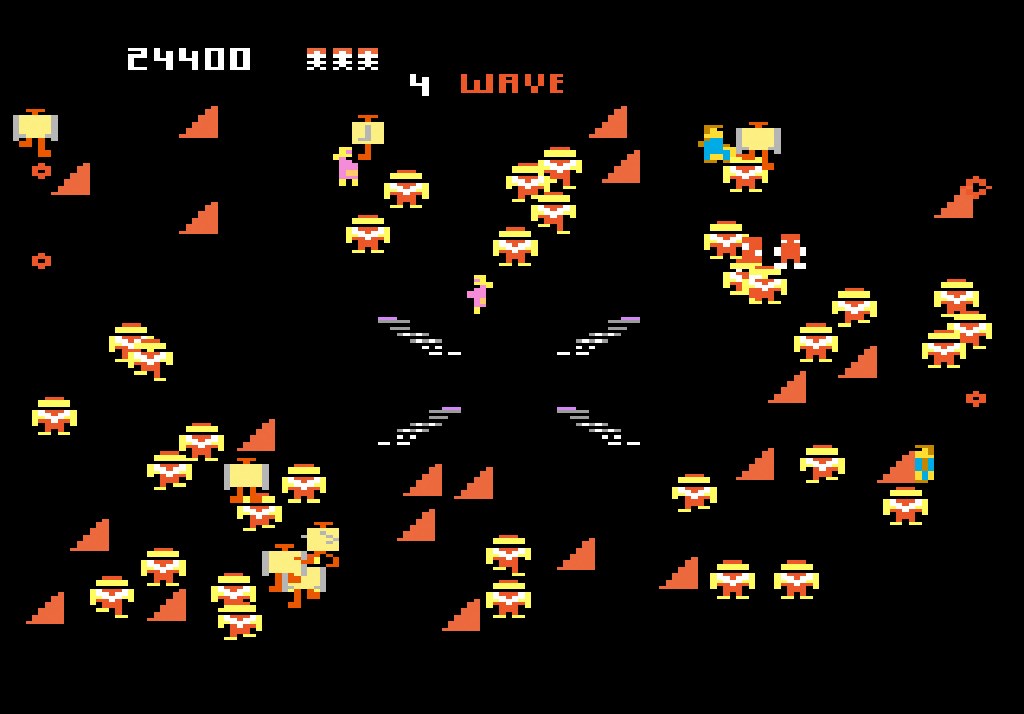
Some hidden gems are hidden by obscurity. Robotron is hidden by its own control scheme — of which more in the small print. The game itself needs no defence: Eugene Jarvis’s twin-stick masterpiece, the last human family besieged by the robot apocalypse, wave after wave of the purest arcade intensity ever designed. The 7800 port is superb — fast, dense, faithful — and the famous workaround defines its cult: two controllers, one for movement and one held by a friend (or coupled together) for firing, recreating the twin sticks the console never had. Set it up once and you’ll understand: this may be the best game on this list, wearing the strangest harness in gaming.
Practical note: the two-controller method sounds like a joke until the first wave closes in and your hands stop arguing. Dedicated players couple the sticks; the rest of us recruit a friend to be the second stick — the most co-operative way to play a game about the end of the world ever devised.
10. Commando

Capcom’s vertical war, ported with pride — and with a secret weapon in the cartridge: a POKEY chip, giving Commando the soundtrack the base 7800 could never produce alone. The game is the familiar one-man campaign: dropped by helicopter into the jungle, fighting north through trenches, bridges and fortresses, rescuing prisoners and collecting that famous arsenal. The 7800 version is colourful, crowded and confident, and its audio lifts it above the system’s usual static — one of only a handful of cartridges that solved the sound problem by bringing their own chip to the fight. A famous name, yes; but on this system, still somehow a sleeper.
Between the POKEY music and the presentation, Commando is also the late library’s best argument that the 7800’s sound problem was a budget decision, not a destiny. The chip was willing. The accountants weren’t — except here, and in Ballblazer, where somebody signed the cheque.
A note on hunting them
Practicalities, briefly. Most of these ten remain sensibly priced — the late-era releases (Klax, Motor Psycho, Fatal Run, Basketbrawl) turn up less often than the launch library but rarely command the money of the system’s licensed trophies, and several on this list are still cheaper than a new release’s downloadable content. The exceptions announce themselves: anything boxed, anything in PAL/NTSC-crossing demand, and Robotron — whose fame is not hidden at all, whatever this list claims — will ask real prices and usually deserve them. Buy the cartridge, not the story: clean the contacts, test before you judge, and remember that half the fun of a hidden gem is the finding. These were buried once by accident. Don’t bury them again in a display case.
The recovery shelf
Ten games, no two alike, all of them evidence for the same argument: the 7800’s library is deeper than its obituary. The famous ports built the console’s reputation; these are the games that reward the owners who stayed after the reputation was settled. Hunt them in any order — though if a friend is visiting, Robotron and its two-controller harness make the best story — and remember the moral of the whole system. The warehouse years buried a lot of things. Most of them were worth digging up.