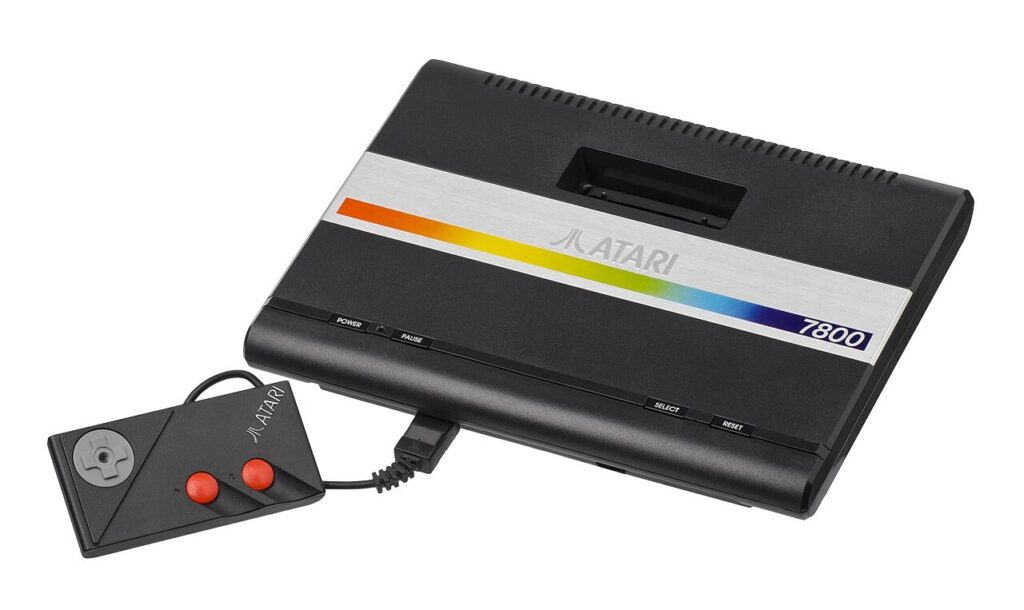
At a glance: The Atari 7800 in Europe · Atari 7800 · Regional feature · The console’s quiet second life
The 7800’s American story is famous: designed in 1984, warehoused, relaunched into Nintendo’s America, gone by 1992. Its European story is quieter, stranger and in one respect happier. The ProSystem crossed the Atlantic late and lived differently there — different controller in the box, different game built into the machine, a long twilight as the budget console of the early 1990s, sold in the kind of shops that also sold the games’ grandparents. For European players of a certain age, the 7800 wasn’t a footnote to the NES era. It was the affordable door into it.
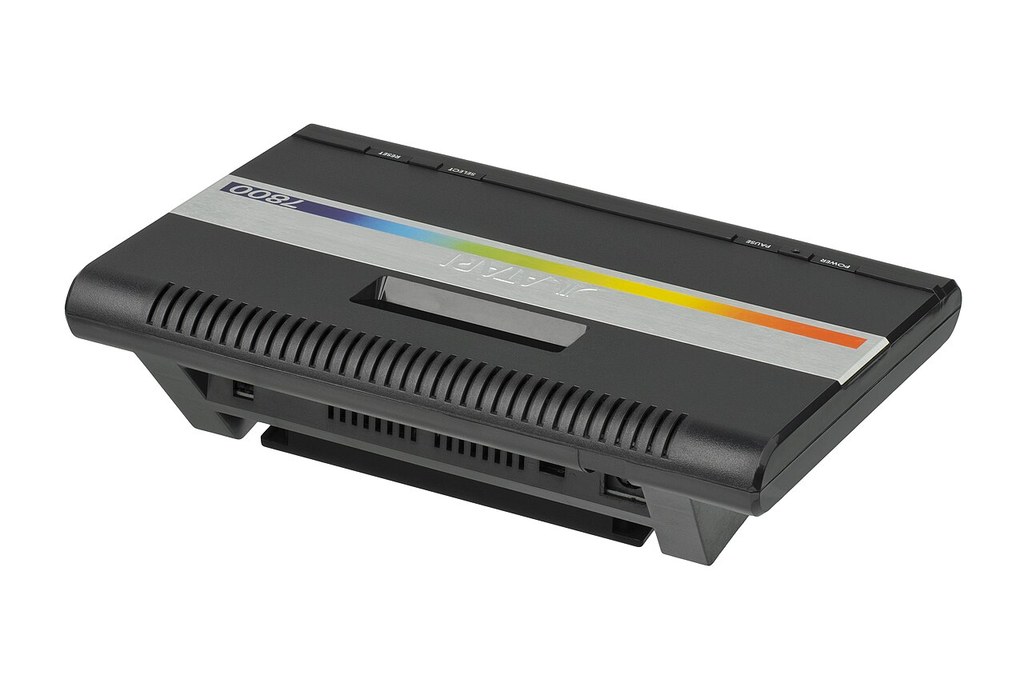
The hardware itself tells the story of a company adapting. The European 7800 is recognisably the same sleek wedge — the rainbow stripe, the low black shell — but the box contained a CX78 joypad instead of America’s much-criticised Pro-Line joystick: a proper two-button pad, years before pads were the European default expectation, and by most accounts the kinder controller of the two. More famous still is what happened when you turned a European 7800 on with no cartridge inserted: Asteroids. Not a menu, not a logo — the full GCC Asteroids, built into the PAL machine’s firmware, free with every console. An entire generation of European owners met the 7800’s best launch game without ever buying it, and many met the console itself the same way: as the machine that already had Asteroids in it.
A different market, a different job
The Europe the 7800 entered was not Nintendo’s Europe. Nintendo’s distribution on the continent and in the UK was patchier, later and dearer than in America; the living rooms of late-80s Europe still belonged substantially to home computers — Spectrums, Commodore 64s, Amstrads, STs and Amigas — with Sega’s Master System building the console beachhead. Into that landscape, Atari’s European operation positioned the 7800 as the honest budget machine: cheaper console, cheaper cartridges, a famous name, real arcade games. It was sold hard through catalogues, toy shops and the big electrical chains, and it found its people — families for whom an NES bundle was a stretch, and players whose arcade loyalties ran to Atari’s back catalogue of Galaga, Ms. Pac-Man and Joust rather than to Nintendo’s new mythology.
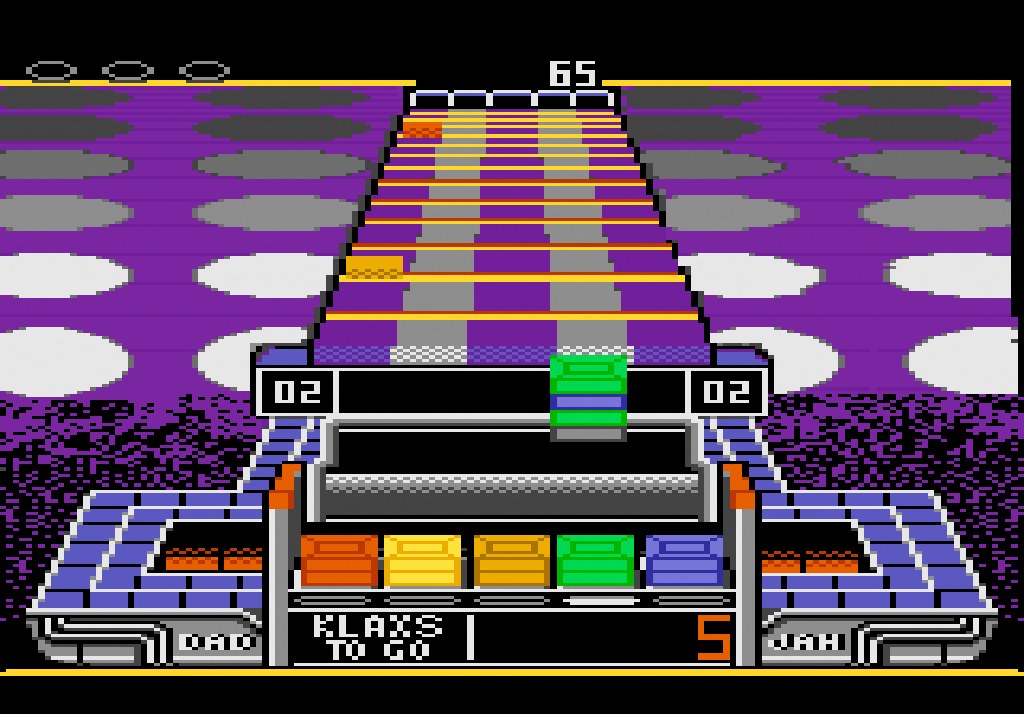
The software story has a European accent of its own. The big GCC ports anchored the range, but Europe’s shelves also suited the console’s arcade heart — and European-developed sensibilities showed through in games like Tower Toppler, the British-born rotating-tower platformer from Hewson, which felt entirely at home in the 7800’s later European life. The library arrived on a delayed fuse compared to America, which produced an odd effect: as the US line wound down around 1990-91, European shelves were still receiving and selling 7800 software, Klax among the last and strangest arrivals — a 1989 arcade puzzle game reaching the PAL 7800 in the machine’s dusk, wearing a 1992 copyright like a postmark from another era.
Price deserves one plain sentence of its own: in shop after shop, the 7800 undercut the NES decisively, cartridge for cartridge as well as console for console — and in the Europe of the late eighties, with the micros setting everyone’s sense of software value, that arithmetic was the entire argument. Atari’s European teams understood their market. They priced for it, packaged for it, and kept selling into it long after the American story had closed.
The PAL experience, honestly
It was not all romance. PAL 7800 gaming carried the era’s usual taxes: many titles ran at the 50Hz continental tempo rather than the 60Hz they were written for, with the borders and pacing that implied — a slower, taller-screened Asteroids is still Asteroids, but the faithful will tell you the difference matters in the late waves. Cartridge supply could be eccentric; some American releases never crossed officially, which made import awareness part of the European hobby early. And the console’s famous backwards compatibility, so central in America, meant less where the 2600’s installed base had always been thinner relative to the home computers. The European 7800 had to stand on its own library. Fortunately, the library — Galaga, Food Fight, Ballblazer, Ms. Pac-Man, and that built-in Asteroids — could stand.
A joypad in the box, Asteroids in the firmware, and a price the NES couldn’t match. Europe’s 7800 wasn’t a leftover — it was a local edition, and it had its own childhoods.
The afterlife sealed the affection. Because the PAL machines were sold late, cheap and wide, they remained common in European second-hand circulation for decades — the console at the car-boot sale, the one in the catalogue remainder bin — and the built-in Asteroids means every single one of them still boots into a masterpiece with no cartridge at all. European retro culture, which grew up through the home computers, has increasingly adopted the 7800 as its console cousin: the Atari that stayed. Modern Atari has noticed, too — the recent 7800+ revival hardware arrived as a knowing nod to the machine’s transatlantic cult, in a market that treats the ProSystem as heritage rather than trivia.

There is a collector’s corollary to all this, and European hunters know it well: the PAL library’s quirks are now its charms. The built-in-game consoles are the commonest survivors — switch one on today, no cartridge, and Asteroids boots like it’s still 1989. The CX78 pad, once a regional footnote, is now the controller many enthusiasts worldwide prefer for the system, and imports of it cross the Atlantic in the wrong direction, which would have amused the sales teams of the time. Even the 50Hz question has been reframed by history: the PAL library stands as its own canon, played at its own tempo by the people it was sold to. Regional variants were supposed to be compromises. Forty years on, they read as editions — and Europe’s edition of the 7800 story is the one with the happiest ending.
So if you meet a European collector whose eyes light up at the rainbow stripe, understand what you’re seeing: not the residue of a failed American launch, but a first console, honestly bought and honestly loved, that happened to come with one of the greatest games ever made already inside it. That is not a consolation prize. That is a head start — and Europe’s 7800 players have been running with it ever since.
There is a footnote for British readers especially: in a market where the Spectrum and the C64 defined a generation’s idea of gaming, the 7800 was the console that most resembled their promise — arcade games, honestly rendered, without the arcade’s price per play. It never outsold the micros. It didn’t have to. It just had to be there, stripe and all, when a family wanted the arcade at home — and it was, for years, in more homes than the histories usually count.
The quiet verdict
America remembers the 7800 as a tragedy of timing — the right console at the wrong corporate moment. Europe remembers something gentler: a well-made, well-priced machine that turned up, included a great game inside itself, and played the arcades honestly for years. Both memories are true. The European chapter just happens to be the one where the console got to live a normal life — and for the players who grew up with the stripe, the pad and the built-in rocks, normal was more than enough.