
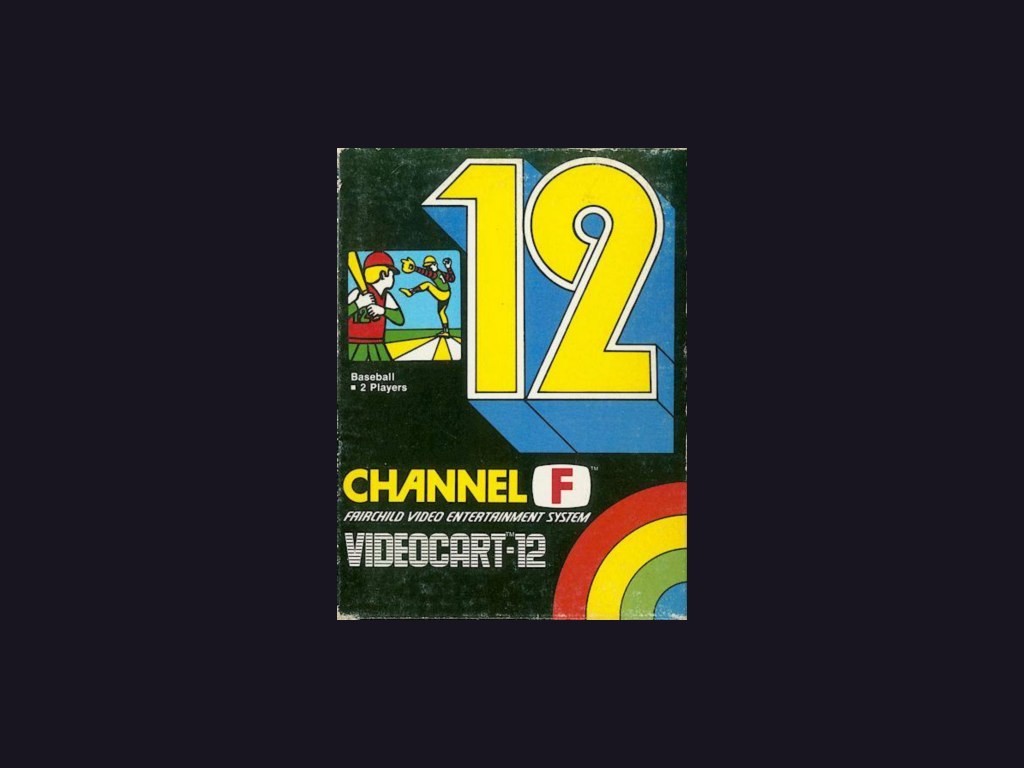
At a glance: Baseball (Videocart-12) · Channel F · Fairchild, 1977 · Sports / baseball · Score: 8.5/10
In September 1977, home baseball barely existed. The dedicated consoles had offered bat-and-ball abstractions; the cartridge era was a year old; and Fairchild’s Videocart-12 arrived as one of the first console games that attempted the actual sport — nine innings of pitching, batting and fielding, with a ball you could genuinely pitch rather than merely serve. Video magazine’s testers, reviewing the Channel F library in 1978, gave Baseball the highest mark they gave anything on the system: 10 out of 10. Decades later, Brett Weiss still called it “highly playable,” which from that source is a medal. Both verdicts survive contact with the cartridge. This is the Channel F’s finest sports game, and one of the finest baseball games of its entire console generation.
The pitching is the revelation, and it is pure Channel F. The hand controller’s full vocabulary — push, pull, twist — is mapped onto the pitch itself: twisting the knob steers the ball, curving it through the strike zone, while pushing forward or pulling back varies its speed. Fastballs, curveballs and change-ups are not menu selections but gestures, performed on the stick in real time. For a 1977 cartridge to offer a pitcher three genuinely different deliveries, controlled analogically by the pitcher’s own hand, was extraordinary; dedicated baseball machines years later would do less. The duel at the heart of baseball — pitcher constructing a deception, batter reading it — exists here, in 2K of framebuffer, because a semiconductor company built a controller with a twist in it.

A rulebook, not a toy
What surrounds the pitching is a completeness that still surprises. Balls and strikes are called properly, so the count develops and walks happen — a batter can be issued a base on balls in a 1977 video game, a sentence worth pausing on. Batters can be hit by pitches, with the consequences the rulebook prescribes. Strikeouts accumulate. When the ball is put in play, four fielders can be moved left or right to convert hits into outs, giving the defence an active role rather than a spectator’s. None of this is lavishly drawn — the diamond is a diagram, the players are marks upon it — but the diagram behaves like baseball, and behaviour is what a sports simulation is for. The machine’s talent for text and numbers keeps score, count and outs legible at a glance, the unglamorous virtue at which the Channel F quietly beat every rival of its day.
It is worth setting the cartridge against its moment honestly. The Atari VCS, launched the same autumn, would not receive a baseball game of comparable mechanical ambition for years, and its machinery — built for two sprites and a playfield — made the pitching duel genuinely hard to stage. The Channel F’s framebuffer, so limiting for arcade speed, turned out to be a sports-simulation engine: draw any diamond, move any fielder, write any score. Videocart-12 is the cartridge where the platform’s supposed weakness reads most clearly as a different set of strengths.
The long game
Nine innings is a commitment, and the cartridge asks for it in full: this is not a three-inning demo of baseball but the whole afternoon, with the slow accumulation of count, score and fatigue-of-attention that makes the sport itself. Two players divide naturally into the duel the game is built around, pitcher against batter, and the twist-pitching system means the duel deepens as both players learn — the curve that fooled a friend in the second inning is a known weapon by the seventh, and the change-up exists precisely for that moment. Single-player against the machine lacks the same psychology, as single-player baseball always would, but the mechanics remain satisfying against any opponent because the gestures themselves are the game.
Fastballs, curveballs and change-ups performed by hand on a twisting stick, walks and hit batsmen in the rulebook, and a 10 out of 10 from the critics of its day: Baseball is the Channel F’s sporting masterpiece.
The limits are the era’s. Fielding control is lateral only, the diagram graphics will never be mistaken for a ballpark, and a full game moves at the contemplative pace of the sport itself, which not every arcade-tempered player of 1977 wanted from a television. None of it dents the achievement. Fairchild’s programmers looked at the hardest mainstream sport to simulate — the one made of pauses, counts and deception — and found that their strange controller and text-friendly screen were, improbably, the best tools any home machine then offered for the job. They were right, and the critics of 1978, who had everything else on the system to compare it with, said so in the strongest terms available to them.

The critics, assembled
It is worth pausing before the verdict to note how unusual Baseball’s file of reviews is. Perfect scores are rare in any era’s games press; in Video magazine’s 1978 survey — the closest thing the young medium had to a comprehensive critical census of a whole library — they were awarded to exactly two cartridges on this system, and one of them was a December 1976 blackjack game. Baseball took the other, outscoring every action title, every arcade adaptation and every novelty the platform offered. The modern consensus has not revised the judgement downward: Weiss, writing with three decades of comparisons available and no obligation to flatter anyone, still reaches for “highly playable,” his praise for the complete pitching repertoire intact. Games that are merely first tend to be forgiven; games that are first and still cited as the class of their library thirty years later are something else. Baseball is the Channel F’s entry in that small category, and its category-mates on other platforms — the games that defined what their machines were for — are a roll of honour any console would envy. The diamond was a diagram. The duel was real. The critics of 1978 saw both halves of that sentence, and scored accordingly.
One more modern consideration seals the cartridge’s case: Baseball is the Channel F game least dependent on nostalgia to function. Its duel is mechanical, its information is complete, its rules are the rules of a sport still played, and a first-time player in 2026 can be taught the twist-pitch in one inning and be genuinely competing by the third. Many historically important games must be appreciated; this one must merely be played, preferably with the friend who believes old sports games were toys. By the seventh inning, the change-up will have made the argument this review has been making for a thousand words, in a single gesture of the wrist.
The verdict
Baseball is the cartridge the Channel F’s design philosophy was secretly for. A framebuffer that could draw a diamond and write a count; a controller that could curve a pitch by hand; programmers patient enough to include the walks, the hit batsmen and the full nine innings. It earned its perfect score in 1978 not as a novelty but as a simulation, and it remains the first name in the library for anyone who wants to see what this peculiar machine did better than the rivals that buried it. Play it with a friend, learn the change-up, and mind the count.
Score: 8.5/10 — One of the first true baseball simulations on a console: three pitches performed by hand, the full rulebook, and the critics’ only perfect score on the system.