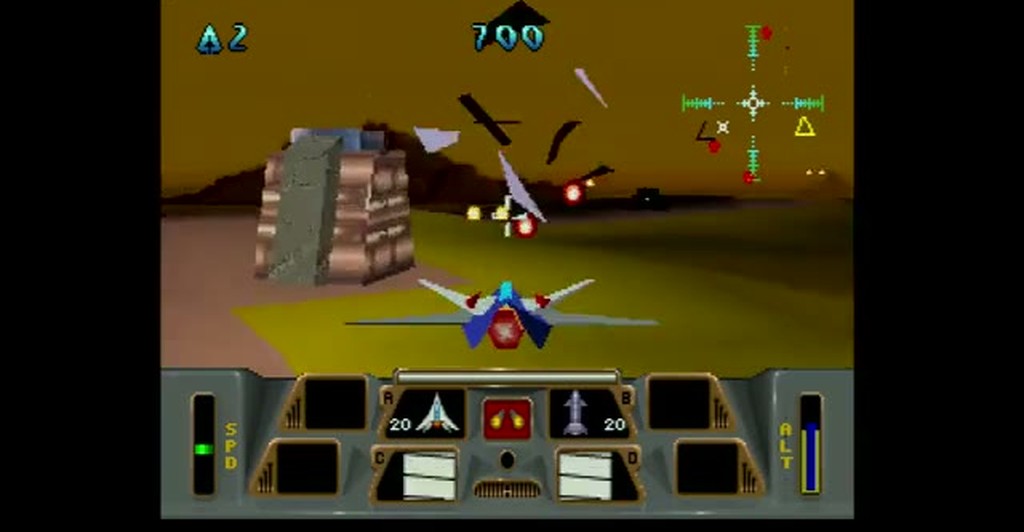
At a glance: Battlemorph · Atari Jaguar CD · Attention to Detail / Atari, 1995 · Free-roaming shooter · Score: 7.5/10
Every Jaguar CD ever sold carried Battlemorph’s burden: it was the pack-in, the game bundled to prove that the toilet-seat add-on on your console was the future. Attention to Detail’s sequel to Cybermorph had to fix the pack-in original’s famous faults — the draw distance, the difficulty, the voice, oh, the voice — while showing off a CD’s worth of new ambition. It fixed more than it missed. Battlemorph is the Jaguar CD’s best original game, and the strongest evidence that ATD, given time and storage, were learning the Jaguar faster than the market was abandoning it.
Same morphing ship, bigger war
The premise widens. Your morphing craft — now able to reconfigure for air, ground, underwater and underground environments — is sent across eight worlds, each a cluster of mission areas, to repel the Pernitian invasion. Where Cybermorph tasked you with collecting pods cube by cube, Battlemorph builds a campaign: dozens of mission areas with objectives that run from convoy defence and facility strikes to full boss encounters, strung together by a proper save system and a structure that lets you feel a war progressing rather than a checklist emptying. The flat-shaded polygon look of the original returns, but the colour, variety and sheer quantity of environments — surface canyons, undersea trenches, cavern systems, night operations — give the sequel a sense of place its parent never had.
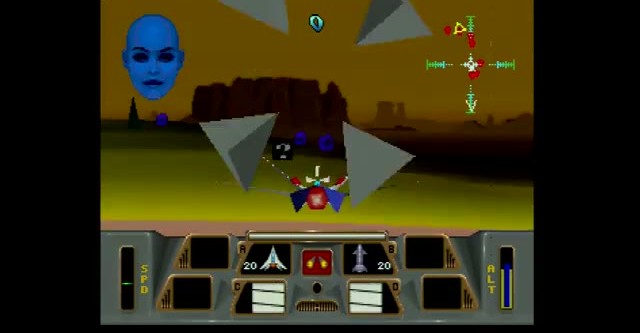
The morphing itself is the sequel’s best idea, inherited and expanded. Your craft’s transformations are contextual and seamless — dive at water and you are a submarine, with sonar-flavoured muffled audio and a different weapon feel; burrow into the underground zones and the game becomes a tunnel shooter. None of the forms is a gimmick: the missions are designed around the transitions, and the underwater sections in particular — slow, blue, tense, with enemy signatures resolving out of the murk — are unlike anything else on the Jaguar in any format.
Fixes, honestly assessed
So, the checklist of original sins. Draw distance: substantially improved, with terrain resolving far enough out that navigation feels fair — the fog is still present as atmosphere and as technology, but the pop-in ambushes of Cybermorph are largely gone. Difficulty: rebalanced towards the humane, with a save structure that respects your evening. The ship’s AI companion: Skylar’s infamous catchphrase delivery from the original became so notorious that ATD addressed it directly — the sequel’s voice work is present but toned down, and players who lived through “Where did YOU learn to fly?” on loop will feel the apology in every quiet cockpit. Frame rate and control both take a step forward, the craft feeling less like a shopping trolley in a gale than its parent sometimes did. The CD audio — full soundtrack work rather than cartridge chips — gives the whole production a weight the original lacked.
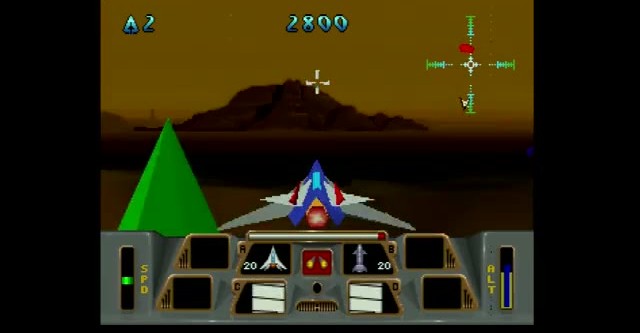
What remains imperfect is instructive, too. The flat-shaded aesthetic, already retro in 1995, was never going to win the screenshot wars against the PlayStation, and some worlds are markedly more interesting than others — the campaign’s middle sags under a few escort-and-fetch objectives that the engine’s combat doesn’t elevate. The Jaguar pad continues to ask a lot of your thumbs in the busiest dogfights. And as a pack-in for an add-on, Battlemorph shared the add-on’s fate: most Jaguar owners never played it, and its reputation lives at one remove, through the CD’s scarcity.
The CD’s best case
Which is a shame, because judged as a game rather than as a market event, Battlemorph is a solid, generous, genuinely distinctive shooter — eight worlds of free-roaming missions from a studio visibly growing into its craft, on hardware nobody else was using this well. In the tiny Jaguar CD catalogue it towers: the add-on’s other exclusives are film licences, ports and experiments, while Battlemorph is a full original campaign that could only have existed there. If the Jaguar CD is remembered kindly for anything, this is the anything.
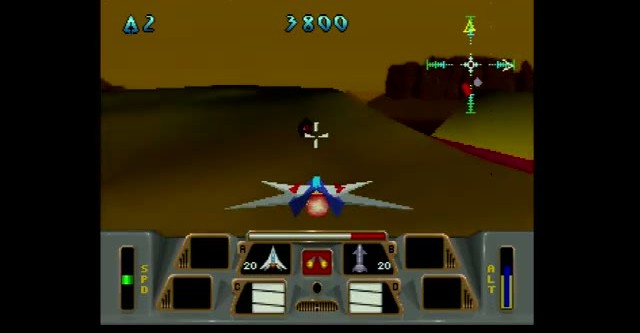
For modern players the calculus is simple enough. The CD hardware is rare and delicate, and Battlemorph with it — but as the flagship of that library it is the game that best repays the effort of emulation or a lucky find, and the natural second chapter for anyone who survived Cybermorph and wondered what its makers could do with a budget and a disc. The answer: quite a lot, actually.
The eight worlds, and the water
The campaign’s geography deserves a closer word, because structure is where Battlemorph most outclasses its parent. Eight worlds, each with its own palette, weather and tactical personality, replace Cybermorph’s procession of similar horizons: there are worlds of canyon and mesa where the flying game dominates, drowned worlds where missions chain surface strikes to long submarine approaches, and fortress worlds where the underground tunnel networks turn the game into a burrowing siege. The mission design within them is equally grown-up — objectives stack and combine, so a single sortie might run reconnaissance, convoy cover and a facility strike in sequence, with the morphing craft’s whole repertoire exercised in twenty minutes. It feels, in the best sense, like a second-generation Jaguar game: the same ideas as the launch titles, but composed by people who had finished learning the instrument.
And the water bears repeating. Console games of 1995 did not do underwater well — they did it slowly, murkily and apologetically. Battlemorph’s submerged missions are the exception that shames the rule: a distinct physics, a distinct soundscape, enemies resolving from blue darkness with genuine menace. If the Jaguar CD had lived long enough for a library, its designers would have pointed at these levels the way Genesis designers pointed at their best water stages. That there was no library, and that these levels survive mainly as connoisseur knowledge, is the format’s small tragedy in its purest form.
For Cybermorph survivors, a footnote
If the original pack-in left scars, Battlemorph is best approached as the same developer’s sworn second draft, and it helps to know that ATD themselves framed it that way in the interviews of the day, acknowledging the first game’s faults with a candour publishers rarely permitted. The sequel’s gentler opening worlds are practically an apology tour: clear objectives, forgiving skies, a craft that feels eager rather than reluctant. Players who filed Cybermorph under “never again” owe this one a single evening. The distance between the two games — same studio, same hardware family, two years apart — is the clearest measure in the whole Jaguar catalogue of what familiarity with this eccentric machine was worth, and why its best developers kept getting better right up to the moment the market stopped asking.
And if you meet it the way its first owners did — lid up, disc in, the add-on humming its improbable hum — give the Virtual Light Machine a spin afterwards with your favourite album. It is the Jaguar CD in miniature: eccentric, excessive, and quietly wonderful.
Eight worlds, four forms, one small studio’s reputation rebuilt in public: the disc the Jaguar CD deserved as its ambassador, arriving precisely on time and five years too late, both.
Verdict
A sequel that listened: bigger, fairer, more varied and more confident than Cybermorph in every way, and the Jaguar CD’s essential original game. Score: 7.5/10