
At a glance: Flashback · Atari Jaguar · Delphine Software / U.S. Gold, 1994 · Cinematic platformer · Score: 8.0/10
Some games get ported everywhere because they are easy. Flashback got ported everywhere because it was essential — Delphine Software’s 1992 rotoscoped masterpiece, a science-fiction platformer of such visual and narrative confidence that every machine of the era wanted its name on the box. The Jaguar’s turn came in 1994, and the question for this review is the only one that matters with a game this canonical: is the Jaguar build a good way to play Flashback? It is — faithful, complete and smooth — with one or two cartridge-era compromises that a buyer should know about.
The game, for the uninitiated
You are Conrad Hart, an agent of the Galaxia Bureau of Investigation, waking in the jungles of Titan in 2142 with your memory wiped and a holocube in your pocket that tells you, in your own voice, that aliens who walk among humanity in disguise are planning its conquest — and that you must not let the cube fall into their hands. What follows is a seven-stage odyssey from Titan’s jungle and the artificial city of New Washington to a cyberpunk game show, an alien homeworld and one of the great endings of its genre. Flashback plays like the Prince of Persia lineage grown up and gone to the cinema: deliberate, animation-driven movement — run, roll, crouch, draw, climb — through screens of platforming, gunplay and light puzzle-solving, where every jump is a commitment and every alien sentinel is placed by someone who hated you personally.
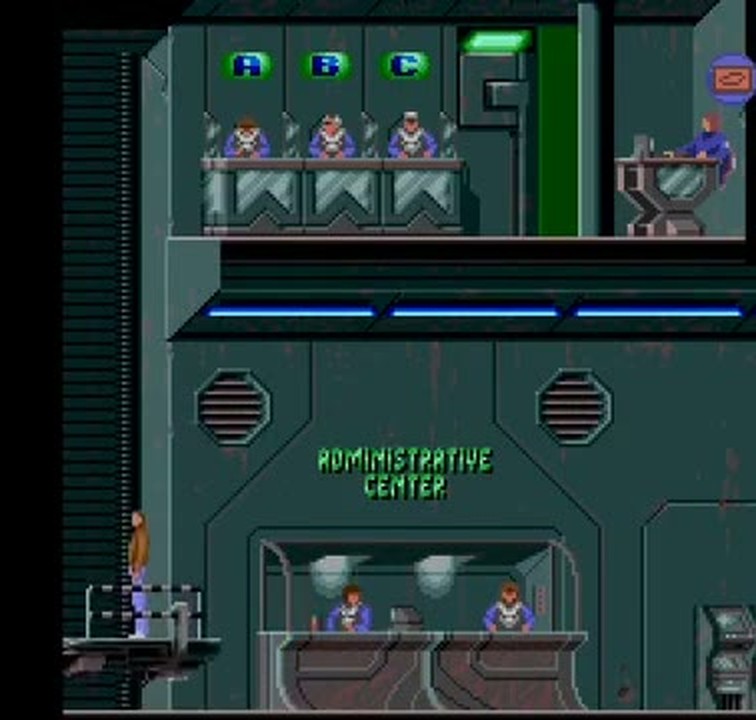
The rotoscoping remains the miracle. Delphine filmed real actors and traced them, and Conrad moves with a weight and fluidity that sprite games of the day couldn’t approach — the way he skids from a run, rolls under a sensor, draws and fires in one unbroken intention. On the Jaguar the animation is all here, the painted backdrops are rich, and the game’s palette of jungle greens, city blues and alien reds reads exactly as it should. If your only Flashback has been a modern re-release, know that the Jaguar version is the real, original article: hand-drawn, unhurried and beautiful.
Jaguar specifics
Version-watchers, here is your ledger. The Jaguar build is based on the game’s home-computer/console lineage rather than the later CD re-releases, so you should not expect the rendered cut-scene upgrades some other versions experimented with — the story is told, as originally, through the game’s own elegant in-engine sequences and text. The cartridge handles the game smoothly, loading is a non-issue in the way CD owners of the era could only envy, and the music and effects — sparse, atmospheric, more about space than tune — are faithfully present. Controls map Conrad’s considerable move-set onto the pad with the usual Jaguar keypad assisting, and the deliberate, animation-locked handling feels at home: Flashback was never a twitch game, and a good D-pad is all it ever asked for.
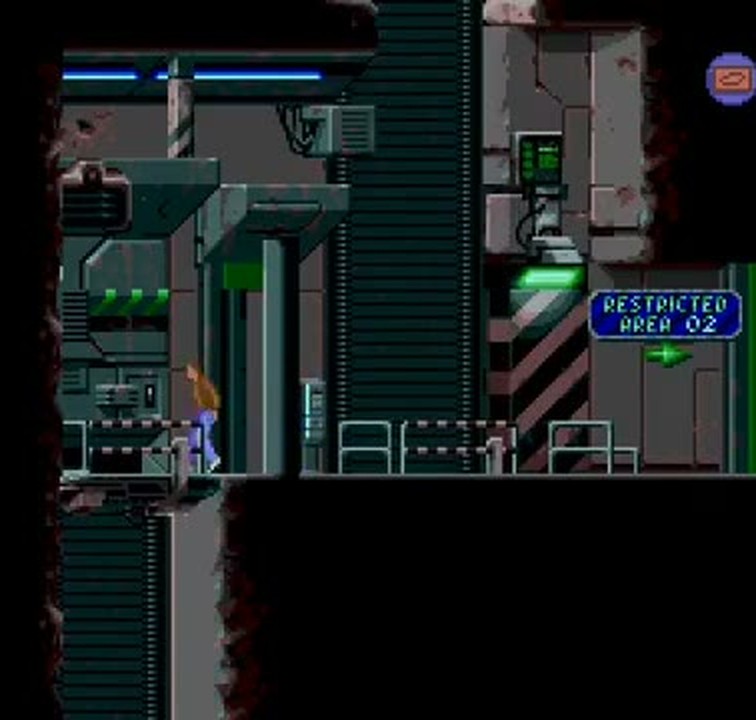
Difficulty is the game’s own, unsoftened: this is a hard, checkpoint-sparse platformer in which a single mistimed roll can cost a long sequence, and the Jaguar version’s password system is the era’s standard mercy. Modern players should also prepare for the game’s one true antique: some solutions — the exact pixel from which to make a running jump, the guard whose patrol must be learned by dying to it — are pure 1992. The genre has spent thirty years sanding those edges. Flashback keeps them, and its devotees would not have it otherwise.
Why the Jaguar version earns its place
Honestly assessed, the Jaguar’s Flashback is not the rarest or the most exotic port — its distinction is competence and context. On a console whose library is dominated by shooters and racers, here is the era’s defining cinematic platformer, complete and well-made, playable on a cartridge that asks nothing of fragile CD hardware. It also arrived as part of a small but real wave of French excellence on the system — Delphine’s classic alongside Ubisoft’s Rayman — that gave the Jaguar, of all machines, a claim on the period’s most beautiful 2D gaming. Played on the console today, it is the library’s best argument for slowing down.

There is one more consideration for collectors, and it cuts in Flashback’s favour: because the game exists on everything, its Jaguar edition was never inflated into the stratosphere by rarity hunters to the degree the system’s exclusives were. It is a cartridge a player can still buy to play, which in this library is a recommendation all by itself.
Playing it in 2026, honestly
Modern players arrive at Flashback by two roads, and the Jaguar version serves them differently. If you know the game — through the Amiga, the Mega Drive, the anniversary re-release with its rewind button and its conscience — the Jaguar build is a purist’s edition: the original challenge, unassisted, on the era’s most unlikely hardware, with the loading-free convenience of a cartridge. You will miss nothing that defines the game, and you will gain the specific satisfaction of Conrad’s story running on a machine its original audience never expected to host it. If you are new, come prepared for the genre’s old covenant: learn by dying, memorise by returning, and treat the password jotter as part of the ritual. Flashback’s first hour is a masterclass that still teaches; its later hours are an examination that still examines.
Either way, the Jaguar is not a strange place to meet this game — it is a fitting one. Flashback was always the connoisseur’s platformer, prettier and more serious than its mascot contemporaries, and the Jaguar, whatever else it was, was always the connoisseur’s console: flawed, fascinating and impossible to summarise in a playground sentence. They suit each other. Delphine’s classic gains a distinctive edition; the library gains its most graceful cartridge. Everybody walks away with the holocube.
The craft, frame by frame
It is worth slowing down for the animation, because Flashback’s rotoscoping is the rare technical boast that improves the game rather than decorating it. Every action Conrad takes occupies its true duration — a long jump cannot be hurried, a drawn gun cannot be instantly holstered, a run carries momentum that the level design prices into its gaps — and that physical honesty is what makes the platforming feel like tradecraft instead of hopping. The Jaguar renders all of it without a stumble, including the set-pieces (the falling sequences, the Running Man-style game show gauntlet, the morphing final levels) that pushed lesser hardware. Watch a modern player meet the game here and the same sequence unfolds: ten minutes of fighting the deliberateness, then the click, then the grudging admiration of a person who has realised the game was never clumsy — it was waiting for them to stop being careless. That conversion experience, faithfully preserved, is the Jaguar version’s whole argument, and it wins it.
Conrad’s story ends, as all good pulp does, with the fate of humanity balanced on one man’s recovered memory. The Jaguar tells that story as well as any machine of its generation, and asks only your patience in return.
Verdict
A faithful, handsome port of a genuine masterpiece — the Jaguar’s best cinematic platformer and an essential shelf-filler for any owner who wants range beyond the shooters. The game underneath was a 10 in 1992; the port’s era-typical rigours make it an 8 today, and a proud one. Score: 8.0/10