
At a glance: The Berenstain Bears: A School Day · Sega Pico · Sega, 1995 · Storybook edutainment · Score: 7.5/10
Some Pico books teach subjects; this one rehearses a life event. A School Day walks Brother and Sister Bear through one complete school day — waking, preparing, travelling, lessons, play, home — and for its real audience, three-to-six-year-olds facing or newly starting school, that walkthrough is the most practical thing the Pico ever did. Starting school is the first big institutional hurdle of a child’s life, and a friendly book that makes the day familiar, in order, with kind bears, is doing emotional education of a very concrete kind. The Berenstain Bears were the natural licence for it: Stan and Jan Berenstain built a whole shelf of first-experience books, and this is that shelf, animated and talking.
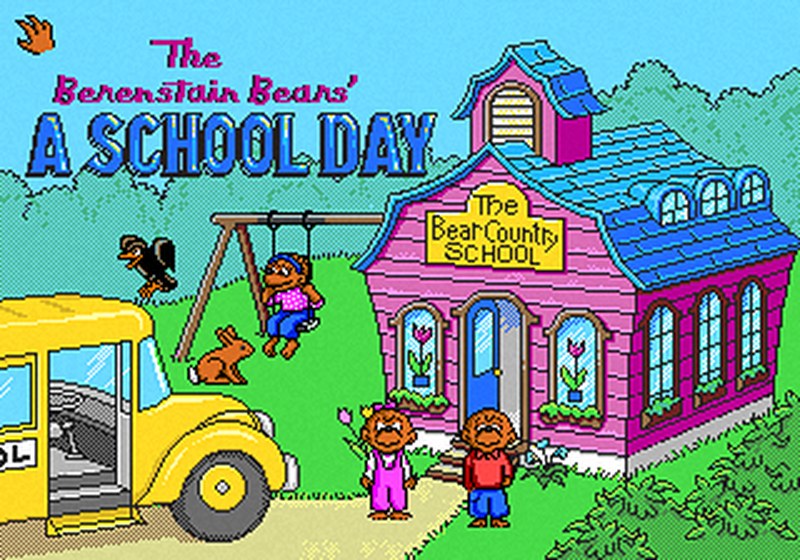
The book, page by page
A Pico Storyware is a picture book first and a cartridge second, and The Berenstain Bears: A School Day uses that shape well. The cast — Brother Bear, Sister Bear, Mama and Papa Bear in Bear Country — carries the child through getting ready for school, classroom scenes, playground and lesson activities, and story pages following one complete school day. Turning a physical page changes the scene on the television, changes the music, and changes the job to be done, and that rhythm still feels clever: the book tells the hands when to move on, and the screen rewards the turning. Sessions settle into a comfortable loop of story page, activity page, praise, next page, which a child of 3 to 6 can follow without an adult reading instructions aloud — the voices do that work, page after page.
Pen work
Everything is driven by the Magic Pen on the touch pad and on the book’s own final page, with the console’s chunky buttons in support. The pen suits this material: pointing at answers, tapping objects in busy scenes and drawing where the book invites it are natural actions for small hands, and the targets are big, forgiving and clearly spoken. There is a real skill being practised underneath the play — hand-eye coordination between pad and screen, careful pointing, listening to a whole instruction before acting — and the book paces it kindly, never timing a 3-year-old into panic. Adults should expect to set the console up, then be usefully unemployed for most of a session.
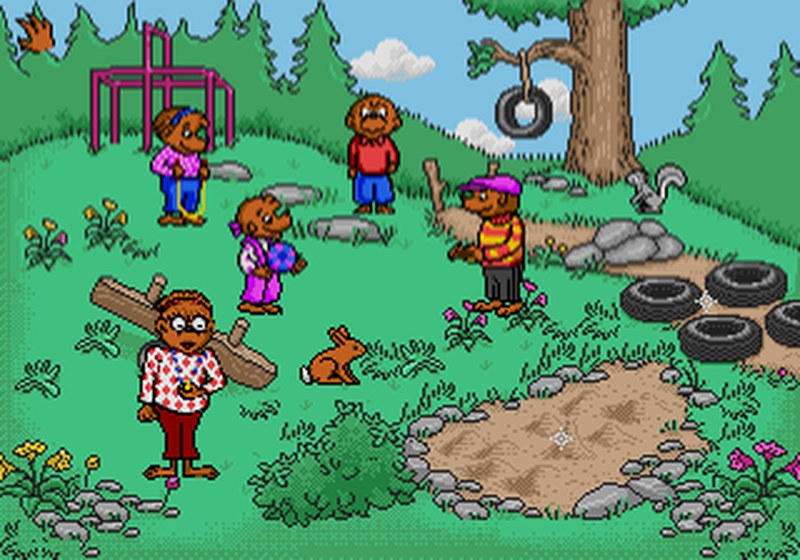
What it teaches, honestly
The stated curriculum is school routines, letters and numbers readiness, social confidence and following a day in order, and the honest verdict is that it is really taught, not merely advertised: emotional education done concretely — routine, order and social modelling that genuinely helps a child facing school. That is the standard this site judges Pico software by — not whether it resembles a Mega Drive game, but whether a child leaves a session having practised something real, willingly, at the right level for 3 to 6. On that standard this book earns its place. Its limits are equally clear: deliberately the gentlest challenge on the system, and its usefulness peaks in the narrow window when school is new. Neither the strength nor the limit is a surprise, and parents in the 1995 knew what they were buying — which is part of why the Pico sold in the millions.
Not a subject but a rehearsal: one whole school day, in order, with kind bears — the most practical book the Pico ever published.
The readiness skills ride along inside the routine — letters appear where letters live, numbers where numbers live, and social moments (sharing, listening, taking turns) are modelled rather than lectured. That modelling is the book’s real curriculum and it is done gently and well. Its limits are the limits of its comfort: nothing here challenges a confident child, activities are among the simplest on the system, and once school itself is familiar the book’s central trick is spent. But shelf life is the wrong measure for a rehearsal book. It needs to work for the few months when school is new and looming, and for those months, in 1995, few cartridges in any format did a warmer or more useful job.

Presentation and place in the library
Built on the Pico’s Mega Drive-derived hardware, the book mixes large, clear cartoon art with constant sampled speech — the system’s party trick, and the reason pre-readers could use it alone. Music is cheerful and short-looped in the way of all Pico software; adults in the room will hear those loops in their sleep, which was as true in 1995 as it is for collectors now. As a USA release it also tells you something about its market: this is the storybook edutainment end of a library that treated very young children as a real audience with real design, years before the app-store era rediscovered them.
A session, start to finish
Picture the intended scene, because Pico software was designed for a room, not a desk. The console sits open on a table or a lap tray, the book locked into its slot, the television a few feet away. Power on, cover page, a burst of music and speech, and Brother Bear, Sister Bear, Mama is already talking to the child before a single instruction has been read by anyone. The first pages teach the session’s grammar — turn, look, tap, listen — and by the third spread a child of 3 to 6 is running the book alone: turning pages at their own pace, repeating a favourite activity four times because the book allows it, skipping nothing because the story will not let the pages be skipped in spirit. A full run through the book suits the format’s natural session length, roughly fifteen to twenty-five minutes, and the closing creative or free-play pages act as a cool-down rather than a cliff-hanger. There is no save file because a picture book does not need one; tomorrow’s session starts at the cover, and for this audience repetition is not a compromise but the entire method, the same page teaching the same lesson a little deeper each time it is turned.
The adult in the room: replay, siblings and patience
Every Pico book is also, unavoidably, entertainment for an audience of one supervising adult, and The Berenstain Bears: A School Day handles that audience better than most. The speech is constant but characterful rather than robotic, the music loops are short — you will know them by heart within one session, for better and for worse — and the activities are pitched so that an older sibling can be promoted to helper rather than excluded as too old, reading the story pages aloud and demonstrating the pen while the younger child takes the turns. That sibling ladder matters in real houses, and Pico books that built it in, as this one does through its clear story-activity rhythm, stayed in use for years instead of months. For collectors playing today, the same qualities make it a kind book to demonstrate the system with: five minutes shows a visitor everything — the page turns, the voices, the pen, the praise — and why a machine like this sold in the millions to families who had never bought a console before.
Verdict
Judged on its own edutainment terms — target age 3 to 6, pen in hand, book open on the lap — The Berenstain Bears: A School Day scores 7.5/10. It is recommended for collectors building a representative Pico shelf and, more importantly, it would still do its original job today for a child of the right age with a working console and a patient television. That double life, teaching tool and time capsule, is the Pico’s whole appeal, and this book carries both halves well.