
Imagic lasted barely three years, and it spent them making some of the prettiest, cleverest games on the Atari 2600. Founded in 1981 by veterans from Atari and Mattel’s Intellivision team — including designer Rob Fulop, whose Missile Command conversion had already proven his 2600 craft — the company set out to be the thinking player’s third-party publisher: original ideas, striking silver packaging, and graphics that routinely embarrassed the hardware’s age. The crash of 1983 killed Imagic before the decade could reward it, and its catalogue was scattered. That is precisely why a list like this matters. These ten games are the argument that Imagic deserved longer.
Every entry below is a real Imagic release for the 2600, ranked by how well it plays today, how much it shows off the company’s particular gifts, and how essential it is to a shelf that claims to understand the machine.
1. Demon Attack

Rob Fulop’s masterpiece, and the game that made Imagic’s reputation in 1982. A fixed shooter in the Space Invaders / Phoenix lineage — your cannon at the bottom, waves of demons above — executed with a flair the 2600 had rarely seen: the demons are genuinely lovely sprites, splitting, diving and mutating as waves progress, and the whole game moves with a smoothness that feels borrowed from a more powerful machine. What lifts it from excellent clone to essential game is control and escalation: the cannon is responsive, the demons’ behaviour keeps changing its mind about how to kill you, and later waves introduce splitters that punish greedy shooting. It reviewed superbly at the time, sold accordingly, and attracted a famous legal shadow — Atari sued, arguing it was too close to Phoenix, whose home rights Atari held — which only confirms how well Fulop had done his work. Play it first. This is Imagic’s calling card, and it has not faded.
2. Cosmic Ark

Also from Fulop, and in some ways the more original game. The Ark orbits a planet under meteor bombardment; in the first phase you blast meteors from all four directions with a control scheme — shots fire toward the direction you push — that makes the little ship feel like a proper turret under siege. Then comes the stroke of genius: you descend in a shuttle to the planet’s surface to beam up pairs of alien creatures, Noah-fashion, while dodging the planet’s defences, and you must rush back if the Ark comes under attack mid-rescue. Two games, nested, each pressuring the other, with a gentle ecological premise underneath the shooting. The creature rescue, the alarm that calls you home, the escalating meteor storms — Cosmic Ark is 1982 Activision-grade design from a company a year old, and its two-phase structure anticipates game design ideas that would not become common for years.
3. Atlantis

The most beautiful defeat in the 2600 library. Atlantis, the domed city, sits at the bottom of the screen, and the Gorgon fleet crosses above in waves; you aim fixed guns on either flank and a central cannon, leading your shots as the ships descend in steps and quicken. You cannot win. The fleet always eventually gets low enough, and Atlantis always falls — the only question is how long the city holds and how many ships burn above it, and that doom gives the game an elegiac quality no other fixed shooter on the system attempts. A predecessor in spirit to Missile Command‘s hopeless defence, rendered in Imagic’s richest colours, with a famous contest in its history: the company challenged high scorers, and the very best were invited to compete for a prize. As a pure score-attack experience it remains superb; as a mood piece, it is unmatched on the machine.
4. Dragonfire
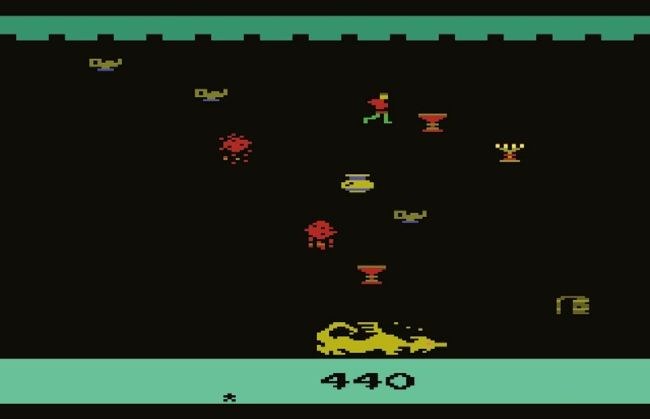
Designed by Bob Smith, Dragonfire is two excellent arcade tests stitched together. First, the drawbridge: you run a gauntlet across the top of the screen while a dragon below breathes fireballs at two heights, ducking and leaping in a rhythm game before rhythm games. Make it across and the castle’s treasure room opens: grab the gold, dodge the dragon stalking the floor — faster every room — and escape through the door before greed ends you. The treasure room’s risk arithmetic is the game’s soul: every extra goblet is points today and death tonight, because the dragon’s speed never resets its mood. Bright, fast, instantly understandable and genuinely tense in its later rooms, Dragonfire is the Imagic catalogue in miniature — a simple idea polished until the simplicity disappears.
5. Moonsweeper

The most ambitious Imagic game on this list, and the one that most feels like a dispatch from an alternate timeline where the 2600 kept evolving. You patrol space in a first-person view, choosing moons to approach; descend, and the game becomes a surface run in your lunar vehicle, blasting towers and obstacles while rescuing stranded miners — who run toward you, endearingly — and ferrying them back to your ship, then blasting off through a ring and back to space. It is Cosmic Ark‘s rescue instinct expanded into a multi-stage mission, with the same humane premise: the shooting serves the saving. The transitions between views, the sense of a job being done across a whole moon, and the steadily mounting danger make it one of the most modern-feeling games of 1983. If a newcomer asks whether the 2600 could do scope, show them this after Solaris.
6. Fathom

Another Fulop design, and the gentlest game here. A caged mermaid — Neptina, in the game’s fiction — waits somewhere in a world split between sea and sky, and you explore both as two creatures: a dolphin below the surface, a seagull above it, switching forms at the waterline. Your task is assembly and discovery — finding the pieces of a trident across an expanding maze of underwater passages and clouds, avoiding tentacles, birds and other hazards — and the game grows, level by level, into a genuinely large exploration puzzle. Fathom refuses the era’s defaults: no shooting to speak of, death replaced by obstruction, beauty as a mechanic. It was less of a commercial hammer than Demon Attack, which is exactly why it belongs high on this list — it shows a young company, and a young medium, experimenting with what a game could be about.
7. Star Voyager

Imagic’s answer to the first-person space combat question, designed by Bob Whitehead — yes, one of the Activision founders, working in the great cross-pollination of the era. Through your cockpit view, enemy ships approach through a starfield; you manage shields, weapons and the strategic choice, via star portals, of when to fight, when to run for repairs, and how to protect the capital ships in your care. It lacks Star Raiders‘ depth and Solaris‘ later polish, but as a 1982 2600 game it is fast, legible and atmospheric, and its energy economy — everything you do costs the ship something — gives combat a longer shadow than pure reflex tests. Two-player options broaden it further. Star Voyager is the catalogue’s workhorse space game: not the flashiest Imagic title, but the one that proved the company could play every position.
8. Subterranea
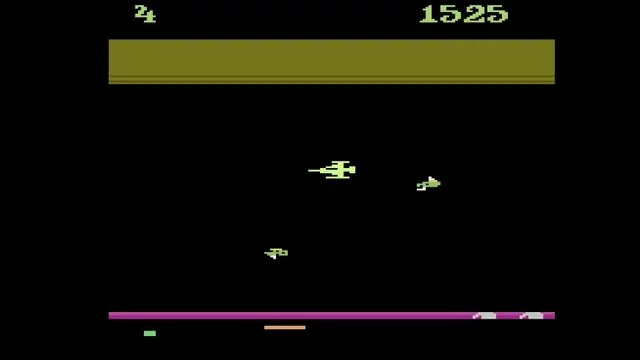
A late Imagic release and a connoisseur’s pick: a horizontal cavern shooter in the spirit of Defender and Choplifter-adjacent rescue, where you pilot a small craft through winding underground passages, blasting the creatures and installations of an alien complex while your fuel and the caverns’ tight geometry conspire against you. The scrolling alone marks it out — smooth lateral movement through a designed space was rare and difficult on the 2600 — and the level structure, descending ever deeper through distinct zones, gives it an adventure’s sense of progress inside a shooter’s frame. It arrived in 1983, into a market already collapsing, and was easy to miss; the retro years have been kind to it, rightly. Seek out the cartridge if you collect, because this is the later Imagic, confident and technically ambitious, in full flow.
9. Laser Gates

Another 1983 deep cut: a side-scrolling shooter set inside a vast computer, where your ship runs a gauntlet of corridors, destructible barriers and the laser gates of the title — energy barriers that open and close on timing, demanding the oldest skill in gaming, patience at speed. Enemies and obstacles vary by zone, your shield is a resource rather than a formality, and the whole production has the clean, slightly austere elegance of a good European shooter arriving years before that style had a name. Laser Gates was overlooked even by the standards of late Imagic releases, partly because the crash buried everything not nailed down in 1983, and it rewards rediscovery: precise, escalating, and built around a single clear idea executed cleanly.
10. Riddle of the Sphinx
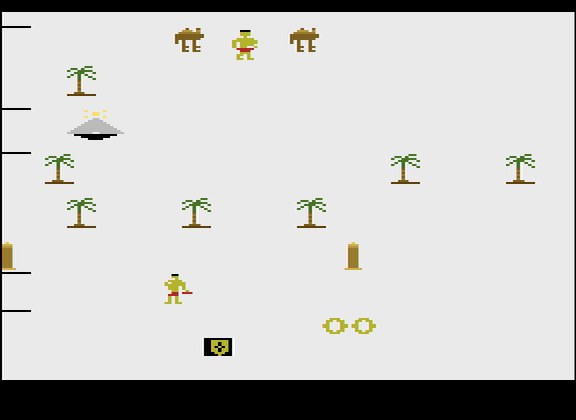
The odd one out, and proudly so: an adventure game, also designed by Bob Smith, in which you cross a desert of scrolling screens as a prince of Egypt, gathering treasures and sacred objects, trading with nomads, fending off scorpions, thieves and the displeasure of gods, on a quest toward the Sphinx. Where Adventure abstracts its world, Riddle tries to flavour its own: anubis-headed figures, temples, oases, a curse system, and offerings that matter. It is slower and stranger than anything else on this list, requires its manual like a good 1982 adventure should, and is all the more valuable for it — proof that Imagic’s ambition was not only technical. A company that made both Demon Attack‘s purity and this sprawling, eccentric quest in the same short life was a company the industry needed. The crash disagreed, and the crash was wrong about a great many things.
A note on the ones that missed the cut
Any Imagic top ten honest about the catalogue has to acknowledge the bench. Quick Step, the trampoline duel in which two creatures bounce and repaint panels while trying to knock each other off the bottom of the screen, is one of the most charming two-player games on the system and was the hardest exclusion here — it loses out only because its charms need a second player to fully ignite. Trick Shot, the company’s pool and trick-shot simulation, showed Imagic attempting genres nobody else on the 2600 would touch, and Shootin’ Gallery brought a light-gun carnival feel to a machine with no light gun, on the strength of timing alone. Fire Fighter, Fulop’s rescue game of ladders, hoses and a burning building, shares Cosmic Ark‘s humane instinct. A weaker publisher’s top ten would have room for all of them; Imagic’s does not, which tells you everything about the density of quality in a catalogue produced in barely three years. Hunt the ten above first — then keep going, because this is a publisher whose second tier beats most companies’ first.
Taken together, these ten make a complete picture: arcade purity, structural invention, beauty, ambition, and one baffling adventure. Imagic’s silver boxes promised games from another, better future for the 2600. For about three years, the company delivered exactly that.