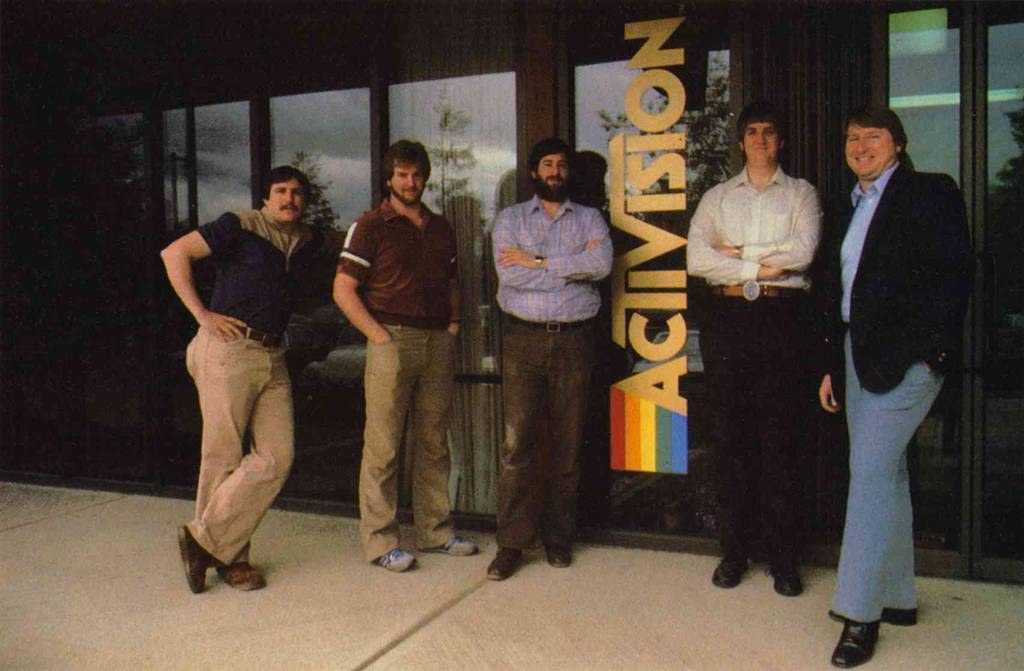
In October 1979, four men who had written some of the best-selling games for the Atari 2600 did something the video game industry had never seen: they left, set up their own company, and started selling games for a machine they did not make. The company was Activision — named, in part, so it would come before Atari in the phone book — and its founders, David Crane, Larry Kaplan, Alan Miller and Bob Whitehead, were joined in the venture by Jim Levy, a music-industry executive who became its president and public face. Between them they invented the third-party game publisher, the idea of the credited game designer, and a good deal of the business the industry still runs on. They also helped trigger a gold rush that ended, four years later, in the great crash. Both halves of that story begin in the same grievance: nobody knew their names.
Programmers as assembly line
Atari in the late 1970s treated its game programmers the way the old film studios had once treated contract players, and worse: as anonymous production staff. Games were designed, programmed, tested and finished usually by one person working alone — Crane, Miller, Whitehead and Kaplan were responsible for a large share of the 2600’s early catalogue — yet the cartridges carried no credits, Atari’s official policy being that naming programmers would let competitors poach them and let the programmers make demands. Salaries bore no relation to the revenue the games generated. The four later calculated that their titles accounted for a very large share of Atari’s cartridge sales in those years, while their pay stayed at ordinary engineering levels and requests for royalties or recognition went nowhere.
The breaking point, by the founders’ oft-told account, was a management memo listing Atari’s best-selling games — intended as information, received as an insult, because it made plain in print how much of the company’s success sat in a handful of uncredited hands. Approaching management through the proper channels got them a warning that they were replaceable — the famous comparison, attributed to Atari president Ray Kassar, was that anyone could design a cartridge, the way anyone might design a towel. Crane and his colleagues drew the opposite conclusion: if the value was in the designers, the designers should be a company.
Levy, and a new kind of record label
Jim Levy’s contribution was translation. Coming from the music business, he instantly understood the model the programmers were groping toward: treat designers like recording artists. Sign talent, credit it prominently, pay royalties, market the names. Activision’s early packaging did exactly that — the designers were pictured and profiled in manuals, their signatures and photographs treated as selling points, and the company ran advertisements celebrating its designers as stars. To a 1980 audience this was startling. To programmers at other companies, watching Crane’s face beam out of magazine ads while they worked anonymously, it was a recruitment poster for an entire movement.
The legal ground was just as novel. Activision was making and selling cartridges that ran on Atari’s patented hardware without Atari’s permission. Atari sued, as everyone expected, and the fight ran for a couple of years before the parties settled, with Activision continuing in business and agreeing to pay a royalty arrangement — the details matter less than the outcome: the principle was established that third parties could publish for a console. Every independent publisher, every licensing programme, every platform royalty since descends from that settlement, including the strict licensing regimes Nintendo would later build, in direct reaction to what happened next, to control exactly the flood Activision had opened.
The gold rush
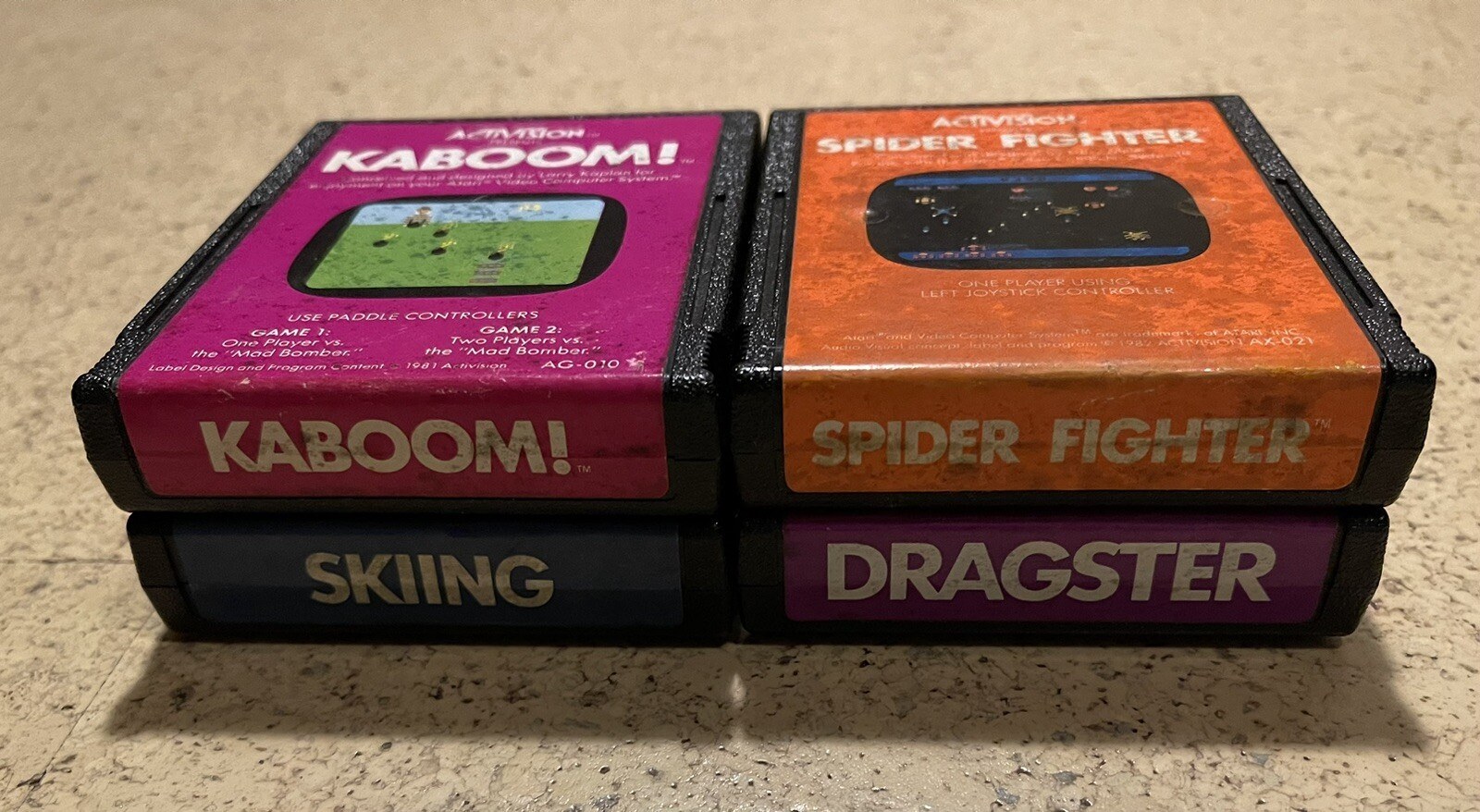
What Activision proved, others rushed to copy — at first, wonderfully. Its own early catalogue is a roll of honour: Kaplan’s Kaboom!, Crane’s Dragster and Freeway, Whitehead’s work, and then the masterpieces of 1982–84 — Pitfall!, River Raid by Carol Shaw, H.E.R.O., Keystone Kapers and more. Activision games had a look: colourful packaging with dramatic painted scenes arcing like a rainbow stripe, manuals with personality, the famous score patches awarded by mail for photographed achievements — an early, physical form of the achievement culture games would later digitise.
Imagic, founded by ex-Atari and ex-Mattel people, followed in 1981 with its own strong catalogue. Then came everyone else. Venture capital, scenting a new entertainment medium, funded dozens of startups; companies with no connection to games — food brands, film studios, a company famous for oatmeal — founded game divisions. Store shelves filled with cartridges of wildly varying quality from publishers with no Activision-grade talent and no discipline about how many copies they manufactured. The founders had shown that a few good designers could build a company; the market misread the lesson as: cartridges print money.

The crash they did not cause but could not escape
When the North American market collapsed in 1983–84, Activision was better placed than most — real designers, real hits, a brand retailers trusted — and it survived by diversifying onto home computers, where the same third-party model had always applied. Most of the imitators died, Imagic among them despite its quality, and the console business in North America had to be rebuilt by Nintendo on opposite principles: lock the platform, control the publishers, ration the releases.
It is tempting, and wrong, to blame the founders for the flood. Their actual innovations point the other way: credit, royalties, quality as brand identity, designers as the product. The crash happened because the industry copied Activision’s existence and ignored Activision’s method. The distinction matters, and the four founders’ later careers underline it — Crane went on to co-found Absolute Entertainment and create A Boy and His Blob; Miller and Whitehead co-founded Accolade; the diaspora of that one 1979 walkout seeded company after company, as if the industry kept re-deriving itself from the same four people.

What the designers actually did differently
It is easy to tell the Activision story as pure business history and miss the craft difference that made the business work. The founders were not merely Atari programmers with better contracts; they were, collectively, unusually systematic designers. Crane thought in algorithms — worlds generated from patterns rather than stored, as Pitfall!‘s jungle would prove. Kaplan had a gift for the pure arcade loop, the thirty-second game that stays interesting for thirty minutes. Miller and Whitehead were prolific across genres in a way that let a young company fill a catalogue without repeating itself. Levy’s artist model worked because the artists were genuinely producing hits at a rate no rival could match through 1982. When the imitators arrived, they copied the box, the rainbow branding style, sometimes even the designer profiles — and shipped games made by whoever could be hired quickly. The market could not tell the difference at a glance, which is precisely the mechanism by which the crash later happened, but players could tell within five minutes of switching on. Activision’s real moat was never the settlement or the packaging. It was that its founding four, and the designers they then attracted — Carol Shaw, Garry Kitchen, Dan Kitchen, John Van Ryzin and others — were better at the work. The founding story matters because it put that talent in a position, for the first time in the medium’s history, to be the company rather than its raw material.
The legacy on the box
Open any modern game and wait for the credits — the hundreds of names scrolling past, the studios that lead with their directors, the designers with public profiles and followings. That culture has roots in records and film, but in games it starts here, with a grievance about a memo and a towel comparison, and four programmers who bet that their names were worth something. The patches are still sewn on jackets. The rainbow-stripe boxes are still collected. And the first lesson of the business remains the one Activision taught it in 1979: the people who make the games are not a cost to be hidden. They are the reason anyone buys the box.