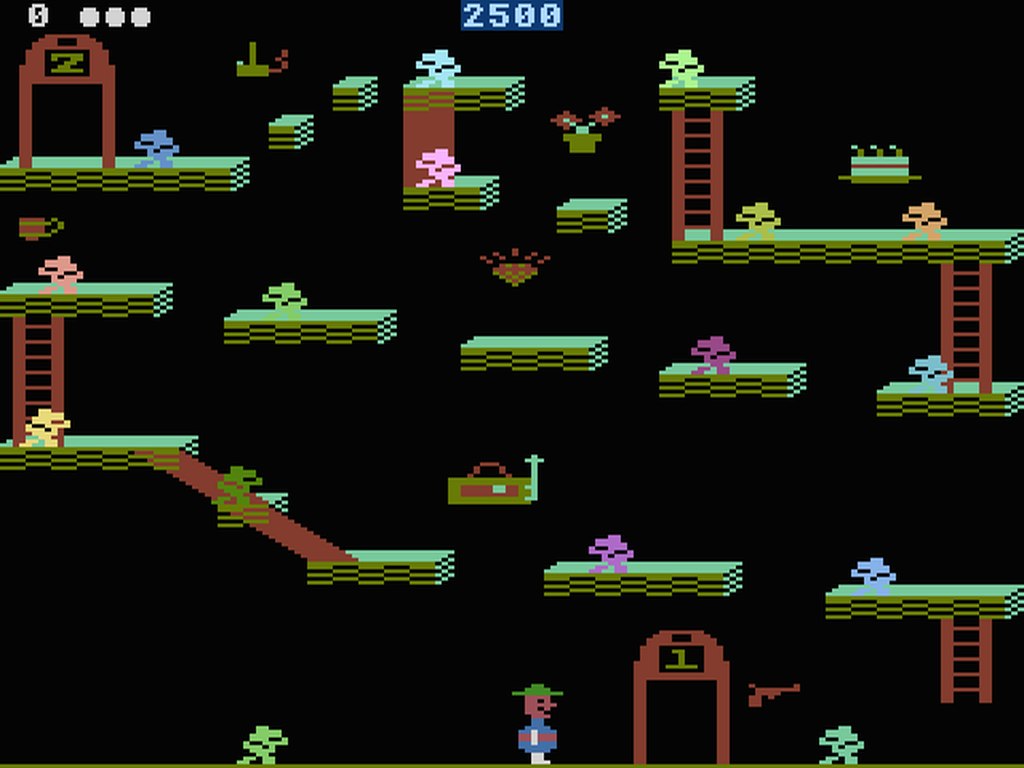
At a glance: Bounty Bob Strikes Back · Atari 400/800 · Big Five Software / Bill Hogue, 1984 · Platform game · Score: 8.5/10
Bill Hogue’s sequel to Miner 2049er did not play safe. Where the 1982 original offered ten stations of immaculate paint-the-floor platforming, Bounty Bob Strikes Back — released by Big Five Software in 1984 — delivers twenty-five, bigger, stranger and harder, wired together with transporters, gravity lifts, suction tubes and a grudge. It is one of the great maximalist sequels: everything the first game did, pushed until the design nearly buckles, and held together by the tightest jump in the business.
Yukon Yohan is still at large, the mine is deeper, and Bob is back in the tunnels with the same sacred task: walk every inch of every platform to claim it, dodge or weaponise the mutant wildlife, and beat a clock that pays out bonus for the bold. The familiar pleasures are intact — the slides, the lifts, the little treats that turn mutants into snacks — but the scale has changed. These are not screens so much as contraptions, spanning multiple levels of machinery that must be ridden, triggered and understood in sequence.
Twenty-five small machines
The new furniture is the story. Suction tubes hoist Bob between floors in a pneumatic whoosh. Gravity lifts carry him on cycles that must be studied like train timetables. Transporters split the mine into numbered nodes, making route-planning a genuine discipline: a floor might need you to paint the far top corner, which is reachable only by a transporter whose other end is guarded, whose guard can only be eaten after a treat that sits above a slide that drops you somewhere you did not want to be. Working out a station is a logic puzzle conducted at jumping speed.

Hogue also loosened the first game’s frame in playful ways. Between the grind, there are diversions — most famously Bob’s encounters with the mine’s birds and the ‘special’ bonus treats — and the presentation leans into the larger canvas with bolder colour and bigger sprites. A code system lets you resume at later stations (a mercy the difficulty makes necessary), and the scoring chases perfectionists with bonuses for clearing floors without losing a Bob.
Hard, and honest about it
Let us be plain: this is one of the hardest platform games of its era, and the difficulty is the point of contention. The original’s purity was its kindness — every death felt like a lesson politely taught. Strikes Back teaches some lessons with a plank. Pixel-tight jumps arrive earlier, mutant patrols overlap nastier, and several stations demand a full rehearsed route before execution is even possible. For players who mastered the original and wanted a sterner exam, this is paradise. For everyone else, the early stations may feel like a locked door.

Strikes Back is the sequel as dare: same Bob, same rule, twenty-five machines built to find out how good you actually got.
Technically the Atari original remains the reference build — this was Big Five’s home turf, and the game uses the machine’s colour and smooth character movement to keep huge multi-level stations legible. The larger areas scroll and shift with a confidence the conversions strain for, and Bob’s jump — that precise, fixed, utterly trustworthy arc — survives the escalation intact. When a sequel’s sins are excess and enthusiasm, the core feel matters most, and the core feel here is still best in class.

Reading the mine
What the sequel understands, and what keeps its difficulty (mostly) on the right side of fair, is that information is a reward. A new station introduces its machinery in survivable doses — a suction tube in a quiet corner, a transporter pair with no patrol across the gap — before the later stations begin combining the furniture into threats. The mine teaches its own alphabet, letter by letter, then starts writing sentences at speed. Deaths late in a station sting precisely because the station has shown you everything you needed; the failure was in the execution, or in the route you chose under time pressure, and the restart is instant enough that analysis flows straight into another attempt.
There is also a generosity in the small print that pure difficulty tourists miss. The game’s scoring celebrates the flawless clear, its resume codes respect the player’s evenings, and its extra-life economy is tuned so that a improving player feels the curve bending in their favour across a session. Strikes Back wants you beaten, but it wants you beaten fairly, at the frontier of your own ability, which moves. That is the difference between a hard game and a cruel one, and it is why Bob’s second expedition still has active devotees setting themselves its hardest stations as weekend projects while a hundred forgotten sequels gather the dust they earned. Big Five made the bigger game. It is the discerning player’s sequel — the one that assumes you finished the first and came back hungry.
A word about the timer
Every station runs against a bonus clock, and the clock is the game’s quiet argument about what mastery means. A safe clear banks lives and modest points; a fast clear — lifts timed to the half-second, mutants dodged by pixels rather than margins, the route drawn as one continuous sentence of jumps — banks the kind of score that fills the table’s top line. The timer never kills you directly; it merely prices your caution, and lets you watch the price tick down in the corner of the screen while you decide whether the gap is makeable. Entire evenings vanish into that decision. The stations are small enough that a failed gamble costs a minute, and fair enough that the gamble always feels chosen rather than forced — the signature of Big Five’s design at its peak, and the reason this sequel, of all the platform’s hard games, is the one its devotees describe with the word ‘fair’ first.
Finding a copy
One practical wrinkle colours this game’s reputation: it was always scarcer than its predecessor. The first Miner was a phenomenon on every platform; Strikes Back arrived in 1985, into a market in turmoil, and sold to the faithful rather than the masses — which is why so many Atari owners know it by reputation and magazine screenshots rather than by hand. Today it is a mid-priced collector’s piece on cartridge and unreasonably reasonable on disk, and it loads instantly from modern storage for the unromantic. Do not let the scarcity fool you into treating it as a footnote. It is the main text, for anyone who finished the first twenty-five thousand points and asked the only question that matters: what else is down there?
Bob, the character
A last, unlikely virtue: charm at scale. Bob himself is a dozen pixels of determination — hat, grin, and a walk cycle with genuine swagger — and the mine’s mutants, for all their menace, have the same hand-made warmth. Big Five’s art never confuses detail with personality, and in a sequel defined by bigger numbers (more stations, more gadgets, more ways to die), the smallest sprite in the building keeps the whole enterprise likeable. You do not grind twenty-five stations for a score. You grind them because Bob, indefatigable, is already waiting at the next lift with his hat on. Some heroes get statues. Bob got a harder mine. He would not have it any other way.
Verdict
Bounty Bob Strikes Back is the connoisseur’s Miner game: less welcoming than the original, deeper for those who stay. Twenty-five inventive stations, a toolbox of transport tricks ahead of their time, and a difficulty curve with genuine teeth. Newcomers should start in 2049er. Graduates report here.