
At a glance: Alley Cat · Atari 400/800 · Synapse Software / Bill Williams, 1983 · Action / mini-game collection · Score: 8.0/10
Bill Williams was one of the Atari 8-bit’s true originals, and Alley Cat — published by Synapse Software in 1983 — is his most beloved postcard. You are Freddy, a tomcat with one ambition: climb the alley’s fences and dustbins, dodge the dogs and the thrown boots, slip through an apartment window, and cause cheerful chaos in the rooms beyond until you reach the love of your life, Felicia, on the top floor. It is a cartoon you play, years before cartoon games were a genre, and its charm has not dimmed in four decades.
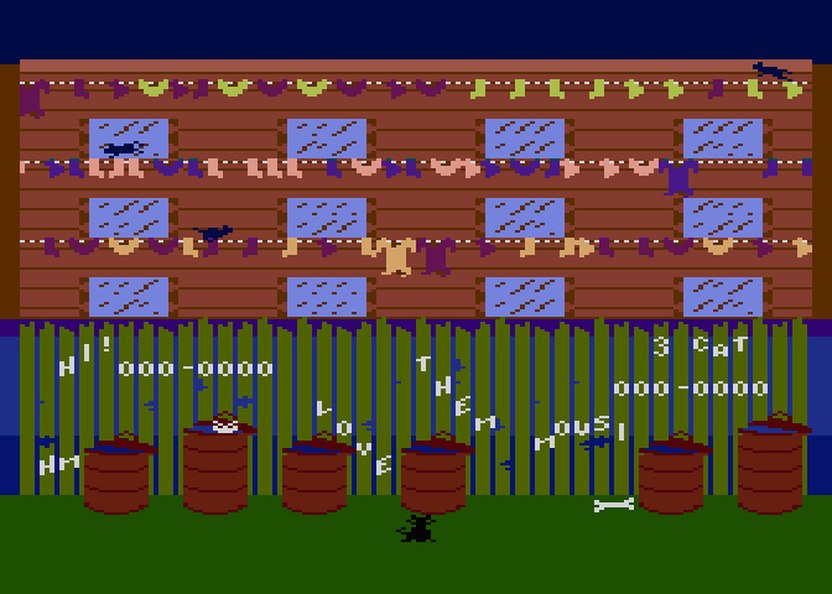
The alley itself is the hub and the first test. Freddy runs the fences, leaps between dustbins, and picks his moment to scale the wall into whichever window happens to be open — each window a different apartment, each apartment a self-contained mini-game with its own rules, enemies and scoring. The other cats are rivals, the dog at the bottom is death, and the whole thing hums with silent-comedy timing.
Five rooms, five little classics
The rooms are where Alley Cat shows its invention. In one, Freddy must knock every plant off a shelf while the room’s dog sleeps and wakes in rhythm. In another he dives into a fishbowl, eating fish while evading an electric eel, and must escape before his air — and the bowl’s owner — run out. There’s a cheese room patrolled by mice whose holes must be raided, a living room of birds in cages and a particularly hostile broom that sweeps Freddy across the floor with Looney Tunes physics, and a library-scale climb up bookcases to reach a sleeping… the set is small, but no two rooms share a mechanic, and each is tuned to the length of a good joke.
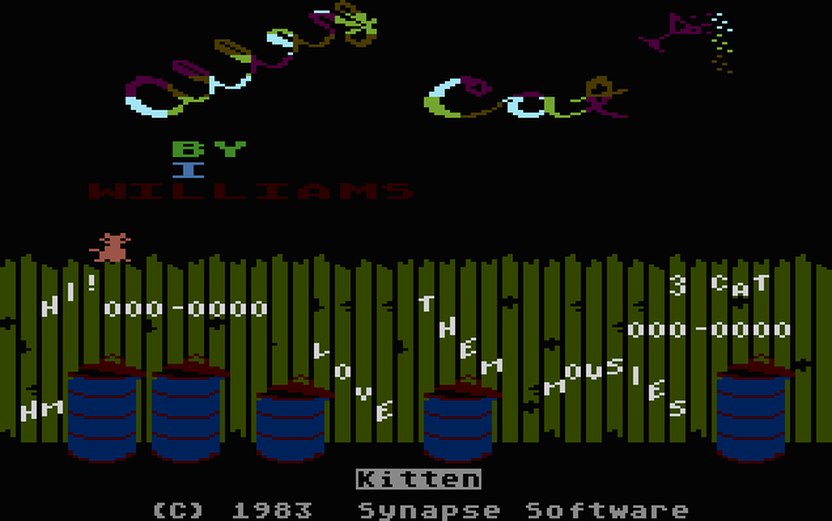
Clear a room and the reward builds towards the finale: a climb up the apartment of love itself, past rivals and obstacles, to reach Felicia — whereupon a cherub’s arrow, a shower of hearts and a litter of bonus kittens conclude the courtship in the most 1983 way imaginable. Then the alley returns, faster and meaner, as these loops should.
The Williams touch
Williams’ fingerprints are the animation and the humour. Freddy stretches, scrambles and flattens with a cartoon elasticity rare in games of any era, and the whole cast — the mop-shaking tenants, the diving Freddy in his fishbowl, the dog’s patient malice — performs rather than merely moves. POKEY provides a jazzy little score and effects with comic timing; the broom’s swish and the window’s clatter are punchlines in sound.

Alley Cat is a silent cartoon that happens to be a video game — every room a gag, every gag a mechanic.
Perspective for modern players: Alley Cat is a score-chaser, its rooms repeat with rising speed, and the controls — while responsive — demand precision on the fence leaps that the early game does not teach gently. The Atari original is the version to play, ahead of the later PC adaptation: it was drawn for this hardware’s colour and the stick’s single button, and the whole performance runs at a whisker’s smoothness the port chases. Synapse’s catalogue is full of sterner masterpieces; this is the one everybody in the room, gamer or not, ends up watching.
Skill dressed as slapstick
It would be a mistake to file Alley Cat as a novelty. Under the whiskers sits a demanding little score-attack game with a connoisseur’s structure. Each room pays out differently, the route between windows is a risk decision — the higher windows promise better rooms and worse falls — and the whole loop accelerates with the pitiless smoothness of the best arcade design. The dog at the alley floor is the game’s quiet masterpiece of pressure: it does not chase you so much as own the ground you must eventually cross, and every descent from a window becomes a small negotiation with its patrol. Losing a life in Alley Cat almost always feels like a joke you told on yourself: the leap you knew was greedy, the window you entered one beat too late.
The extra lives and bonus structure reward exactly the behaviour the rooms teach — variety. A player who farms the easiest apartment plateaus quickly; the score lives in rotating through all five rooms under rising speed, which is why Alley Cat sessions develop that ‘one more circuit’ pull. Williams understood something the mini-game collections of later decades kept forgetting: five mechanics, each fully explored and none overstaying, beat fifty mechanics at half depth.
A Synapse apart
Context flatters it further. Synapse Software’s early catalogue was a parade of stern, systems-heavy classics — Shamus, Necromancer, Fort Apocalypse — and Alley Cat was the same studio proving it could do warmth without losing rigour. Williams himself is one of the platform’s great might-have-beens: a designer of rare visual wit whose career was cut short by illness, and whose Atari work (Necromancer and Alley Cat especially) still feels like it arrived from a more playful future. The Atari original carries a further distinction: it is the version designed for the hardware it runs on, and the later, more famous PC conversion — the one a generation met through shareware — is, ironically, the port. Played here, at full speed, in its native colours, Alley Cat is not a curiosity that anticipated a genre. It is the genre’s founding document, still chasing its own tail across the fence tops.
The sound of the alley
One more credit, rarely given: the audio. The alley’s night is scored with a confidence the PC version’s beeper could only envy — the bin-cat yowls pitched like a small choir, the window scenes announced by their own musical furniture, the piano-romp of the cheese room, and underneath everything the rhythmic clatter of a game that understands itself as slapstick. Synapse’s sound work was a house strength (Necromancer’s forest sings; Shamus hums with menace), and Alley Cat is its most purely joyful expression: a cartoon soundscape in four POKEY voices, timed to the pratfalls. Play it loud, the way it was meant to drown out the homework you were avoiding, and notice how many of the jokes are audio cues — the broom announced before it arrives, the dog’s snore sawtoothing towards a wake-up you can hear coming. Freddy’s world is fair because it is legible, and half its legibility is sound. Few games on any 8-bit machine use their ears this well.
Felicia, and the kittens
It is easy to race past the goal in summary, so state it plainly: Freddy is courting Felicia, who watches from the upper windows, and the courtship’s stakes escalate with every heart delivered, through the arrow gauntlet where Cupid’s other clients take offence, to the final leap and the litter of kittens that announces your dynasty. The whole structure — risk the alley, prove yourself in the rooms, win the girl, face the consequences — is a vaudeville act in three parts, and its economy is unmatched on the system: no cutscenes, no dialogue, one cat, total clarity. Modern games spend millions teaching players their goals. Bill Williams spent a window, a heart and a very patient cat.
Verdict
Alley Cat is small, silly and perfect at what it attempts: a slapstick cartoon built from five excellent mini-games and one unforgettable cat. In a library of space wars and economic simulations, it is the Atari 8-bit’s house party. Bring it out whenever someone claims old games had no personality.