
When this site first wrote about Lizard in November 2014, the game was a promise: a half-built NES platformer, a Kickstarter page, and a Canadian programmer asking strangers for twelve thousand dollars to finish a game for a console Nintendo had discontinued two decades earlier. It is one of the happier stories in homebrew that the promise was kept — but it took more than three years, and the game that finally arrived in February 2018 was stranger, quieter and more interesting than the pitch suggested. This is the full story of how Lizard got made.
The musician who came to the NES sideways
Lizard is the work of Brad Smith, known across the chiptune and homebrew scenes as Rainwarrior. Unusually for an NES developer, Smith never owned the console as a child — he grew up with an Atari ST and a Sega Master System, playing Nintendo games at friends’ houses. His route to the machine ran through music. A trained musician as well as a programmer, he discovered FamiTracker, the software that composes music in the NES’s own sound language, and used it to produce an audacious calling card: a complete NES-style rendition of Pink Floyd’s The Dark Side of the Moon, every track re-orchestrated for the 2A03 chip.
Composing for the hardware raised questions that only the hardware could answer, so Smith bought an NES and a PowerPak flash cartridge and began writing test programs. The machine hooked him. In interviews he has described the NES as a design partner — powerful enough to hold big, explorable worlds of the kind Super Mario Bros. 3 pioneered, yet limited enough that every game made for it bears the marks of its quirks and dark corners. Just as importantly for a solo developer, an NES game’s scope is small enough for one person to actually finish. Lizard would test that assumption thoroughly, but it is where the project began.
November 2014: the Kickstarter
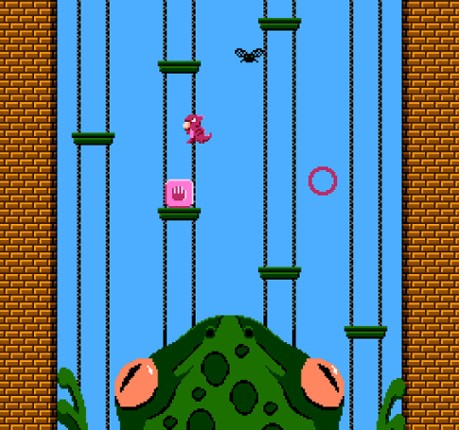
The pitch, when Smith took it to Kickstarter in the autumn of 2014, was disarmingly plain: “a platforming adventure about free exploration while wearing a lizard”. Backers were offered the finished game on NES cartridge — real hardware, manufactured with Infinite NES Lives — alongside PC and Mac versions. The campaign asked for $12,000 and closed at almost $18,500, roughly half as much again as the target. Smith later admitted he had not expected the strength of the response, nor how many of the backers were too young to have grown up with the NES at all.
What the money bought was time, and Lizard needed all of it. Smith documented the development in famously thorough Kickstarter updates — part progress report, part NES programming masterclass — as the game grew through 2015, 2016 and 2017. A playable demo circulated during the campaign itself, so backers were never being asked to fund a mystery: they could already hop around an early corner of the world, meet its creatures and hear the house style of the music. That openness set the tone for everything that followed. Anyone who has followed solo homebrew projects will recognise the pattern: the last ten per cent of a game contains most of the work, and a cartridge release adds manufacturing, testing on real hardware and the thousand small betrayals of a machine that behaves differently from any emulator. The wait stretched years beyond the campaign’s hopeful estimates — but because the updates never stopped, and never hid the problems, the backers’ patience famously held.
A platformer with no weapons and no orders
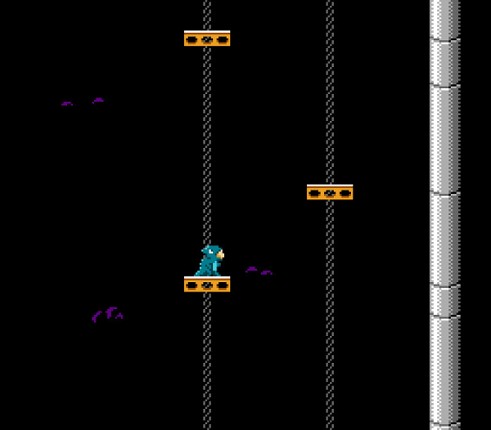
The finished Lizard is an exploration platformer in the truest sense. You play a small human who finds and wears lizards — six of them are scattered across the land, and each is both costume and toolkit. The Lizard of Bounce, for instance, can make huge leaps from a suitable platform; the Lizard of Stone can petrify itself to hide from danger in plain sight. Progress is gated not by keys and locked doors so much as by your own understanding of what each new lizard lets you do, and by your willingness to experiment.
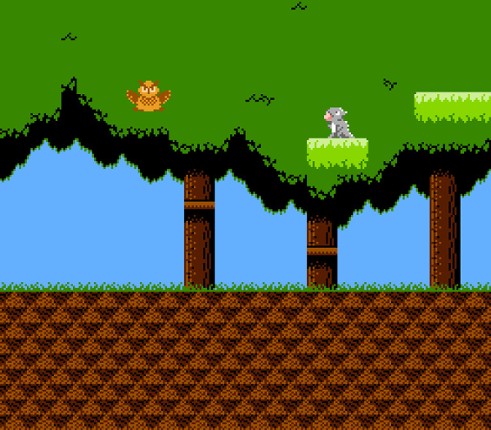
Just as distinctive is what the game refuses to include. There are no guns, no swords, no attacks at all. The challenge is traversal: reading a room, judging a jump, and finding a safe way past creatures and hazards that can hurt you but that you cannot hurt back — Smith has said he wanted the emphasis on moving safely through a dangerous world rather than conquering it. The world itself is one connected, nonlinear place — you can hop to the top of an active volcano, surf down a surging river, swim an underwater lake and climb a snowy mountaintop, meeting creatures friendly and unfriendly, in largely your own order. It is also full of the kind of secrets that reward nosiness: hidden modes, odd jokes and at least one talking moose have been reported by explorers who poked at its edges.
And then there is the sound. Given Smith’s background, it is no shock that the soundtrack — composed, like everything else in the game, by Smith himself — is one of Lizard‘s most praised elements: melodic, unhurried music that treats the NES’s five channels as an ensemble rather than a limitation. In a genre where the solo developer often outsources the audio or treats it as decoration, Lizard‘s score is a reminder that its author came to game-making from the composer’s chair.
Hindsight: the long road to February 2018
Lizard finally launched on 6 February 2018 — on NES cartridge through Infinite NES Lives, fulfilling the Kickstarter’s central promise, and simultaneously for PC, Mac and Linux players. Reviews and player response were warm: the game was praised for its exploration-first design, its atmosphere and its music, with its occasional toughness noted as very much in keeping with the hardware it was built for. Smith himself, looking back, said he was satisfied that the finished game was very much the one he had set out to make, even if its details had been decided gradually along the way.
The afterlife kept going. A DOS version followed in October 2018, built for actual period hardware, and in 2022 Smith even produced an SNES ROM of the game — a homebrew title quietly colonising neighbouring formats, one port at a time. Few Kickstarter projects of the 2014 retro wave can show so clean a ledger: funded modestly, delayed honestly, documented obsessively, and delivered in full, on a real cartridge, for a console that had been officially dead for over twenty years.
That, in the end, is why Lizard still gets talked about in homebrew circles. It is a good game — but it is also a proof of concept for a way of making games: one person, one obsolete machine, a small crowd of believers, and a lizard suit. Choose your lizard carefully.