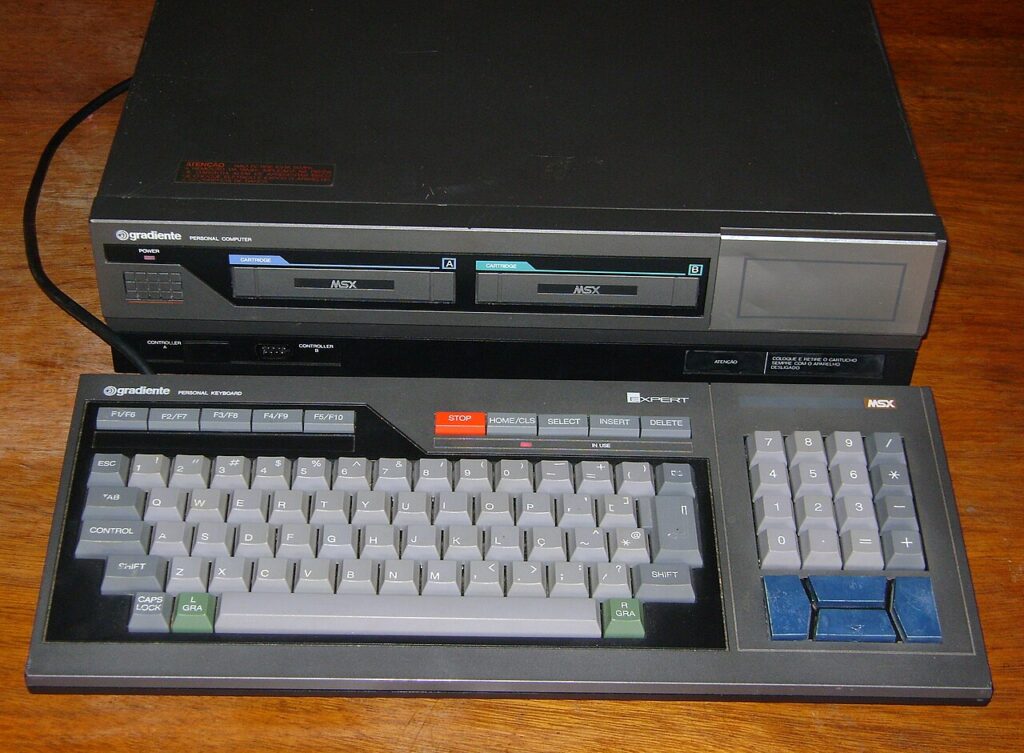
The MSX conquered Japan by design and Europe by enthusiasm. Brazil it conquered by law. In the 1980s, Brazil’s informatics policy restricted computer imports to nurture a domestic industry — and when the MSX standard arrived, Brazilian manufacturers did not merely distribute it. They built it: Brazilian machines, Brazilian software houses, Brazilian magazines, in Portuguese, for one of the largest home-computer markets on earth. The result was the MSX’s third heartland, a parallel history of the standard that played out in São Paulo as surely as in Tokyo or Amsterdam.
Made in Brazil: Expert and HotBit
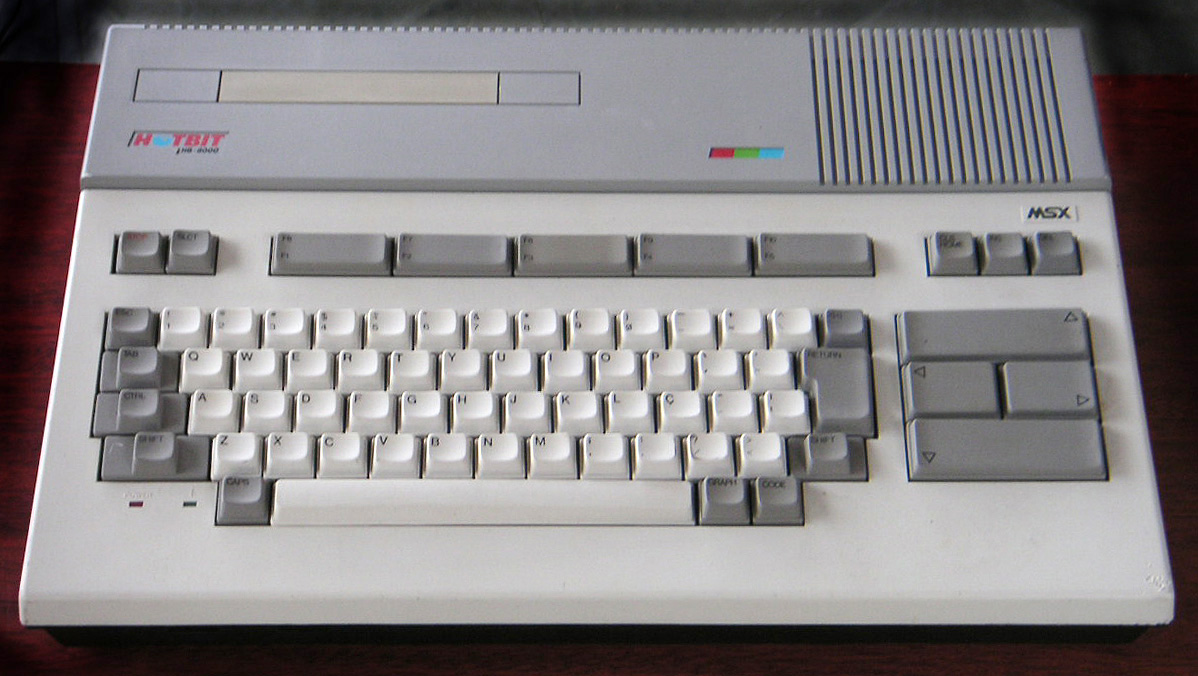
Two machines defined the era. Gradiente’s Expert line, launched in 1985, became the archetypal Brazilian MSX — handsome, sturdy, nationally manufactured, and sold in numbers that made the standard a fixture of Brazilian middle-class homes and schools. Sharp’s HotBit HB-8000 answered with its own design language and a loyal following of its own; the two camps argued their preferences with the fervor other countries reserved for football. Both lines evolved with the standard — MSX2 models followed — and both seeded a generation of Brazilian programmers whose first machine spoke BASIC with a local accent. Import restrictions were meant to protect an industry; accidentally, they also manufactured a culture.
A Software Culture of Its Own
Where hardware is local, software follows. Brazilian publishers translated and released international titles, local developers produced original games and educational software, and a magazine ecosystem — newsstand computing press being a Brazilian institution — carried listings, reviews and scene news to a mass audience. Piracy, the era’s universal shadow, was also rampant, as it was everywhere the standard lived; but alongside it grew something more durable: user groups, fairs, and a repair-and-modify culture built on the necessity of keeping nationally-made machines alive. When the commercial era ended, that culture did not. Brazilian MSX gatherings continued through the decades when the rest of the world had filed the standard under nostalgia.
The Scene That Never Left
Today the Brazilian MSX community is one of the standard’s most productive: hardware projects, new software, translations, and some of the deepest technical documentation in the scene carry Brazilian names, and the country’s collectors have lately become exporters of both machines and knowledge to a world rediscovering the platform. The Expert and the HotBit — once symbols of a closed market — now trade internationally as design classics of the standard’s global family, their Portuguese keyboards telling the whole story at a glance.
Why Brazil Matters to the MSX Story
Tell the MSX story without Brazil and you miss its proof of concept. The standard’s founding idea — one software library, many manufacturers, any country — was tested most completely not in Japan but in South America, where the machines rolled off local lines and the culture grew local roots deep enough to outlive the industry that planted it. A million keyboards later, Brazil’s MSX scene is still typing. The standard was designed in Tokyo and Redmond. In Brazil, it became a native.
The Classrooms of the Standard
Brazil added one chapter to the MSX story that neither Japan nor Europe wrote at the same scale: the classroom. Nationally manufactured machines, priced for institutions as much as for homes, carried the standard into Brazilian schools, where a generation met computing through MSX BASIC, educational software in Portuguese, and the particular pedagogy of a machine that booted to a programming prompt. The alumni effect is still visible — Brazil’s technology culture has MSX in its family tree the way Britain’s has the BBC Micro — and it explains the scene’s durability better than any market statistic. Platforms survive commercially on sales. They survive culturally on the people they raised. Brazil raised a lot of people on the MSX, and those people built the scene that keeps the standard’s southern heartland beating today: the fairs, the hardware projects, the translations flowing outward to the rest of the world, reversing the direction of the 1985 trade winds.
Collecting the Brazilian Chapter
For collectors abroad, the Brazilian machines have become the standard’s exotic frontier — the Expert’s clean industrial design and the HotBit’s unmistakable styling read as design objects now, and complete Brazilian software in Portuguese is a collecting field of its own. A word of care accompanies the enthusiasm: these are forty-year-old machines from a tropical market, and condition varies with biography, so buy with photographs and patience, and lean on the Brazilian community’s own expertise, which is generous and deep. What you are acquiring is not a variant. It is a national chapter of computing history that happens to run the world’s most international software library — the standard’s founding promise, fulfilled in Portuguese.
The Magazines Remember
If you want to feel the Brazilian scene’s scale, find its paper. Brazil’s newsstand computing press of the eighties and nineties — thick, colorful, everywhere — covered the MSX the way other countries’ magazines covered entire industries: hardware reviews of the national machines, type-in listings in Portuguese, game coverage that treated a Gradiente release with the gravity of a national event. Surviving issues trade among collectors today as the scene’s folk archive, and they document something the machines alone cannot: a mass readership, the sense of a whole country computing in public. Japan gave the MSX its library and Europe gave it its fairs. Brazil gave it a popular press, a school system, and a Portuguese accent — and kept all three long after the multinationals went home. In the standard’s global family album, that is not a footnote. It is a chapter with its own cover.
There is an alternate history worth one paragraph, because Brazilians in the scene sometimes tell it themselves: had the import rules never existed, Brazil would have been one more import market in the standard’s story — a line in a sales report. Instead the restrictions forced the creation of factories, magazines, classrooms and expertise, and those proved more durable than any market. The Expert and the HotBit are not Brazilian copies of a Japanese idea. They are the proof that the idea was bigger than its inventors — a standard genuinely standard enough to become, in the right soil, a national industry. When the MSX’s historians write the platform’s next forty years, the Brazilian chapter will not be an appendix. It will be one of the reasons there is a next forty years to write.
Somewhere in Brazil tonight, an Expert is being switched on by somebody who learned to type on one, or by that person’s grandchild, learning the same BASIC on the same prompt. Platforms dream of endings like that and almost never get them. The MSX, in its third heartland, did not end at all. It just became Brazilian — and carried on.
It is the oldest lesson in the standard’s long history, taught in three languages on three continents: give people a machine they can truly own — build, program, repair, gather around — and they will keep it alive longer than any corporation’s product plan. Brazil’s MSX scene is simply the lesson’s largest graduating class. Aula dismissed; the machines stay on.
Obrigado, Brasil — from everyone who ever booted an MSX anywhere. The standard was a world project, and no country proved it like yours.