

Somewhere in your city there is a street that only exists in video games. That, more or less, is the premise of the Game Map — a large-format print by the British design studio Dorothy that rebuilds a corner of Tokyo as an imaginary city whose every street, district and landmark is a video game reference. When this site first brightened up its games room with the Game Map in November 2014, it was a shopping tip: a beautiful print, £25, treat yourself. A decade later the print rewards a slower look, because Dorothy’s map belongs to a much older and stranger tradition than games-room décor — the tradition of maps that invent the places they claim to describe, and of games themselves, which have always been maps you can walk around in.

The Game Map: a city you already know by heart
The Game Map plots more than 500 references across its fictional streets. The city is organised the way games organise our memories: by genre. There’s a beat-’em-up quarter where the streets take a pounding, a survival-horror district anchored by the Umbrella Corporation, and — the detail everyone remembers — Super Mario Land, with Yoshi’s Island sitting just off the pier. To read the map is to take a walking tour of your own gaming life: the street names are the games, and the neighbourhoods are the moods those games left behind.
Dorothy knew exactly what they were doing. The studio had already broken through with the Song Map, which rebuilt a city from song titles, and went on to apply the same trick to film, books and football. The Game Map, released in 2014 — it drew coverage from the likes of Fast Company — was the games entry in the series, litho-printed at 60 × 80 cm in seven colours, three of them metallics, because a map about golden-age gaming should literally shine. The open edition sold for £25 (it was listed at $40 in the US); a signed, limited edition went for £100.
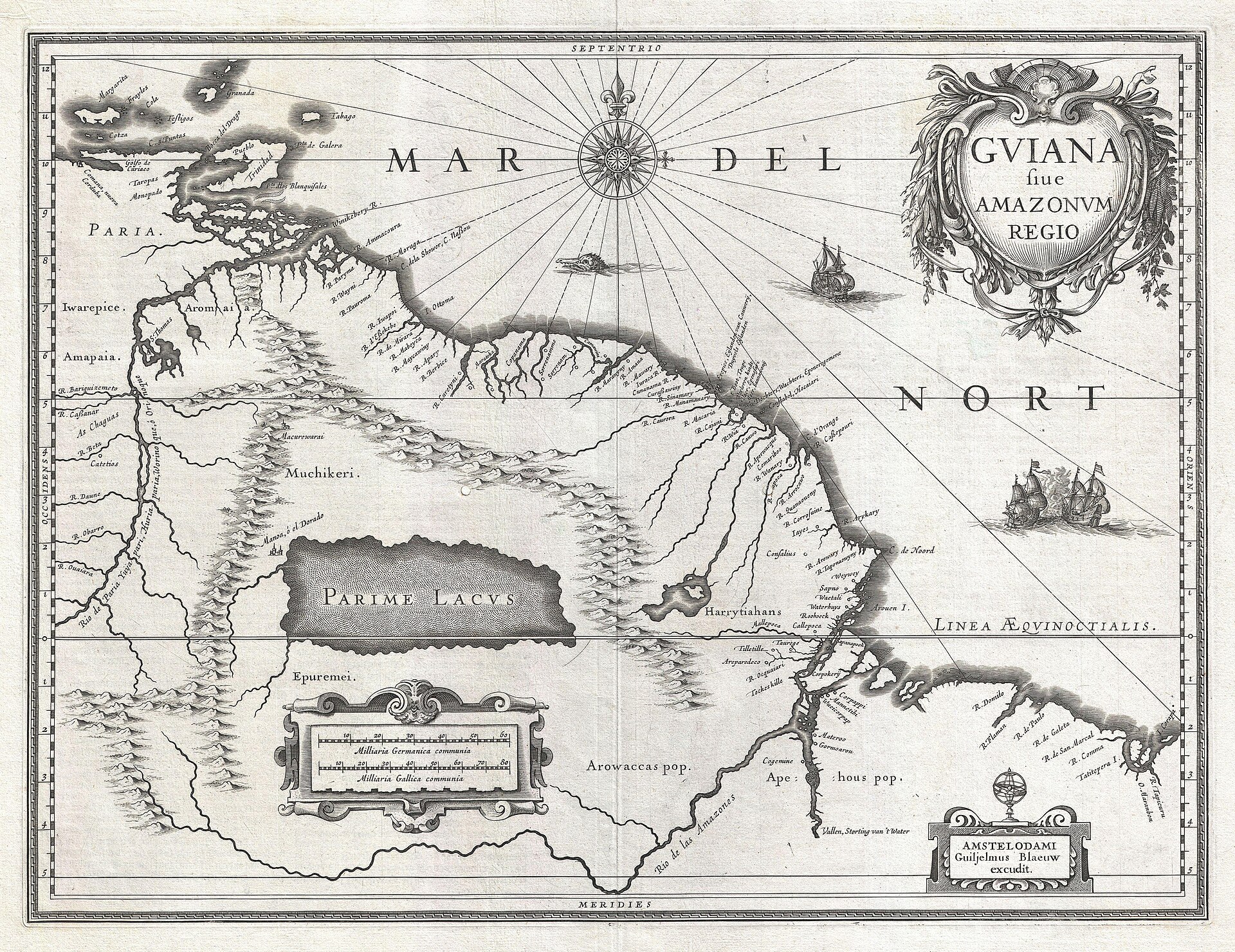
In the company of El Dorado
The knowing joke under the Game Map is that cartography has form here. Blaeu’s beautiful 1635 map of Guiana gives pride of place to Parime Lacus — the great lake of El Dorado, the golden city that bankrupted expeditions and never existed at all. For centuries, maps were where reliable geography and hopeful invention shared a sheet of paper without anyone marking the join. Dorothy’s map reverses the trick with intent: everything on it is invented, yet everything on it is recognisable, and the recognition is the geography. You navigate it by memory, not by compass.
It also anticipated the direction games themselves were heading. The modern open world is a Dorothy map made playable — a city whose districts are genres, whose landmarks are references, whose street plan exists to be read as much as travelled. The print asked, in 2014, why we love those places enough to hang them on a wall. The games industry has spent the decade since answering with bigger and bigger cities; the print still answers with a single sheet and metallic ink.
How to read it
Half the pleasure is structural. Dorothy’s maps divide their cities into districts that work like game genres made urban: combat in one quarter, horror in another, platforming innocence down by the water. Woven through are the landmarks — the corporations, castles and corporations-as-castles of gaming lore, given addresses and made into neighbours. Umbrella Corporation as a local landmark is a joke with a thesis inside it: these fictional institutions occupy real estate in players’ heads, so why not draw the deeds? The map keeps revealing new adjacencies the longer it hangs — a street you crossed a hundred times in games, suddenly crossing another — which is why owners describe it less as a poster and more as a slow puzzle the room keeps solving.
It helps that the thing is made properly: litho print, seven colours, metallic inks that catch the light like a foil trading card. Dorothy’s maps were never clip-art exercises; the studio’s whole range — music, film, books, football — is built on research deep enough that fans of each subject audit the references, and the Game Map’s 500-plus sightings were compiled to survive exactly that audit.
Why games make good maps
There’s a reason the conceit works so well for video games specifically, better even than for songs or films. Games are already spatial. Players don’t just watch places in games; they learn them — the shortcut in the racing game, the safe room in the survival horror, the exact hill where the sniper sits. Ask a player to draw their favourite game world from memory and they’ll produce, without thinking, a map: rough, personal, and navigable. Dorothy’s insight was to take thousands of those private maps and merge them into one shared city, drawn to professional cartographic standards. The streets aren’t arranged randomly or alphabetically; they’re arranged by affinity — the games that feel related live near each other, the way they do in memory.
That is also why the print keeps working as the medium ages. New districts keep suggesting themselves — the soulslike quarter would be a grim place to rent — and the map becomes a period piece in the best sense: a fixed chart of what gaming meant at the moment it was drawn, the way Blaeu’s chart fixes what the world meant in 1635, El Dorado and all.
Dorothy, and the map as house style
The Game Map wasn’t a one-off experiment for its makers. Dorothy built the studio around a single elegant idea — take a beloved subject and re-draw it as a place — and applied it with a cartographer’s rigour across music, film, literature and sport before turning to games. Each map in the range is researched like a reference work and finished like a piece of art, which is why they keep escaping the games room and the study: you’ll find Dorothy maps in design studios, university departments and, in the Song Map’s case, referenced far beyond the print world. The studio’s range has continued to grow since 2014, but the Game Map occupies a special seat in the catalogue. Music and film fans are used to being taken seriously as cultures; in 2014, gamers were still being offered posters as an afterthought. Dorothy offered them an atlas.
Still the best games-room upgrade
The original post’s advice stands, with interest. Of all the merchandise a retro fan can buy, the Game Map remains the rare piece that rewards knowledge — every visitor who spots their game on your wall has found their street in a city built from the medium itself. And the studio is still at it: Dorothy’s catalogue of cultural maps has kept growing, but the Game Map is the one that belongs here. £25 for a city you’ll never finish exploring is the best exchange rate in gaming.
One last thought for the games-room wall: hang it at reading distance. This is not a poster to be glanced at from the sofa; it’s a text, and it behaves like one — rewarding the second look, the tenth look, the look through a magnifying glass that its makers plainly anticipated. Somewhere on it is the first game you ever loved, drawn as a street in a city that never existed. There are worse ways to remember where you came from.