
At a glance: Bruce Lee · Atari 400/800 · Datasoft / Ron J. Fortier, 1984 · Platform action / beat-’em-up · Score: 8.5/10
Licensed games were supposed to be bad. Bruce Lee — designed by Ron J. Fortier for Datasoft and released in 1984, with the Atari 8-bit among its original platforms — is the counterexample that has been embarrassing tie-ins ever since. It takes the great man’s image, builds a tight little platform adventure around a simple, brilliant idea, and lands so cleanly that players who have never seen a Bruce Lee film still rank it among the best games on the machine.
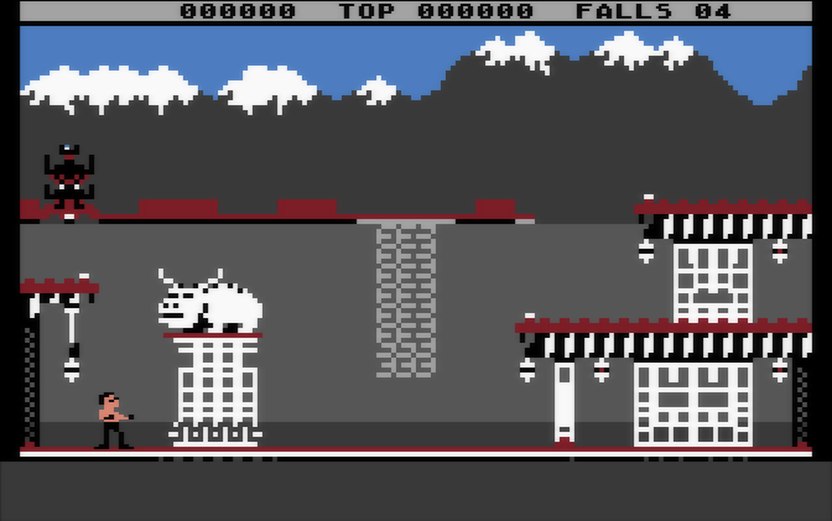
The idea is the lanterns. Bruce has infiltrated the fortress of an evil wizard to steal the secret of immortality, and the wizard’s stronghold is a chain of single-screen chambers, each hung with lanterns that must all be collected to unlock the way onward. Collecting is pure platform craft — climb the vines, ride the moving platforms, time the bursts of steam and the crackling electric floors — except that Bruce is not alone in the fortress, and the company is the game’s genius.
Two enemies, eternal war
The Black Ninja and the Green Yamo — a sumo mountain of a man in green — hunt Bruce through every screen, forever. They cannot be permanently killed; knock them down with a flying kick and they will be back in the next chamber, or the same one if you dawdle. What they can be is managed: drawn away, ducked under, dropped past, kicked off ledges into pits. The result is a platform game with a permanent pressure system. Every route through a chamber is a negotiation between the lanterns you need, the hazards the room owns and two very personal problems who keep arriving to renegotiate.

Bruce himself controls like a dream by 1984 standards: run, climb, duck, jump, and two attacks — a standing kick and the glorious flying kick, which doubles as the game’s best movement tool, clearing gaps and enemies in one committed arc. The animation sells it; Bruce has a looseness, a coiled quality, that the chunkier sprites of rival games lack. Chambers mix their challenges intelligently — precision climbing here, a gauntlet of floor hazards there, a screen where the whole puzzle is crossing open ground between two converging hunters — and the difficulty builds towards a final confrontation with the wizard himself, all fireballs and menace, at the treasure’s heart.
Ahead of its time in multiplayer, too
Buried in the options is one of the era’s great multiplayer inventions: a second player can take control of the Green Yamo. In 1984, letting a friend play the villain — actively hunting the hero through the campaign, screen by screen — was close to unheard of, and it transforms the game into a duel of sabotage and counter-sabotage that anticipates asymmetric multiplayer by decades. Even in solo play, alternating control modes and the ever-present second hunter give Bruce Lee a replay value its modest chamber count shouldn’t support.

Bruce Lee’s enemies are not obstacles. They are opponents — and in two-player mode, one of them is your best friend.
The Atari original is the version connoisseurs argue for: fast, responsive and colourful, with POKEY providing spare, effective punctuation of sound — the swish of the kick, the thud of a landing, the crackle of the electric floors. If there is a flaw, it is length: a practised player can finish Bruce Lee in well under an hour, and the chamber designs, excellent as they are, do not change between runs. The game’s answer is score, lives and the pursuit of a cleaner run — arcade values again — plus that multiplayer mode, which has no natural end at all.
Design that respects the player
What separates Bruce Lee from the era’s licensed crowd is how completely its design serves the fantasy without leaning on it. There is no digitised face, no film footage, nothing but a small yellow figure — yet everyone who plays it calls that figure Bruce, because the game gives you his tools: speed, elevation, the kick that arrives from nowhere. The fortress is fair in the way that builds legends. Hazards run on readable cycles; the electric floors crackle their warning; the hunters telegraph their approach by entering at the screen’s edge with intent you can read. Deaths are tuition, and the tuition is cheap because returning to a chamber costs seconds, not lives’ worth of progress.
The chamber design deserves the compliment usually reserved for later classics: each room is a sentence in a consistent grammar. Early chambers teach the lantern logic in safety; middle chambers stack the grammar — collect while climbing, collect while hunted, collect across moving platforms while both hunters and the room itself object; the final approach to the wizard compresses everything into a gauntlet that still, forty years on, raises the pulse. That the whole campaign fits in an evening is a feature of its arcade honesty. Bruce Lee does not pad. It presents twenty-odd rooms of escalating argument and then it ends, leaving the score, the second-player mode and your own standards to supply the replay value — which they do, indefinitely.
The Atari version in the family
Bruce Lee was converted widely, and the conversions are a small museum of 8-bit character: the Commodore 64 version is handsome, the Spectrum version is a miracle of its constraints, the BBC and Amstrad versions have their defenders. The Atari original remains the connoisseur’s pick for the oldest of reasons — it is the fastest and the crispest where it counts, in the kick’s timing and the hunters’ pursuit, and the colour of the fortress has a jewel quality the others translate rather than reproduce. It is also, not incidentally, the version from the game’s home stable: Datasoft was an Atari-first house, and Bruce Lee was built by people who knew exactly what the machine’s players expected a Datasoft game to feel like. It feels like this.
The two-player wrinkle
One feature of the Atari original deserves special notice, because it was quietly radical: a second player can take control of the Green Yamo. In 1984, handing a human the villain was almost unheard of — the CPU’s pursuer becomes a friend or a sibling with a grudge, and the fortress run turns into theatre, the chases choreographed by someone who knows your habits and repositions to ruin them. Datasoft shipped a genuinely social idea inside a licensed single-player game and, characteristically, barely advertised it. If you play Bruce Lee today on original hardware, play it twice: once against the machine, as designed, and once against a person, as discovered. The second version might be the better game — and it explains why this one, of all the era’s licensed platformers, is the one people still set up at parties.
Why it never left the shelf
Some games survive on reputation; Bruce Lee survives on utility. It is the disk that goes in when a newcomer asks what the Atari was like, the cartridge a collector reaches for when the evening needs one perfect hour, the licensed game cited whenever someone claims licences are inherently cynical. Brian Rice’s design made the licence earn its keep — Lee’s screen presence translated into verbs (run, leap, strike, endure) rather than portraits — and the Atari edition’s crispness turned those verbs into reflexes a generation of players still carries in their hands. Games this fondly remembered usually disappoint on replay. This one does the opposite: it is better than the memory, because the memory forgets how tight it is.
Verdict
Bruce Lee is the licensed game as it should be: a strong original design that happens to wear a famous face, built around hunters who never stop hunting. On the Atari 8-bit it plays at its best — quick, precise and endlessly replayable, especially with a second player on the green side of the war. Enter the fortress. Mind the Yamo.