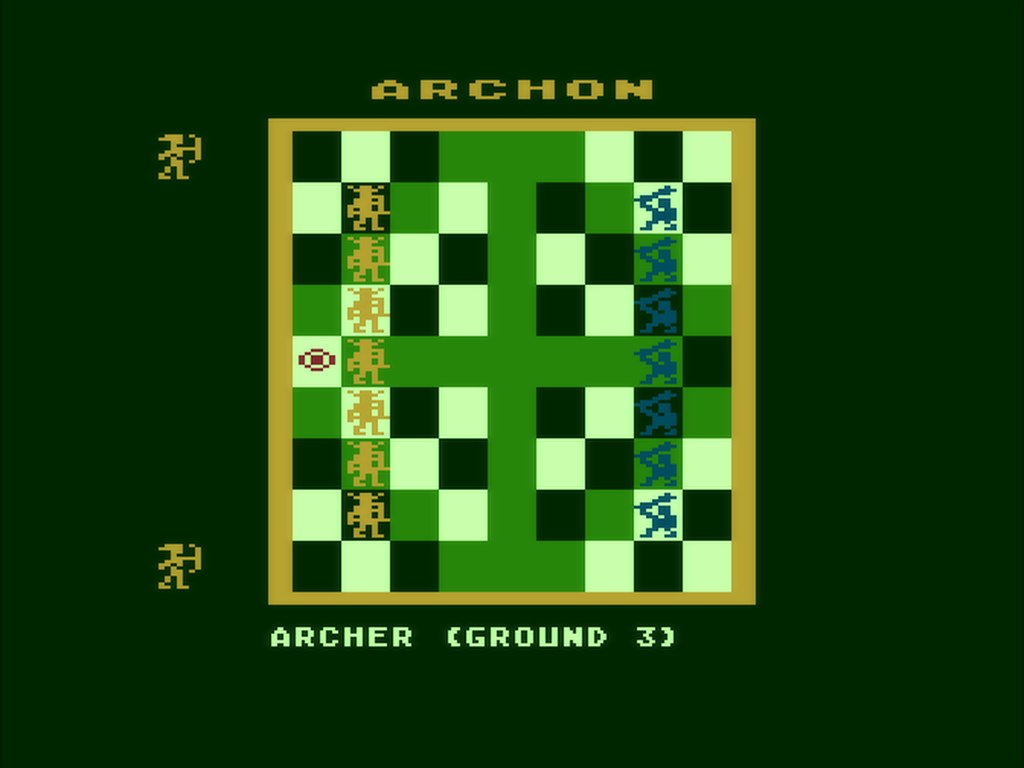
At a glance: Archon: The Light and the Dark · Atari 400/800 · Free Fall Associates / Electronic Arts, 1983 · Strategy / action battle · Score: 9.0/10
Chess, but the pieces fight back. That nine-word pitch — from Jon Freeman, Anne Westfall and Paul Reiche III at Free Fall Associates, published by Electronic Arts in 1983 — produced one of the most imitated games of the 8-bit era. Archon takes the board game’s structure of unequal armies manoeuvring for position and replaces ‘capture’ with a real-time duel: when your phoenix lands on their troll, the board falls away and the two creatures fight it out, live, with your reflexes as the tiebreaker. Strategy decides where the battles happen. Skill decides who walks away from them.
The armies are the game’s first work of imagination. Light fields a wizard, unicorns, djinns, golems, archers, valkyries and a phoenix; Dark answers with a sorceress, a dragon, a shapeshifter, trolls, goblins, banshees and a basilisk. Almost every piece is a distinct fighter with its own speed, health, weapon and personality: the golem hurls boulders in slow, devastating arcs; the banshee’s scream is a widening ring of death; the unicorn is a glass rapier; the dragon is a siege engine with wings. There are no generic pawns here — even the humble goblin and knight have matchups they win.
The board is a weapon
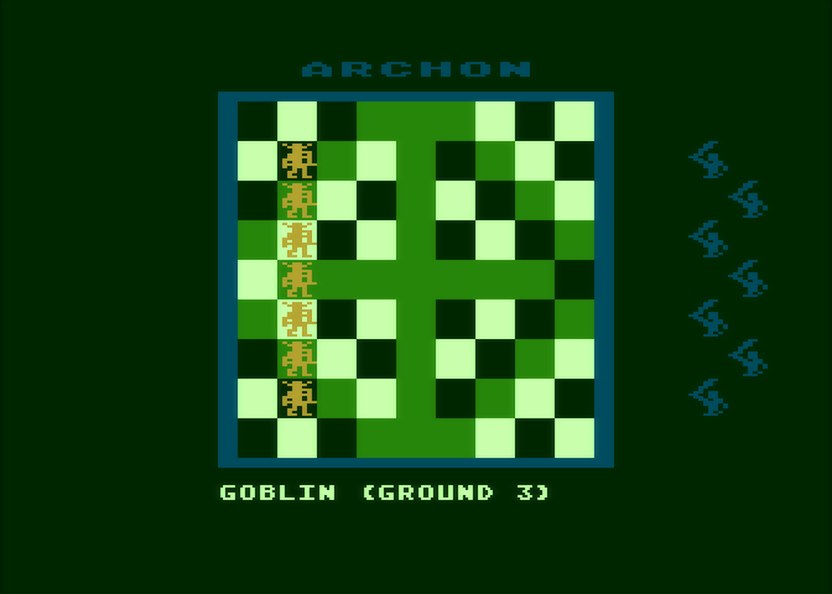
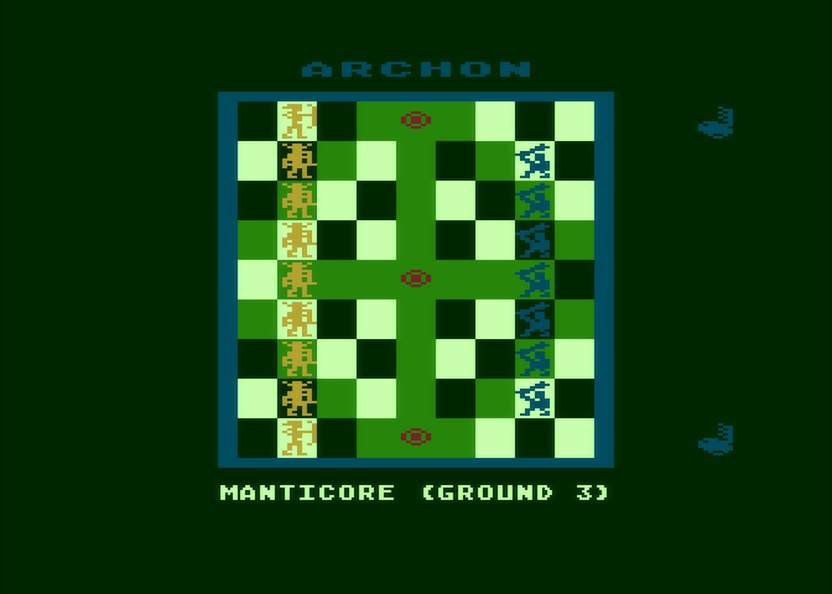
Between duels, Archon is a real strategy game, and a sly one. The board’s squares cycle through shades of light and dark with the turning ‘luminosity’ cycle, and a square’s colour is armour: light pieces standing on light squares are measurably harder to kill. Territory matters in the most literal way — hold the five power points and your side regenerates — and the spellcasters change everything. The wizard and sorceress hold seven spells each, from teleport and heal to the dreaded summon elemental and revive, each usable once per game. A spell is a banked miracle, and Archon’s endgames turn on when the miracles get spent.
The shapeshifter deserves its own paragraph, as it gets in most discussions of this game: it becomes whatever it fights, mirroring its opponent exactly, so its duels are pure mirror matches decided by nerve alone — unless the square’s colour tilts the health bar, a detail that turns board position into mind games. The dragon, similarly, is checked not by any single piece but by the whole system: it is slow to move on the board, ruinous in combat, and vulnerable to being swarmed, healed against and out-positioned. Archon’s balance is not perfect — ask anyone who has faced a well-played phoenix — but its asymmetries interlock with a sophistication 1983 had no right to expect.
Then the board falls away
The combat arenas are obstacle-strewn single screens, the obstacles themselves cycling in and out of solidity with the same luminosity rhythm, so cover is a temporary resource. Fights are short, violent and swingy: a superior piece can lose to a hot hand, an inferior one can steal a famous win, and that variance is exactly what makes the board game breathe. Two human players, one board, one shared screen of shouting — Archon in 1983 was a multiplayer event, and the Atari’s joysticks make the duels as crisp as they ever were. Against the computer you get a competent, occasionally ruthless opponent who understands spells better than most beginners do.
Archon asked what chess would be if the rook could lose — and invented a genre in the answer.
Presentation is EA’s early ‘album cover’ era at its best: clean board graphics, creatures with real silhouette, evocative chimes and battle drums from POKEY, and that famous title treatment. The Atari original is the reference version — designed here first, converted elsewhere afterwards — and it plays with an assurance the ports chase. Modern eyes should forgive the single-screen arenas their simplicity; the depth was never in the scenery.
The EA album era
Archon was one of Electronic Arts’ founding releases, and it shows the young company’s whole thesis: games as authored works, sold like albums, by designers whose names were on the sleeve. Free Fall Associates — Jon Freeman and Anne Westfall’s studio, with Paul Reiche III’s creature designs giving the armies their mythic flavour — had been building strategy games since the hobbyist era, and Archon is where their two loves, the board and the arcade, finally merged. The production values announce the ambition: the armies are not fantasy wallpaper but a designed ecology of counters, and the manual treats the player as a student of a real system, with bestiary entries that read like a field guide to a war you are about to fight.
Its influence is easiest to see in the games that copied it openly — the battle-chess tradition, the arena-fight subgenre, every strategy game since that resolves contact with a duel — but the deeper legacy is conceptual. Archon proved in 1983 that asymmetry could be balanced by a system rather than by mirroring, that a spell could be a resource you spend once and regret forever, and that a board game’s soul could survive having its captures settled by reflexes without becoming either a worse board game or a shallower action game. It is a first draft of a dozen modern genres, written in one pass, on a computer with 48K of memory, by a team that simply assumed players were smart. They were right. They usually are, when designers assume it.
How to learn it in 2026
Approach Archon the way its designers assumed you would: as a student. Play the practice battles from the options until the unicorn’s lance timing and the golem’s boulder arc are habits. Read the manual’s bestiary — it is genuinely well written, and its hints (the banshee’s scream ignores barriers; the djinni is the board’s fastest traveller) are load-bearing. Then face the computer at its strongest and accept the education. The Atari version’s AI is a demanding tutor but a legible one: it plays the odds, husbands its spells, and punishes a careless icon hunt with the patience of a chess engine. Your first victory will feel earned in a way few 1983 games can still deliver, because Archon does not let you win — it lets you become good enough that winning is the outcome. There is a difference, and this game is where a generation learned it.
The sequel question
Archon II: Adept (1984) extended the war to elemental planes with summonable creatures and a spell economy all its own, and it has its defenders — this page among them, on a good day — but it traded the original’s perfect legibility for depth, and history has voted for the first game. That is the correct vote. The original Archon’s balance of powers, its arena variety and its single-screen honesty make it the one to keep beside the machine. If Adept tempts you afterwards, treat it as a graduate seminar: fascinating, demanding, and best attempted by players the first game has already humbled. The board, as ever, is waiting — and the phoenix, as ever, is banned from the power points in spirit if not in rules.
Verdict
Archon is one of the foundational games of the entire medium: the strategy-action hybrid, the asymmetric roster, the spell as a one-time resource — all present, all working, in 1983. Play it against a friend and it is not a history lesson at all. It is an argument, conducted in fireballs.