
At a glance: BurgerTime · ColecoVision · Coleco/Data East, 1984 · Platform maze · This review covers the ColecoVision version specifically · Score: 8.0/10
Peter Pepper has the worst job in arcade history: he is a chef who must assemble enormous hamburgers by walking across their ingredients — bun, lettuce, patty, bun — sending each layer crashing down to the plate below, while the ingredients’ union representatives, Mr. Hot Dog, Mr. Pickle and Mr. Egg, chase him around the scaffolding with murder in mind. Data East’s BurgerTime was one of the great single-screen platformers of 1982, and it reached the ColecoVision in 1984 in a conversion handled as part of the console’s late wave. This is a review of that ColecoVision version on its own terms — the port ColecoVision owners actually played.
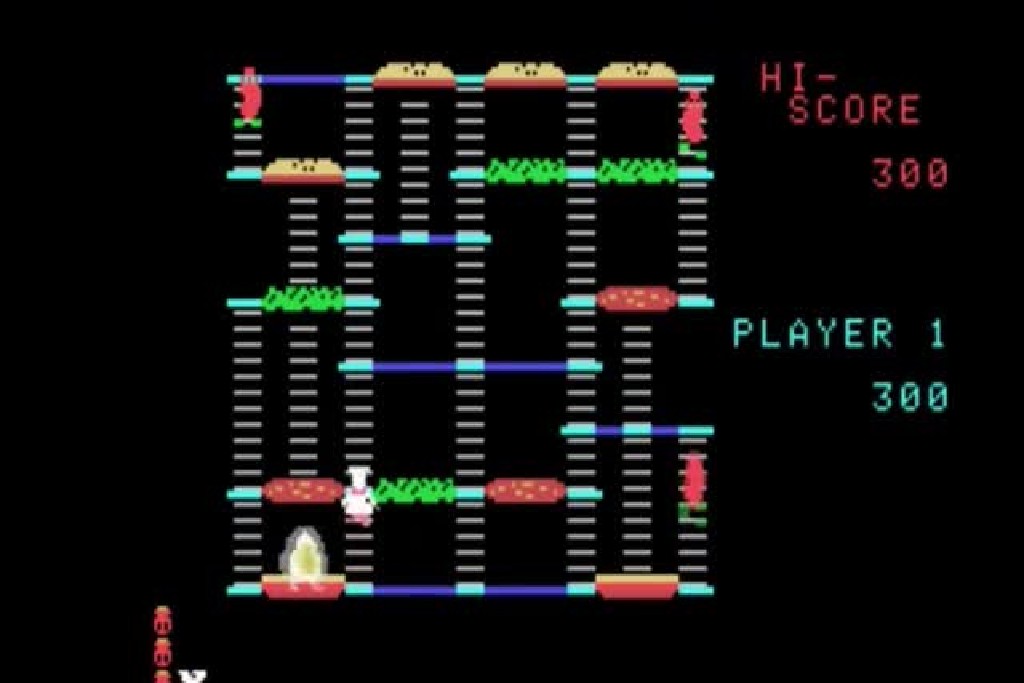
The core loop is deliciously literal. Each screen is a scaffold of platforms and ladders stacked above serving plates. Walk Peter across an ingredient and that section drops one level; drop it onto the level below’s ingredient and that drops too, so a well-routed chef builds burgers in cascading layers. Drop a layer with an enemy standing on it and they ride it down for bonus points — or better, drop it on them. Your only defence otherwise is pepper: a few precious shakes, dispensed with a button, that freeze an enemy in a sneezing standstill for a few seconds. Bonus ice creams, fries and coffee appear for points and, in the coffee’s case, a priceless extra pepper.
The ColecoVision kitchen
The ColecoVision port keeps the full recipe: the scaffold layouts, the three enemy groceries with their distinct pursuit behaviour, the pepper economy, the bonus items, and the escalating kitchens of the later screens. The system’s hardware suits the game’s look — bold, flat colour and chunky sprites — and Peter and his nemeses are rendered with their arcade personalities intact: you always know which grocery is hunting you and how much pepper stands between you and disaster. The kitchens grow more vertical and devious as the game progresses, ladders become commitments, and the enemies’ speed turns burger-building into a genuine route-planning discipline.

Control is where the ColecoVision version asks its one toll. BurgerTime is a game of precise ladder junctions — run past a ladder and you’ll climb it; hesitate at one and the Pickle collects you — and the console’s short stick rewards deliberate, early inputs. Regular players adapt within a few screens, and the game is honest about its demands: everything that kills you does so in plain sight, at walking pace, wearing a hot dog costume. The difficulty curve is classic arcade — fair, then firm, then a full dinner rush — and the extra-pepper bonuses are placed exactly where a planner would pray for them.
One port among many, judged alone
BurgerTime was ported widely in its day — most famously to a rival console of the same era, in a version with its own following — and the two home editions have been compared ever since. The ColecoVision version’s case rests on its fidelity and feel: the layout of the kitchens, the behaviour of the enemies and the rhythm of the drops will be immediately familiar to arcade players, presented in the cleaner, more colourful style this hardware does well. As part of the system’s library it fills the single-screen platformer slot with a licensed classic, arriving in the same late period as Montezuma’s Revenge and Spy Hunter — a reminder that the ColecoVision’s final wave was considerably stronger than its abrupt end suggests.
It is also, simply, a joy to return to: a game with a complete sentence for a premise — build the burgers, dodge the groceries, mind the pepper — that produces endless small dramas. The moment a patty drops two levels with Mr. Egg aboard, lands on Mr. Hot Dog, and completes a burger you had written off, is arcade design at its most generous. Scores reward the full repertoire: enemy drops, chained layers, bonuses grabbed at suicidal angles, peppers unspent.
Pepper management and the art of the drop
Two skills separate the line cooks from the head chefs. The first is pepper economics. Your shakes are few, restocked only by the bonus coffee and the occasional fries or ice cream detour, and their correct use is almost never the emergency freeze at point-blank range — it is the scheduled freeze, spent at the ladder junction where two enemies’ patrols converge, buying the seconds to finish a layer that repositions the whole board. A pepper spent to save a life is a pepper spent well; a pepper spent to complete a burger is a pepper spent brilliantly. The second skill is drop architecture. Ingredients fall one level at a time unless something rides or receives them, so the master game is played vertically: prepare a column of layers at staggered heights, then trigger the cascade that drops three ingredients — and ideally two groceries — in one walk across the top bun. The scoring system knows the difference, and so will you, the first time a whole burger assembles itself from one well-planned stroll.
The late-wave kitchen
BurgerTime’s 1984 arrival makes it part of the ColecoVision’s unexpectedly strong final wave, and it is a good ambassador for that group: a full, faithful conversion of a top-drawer arcade licence, released for a console whose obituaries were already being drafted. The companies kept supplying it — Data East here, Parker Brothers with Montezuma’s Revenge, Bally Midway with Spy Hunter and Tapper — because the installed base kept playing. That is the context this port deserves: not a footnote to anyone else’s BurgerTime, but the ColecoVision’s own, judged on its kitchens, its groceries and its pepper. On those terms it earns its place in the library’s first rank of platformers, and its cartridge remains one of the most replayable in the system’s final year.
For collectors and first-time chefs
BurgerTime arrived late enough in the ColecoVision’s life that its cartridge, while never rare, is less common than the launch-era staples — and its box, with Peter Pepper fleeing the groceries, is one of the shelf’s most cheerful sights. The game asks nothing of the keypad, which makes loose cartridges completely self-sufficient: everything BurgerTime needs is a stick, a pepper button and an appetite. New chefs should expect their first sessions to end quickly and hilariously, usually at a ladder junction with Mr. Pickle in attendance; the learning curve flattens the moment you start planning a full screen ahead instead of reacting to the nearest grocery. From there the game opens into its real self — a route-planning exercise disguised as a lunch rush — and its scores begin their long, satisfying climb. Dinner is served at your place, indefinitely.
And one last detail for the attentive: listen to the game. BurgerTime’s little jingles and kitchen sound effects — the pepper’s sneeze-inducing puff, the thud of a falling layer, the bonus item’s chirp — are rendered with a crispness that flatters this hardware, and they complete a sensory package (colour, rhythm, sound) that explains why the game survived its decade so completely. Some cartridges are documents. This one is lunch, still warm.
The verdict
BurgerTime on ColecoVision is a faithful, flavourful serving of Data East’s classic — the complete game, cooked on hardware that flatters it. Peter Pepper’s kitchen nightmare remains one of the system’s tastiest cartridges.
Score: 8.0/10 — Order up: one arcade classic, extra pepper, no substitutions.