
At a glance: Centipede · Atari 7800 · General Computer Corporation / Atari, 1984 (released 1986) · Arcade shooter · Score: 8.5/10
Centipede was always a game about gardening with a laser. A segmented bug winds down through a field of mushrooms, splitting every time you shoot it; fleas drop from the sky sewing new mushrooms behind them; a scorpion poisons half the garden and sends everything below it into a dive; and a spider — gaming’s most personal enemy — bounces through your home row on a path designed by a sadist. GCC’s 7800 version, completed for the console’s first incarnation in 1984 and released at the 1986 relaunch, is the home Centipede that the 2600 original could only promise: fast, colourful, faithful, and with a two-player mode that changes the game completely.
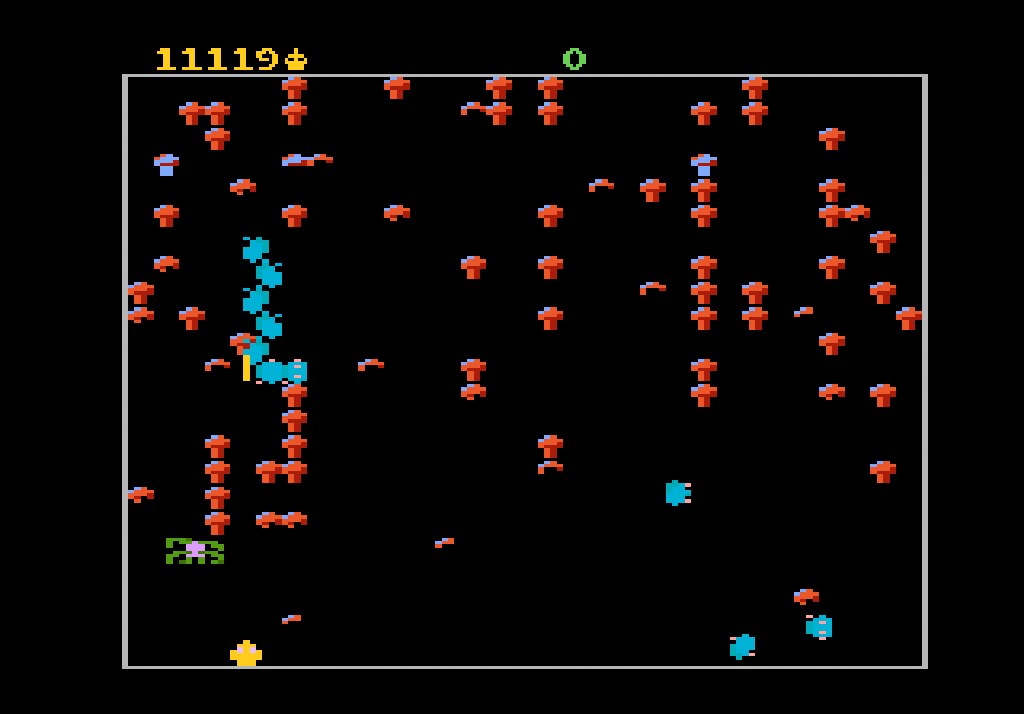
The first impression is density. The mushroom field is a proper field — reds, blues, oranges and greens giving each wave its own palette — and the play area is framed like the arcade cabinet’s vertical monitor, with score lines for both players riding at the top. Your shooter scuttles across the bottom fifth of the screen with the snap the game demands. The centipede itself arrives in that familiar descending zigzag, and the moment a segment breaks off and becomes a second, independent head, the 7800 shows its hand: sprites everywhere, none of them flickering into surrender.
Two gardeners, one infestation
The headline addition is simultaneous two-player play — not the alternating turns of the arcade or the earlier home versions, but both shooters on the field at once, sharing the garden and the score chase. It sounds like a novelty and plays like a revelation. One player can work the left flank while the other holds the right; a spider becomes a shared emergency; a poisoned dive becomes everybody’s problem at once. There is a competitive edge, too, because mushrooms cleared, bugs dropped and bonuses claimed all feed individual scores. It is co-operation with a leaderboard attached, and it makes this the most social version of Centipede ever released on a cartridge.

Underneath the multiplayer, the simulation is right. The flea only falls when the lower field is thin, exactly as the arcade dictates. The scorpion’s poison turns mushrooms — and anything touching them — into a plummet. Head segments regenerate the field between waves in that particular pattern every Centipede veteran knows in their hands. GCC had form here: this was the company that had spent years building arcade-quality work, and their Centipede plays like it was tuned by people who had lost real quarters to the original.
Reading the garden
Colour does tactical work, just as it does in the 7800’s Asteroids. A fresh wave’s palette tells you how deep into the game you are; poisoned mushrooms read instantly against the field; the spider’s zigzag pops against the mushroom colours rather than hiding in them. The sound, TIA-bound as the whole launch library was, is percussive and functional — the descending bug’s patter, the flea’s whistle, the spider’s skitter all present in miniature. A trak-ball would have been the arcade’s final luxury, but the joystick control is tight enough that you stop wishing for one within a wave or two.

Simultaneous two-player Centipede is not a bonus feature. It is the best reason this cartridge exists — and it exists nowhere else in the game’s classic era.
If there is a criticism, it is that Centipede itself is a known quantity: twenty-plus years of home versions mean the 7800 port’s job was fidelity plus one great idea, and some players will always prefer the taller screen of the arcade cabinet. The difficulty also ramps with real intent — by the time fleas, spiders and poison are arriving together, the lower field is a war zone that punishes a moment’s indecision. But that, too, is fidelity. The arcade was exactly this unkind.
Know your infestation
Centipede’s bestiary is tiny and perfectly cast, and the 7800 keeps every performance note. The centipede itself is less an enemy than a process: twelve segments of inevitability, winding down, reversing at mushrooms, diving when the field is poisoned. Shoot the body and you don’t just score — you edit the process, spawning a new head mid-field and rearranging the whole problem. The flea is the gardener’s enemy, dropping vertically when the lower rows are sparse, laying mushrooms as it falls, demanding two hits because the first only makes it faster. The scorpion is the saboteur: one pass and every mushroom it touches turns poisoned, so any centipede segment that reaches one drops straight to your doorstep and starts patrolling there. And the spider — the spider is personal. It eats mushrooms, it bounces in diagonals that feel aimed, and its points are priced by proximity, so the game literally pays you to let it get close before you fire. Every home version lives or dies on whether these behaviours are exact. Here, they are exact.
The wave structure respects the original’s escalation, too. Early fields are sparse enough to teach the geometry; by the middle waves the flea-scorpion-spider rotation is arriving in combinations that force real priorities. Do you clear the diving head first, or the spider already in your kitchen? The two-player mode reframes every one of those calls — suddenly “your side” and “my side” is a strategy, and a shouted warning is a game mechanic. Few arcade ports of any era gain this much from a second joystick.
Why this version, specifically
There were many Centipedes. The 2600’s was brave and flickery; the 5200’s was strong but hostage to its controller; the arcade remained the reference. The 7800’s makes its claim on completeness: the colours and density of the coin-op field, the full bestiary behaving correctly, a control response that suits the standard stick, and the simultaneous mode that no contemporary rival offered. It is also, like several games in this library, a survivor of the warehouse years — built for 1984, released into 1986 — and it plays like evidence for the defence in the argument that the 7800 deserved a fairer hearing.
Longevity, finally, is built into the garden’s cruelty curve. Centipede does not end; it composts you. The score chase is the game, and the 7800 version’s extra life milestones and twin score lines give that chase two shapes at once — the solo grind against your own best, and the shared scramble where a partner’s brilliance and blunders are preserved in adjacent digits. It is a small masterpiece of the form: one screen, four enemies, endless argument. The 7800 is lucky to have it in this form, and so is anyone who picks up the cartridge.
And a footnote for the hardware-minded: Centipede is one of the cleanest demonstrations in the library of what MARIA actually bought Atari. The arcade’s insect ballet is a sprite-management problem — a segmented creature, independent heads, falling fleas, a bouncing spider, your shots, all crossing the same scanlines. The NES, for all its virtues, would have flickered through half of it. Here the field simply holds. That is the 7800’s whole story in one garden: the right chip, waiting for its moment.
The verdict
This is the definitive classic-era home Centipede. It nails the original’s speed, colour and cruelty, and then adds the one thing the arcade never had: a second gardener, working the same field, at the same time. As a single-player score chase it is excellent; as a two-player couch game it is one of the best things on the 7800. Put it in the essential pile.
Score: 8.5/10 — The arcade garden, faithfully replanted, with room for two.