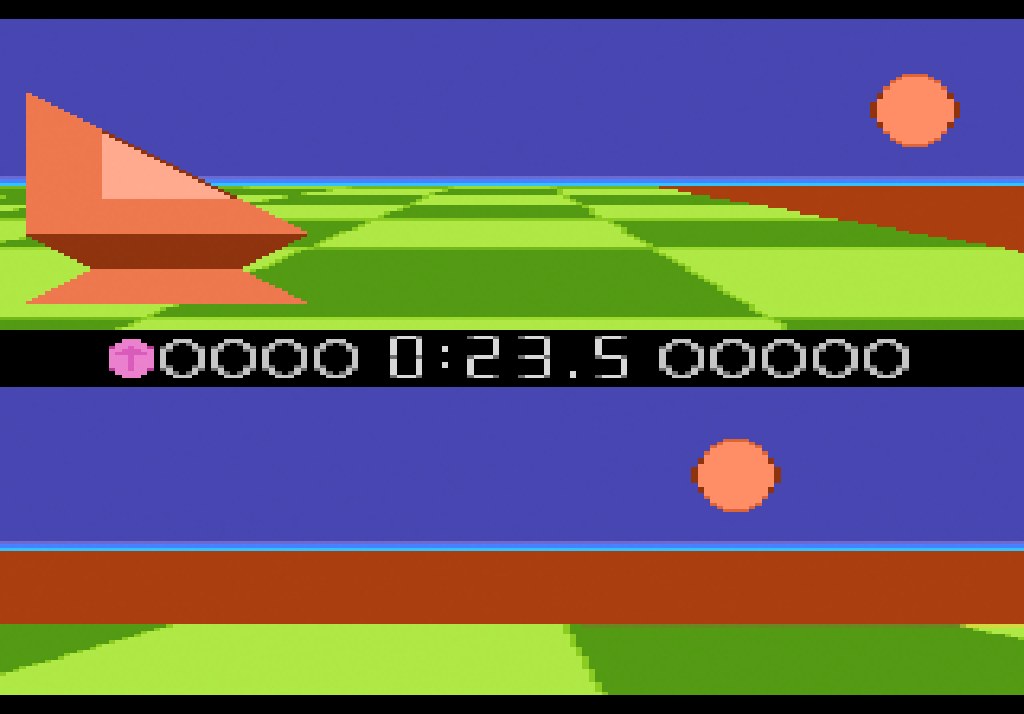
At a glance: Ballblazer · Atari 7800 · Lucasfilm Games / Atari, 1988 · Future sports / action · Score: 9.0/10
There is a short list of games that made people stop and stare at a screen in the mid-1980s, and Ballblazer is on it. Lucasfilm Games’ first release — developed alongside Rescue on Fractalus! as the new division’s calling card — presented something nobody had seen at home: a smooth, fast, first-person future sport, played on a chequered plain under an alien sky, with a split screen so two people could hunt the same glowing ball at once. The Atari 7800 version, arriving in 1988, is not merely a good port of that landmark. With a POKEY sound chip inside the cartridge — a rarity the 7800 desperately needed — it is arguably the definitive home edition.
The premise is beautifully simple. You pilot a rotofoil, a hovercraft with a force field, on a rectangular playfield that scrolls and turns with liquid speed. A plasmorb — the ball — sits somewhere on the grid. Bump it, trap it in your field, and carry it toward the goalposts at the far end, which drift from side to side and narrow as you score. Your opponent, human or droid, is doing exactly the same thing in the other direction. First to ten points wins. Goals from further out are worth more, so every possession is a small calculation: bank the safe one-pointer, or back off and gamble on the long shot while the posts slide away?
Speed with a steering wheel attached
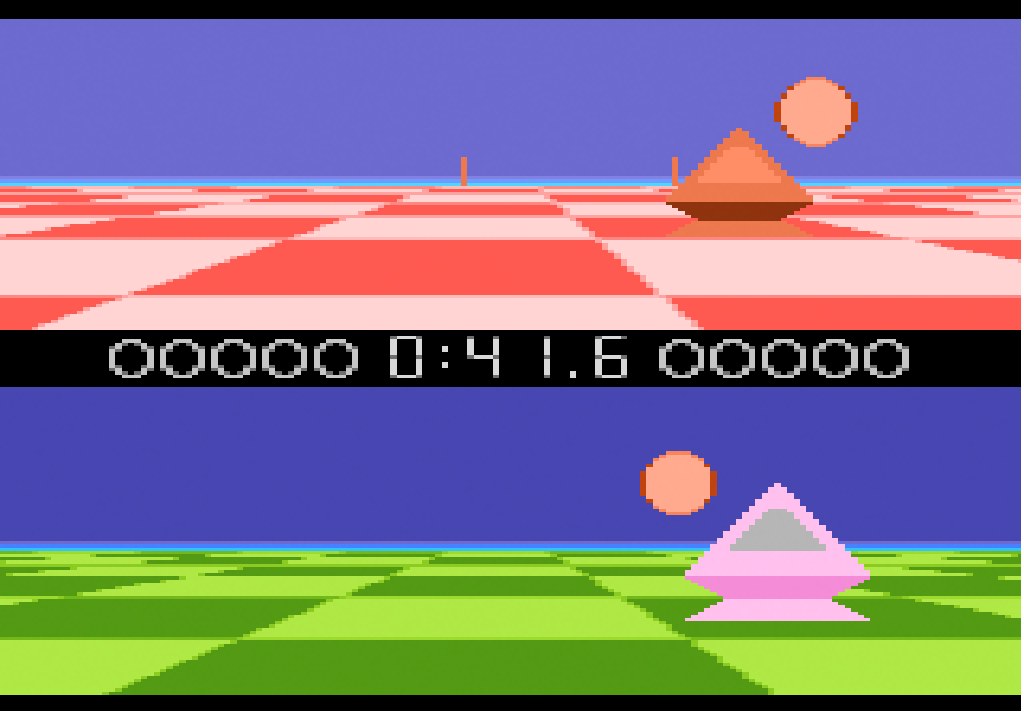
What still astonishes is the motion. The 7800 draws the chequered field in a convincing pseudo-3D that whips around as you turn — there is no rotation button, your rotofoil yaws as you steer — and the whole thing holds a pace that consoles two generations later would be proud of. The split screen, one view stacked over the other with the score bar between them, was a technical flex in 1984 and remains the game’s social engine: you can see your rival’s view, watch them line up a shot, and feel the geometry of the steal before it happens.
The droid opponents deserve their reputation. There are nine of them, graded from a sleepy Droid 1 to a Droid 9 that plays like it has read the manual you lost, and they remain one of the earliest genuinely instructive AI ladders in games: each level teaches you a skill — trapping, turning under pressure, shooting on the move — that the next level demands. Beating the top droids is a credential. Losing to them never feels rigged, because Ballblazer’s physics are honest: the ball squirts, spins and ricochets the same way for both players.
The cartridge with a soundtrack inside
Then there is the sound, and here the 7800 version does something almost no other 7800 game could. The base console’s audio is the wheezy TIA chip from 1977, but Ballblazer’s cartridge carries its own POKEY chip — the same audio hardware that powered Atari’s 8-bit computers — and Lucasfilm used it properly. The result is the game’s famous generative jazz: an ever-shifting, fractal-driven improvisation (the team called it “riffology”) that never repeats and somehow always fits the tempo of the match. Thumps, bounces and goal stingers sit on top of a living soundtrack that was years ahead of its time. On a console starved of good audio, Ballblazer doesn’t just sound better than the competition; it sounds like it’s from the future it depicts.
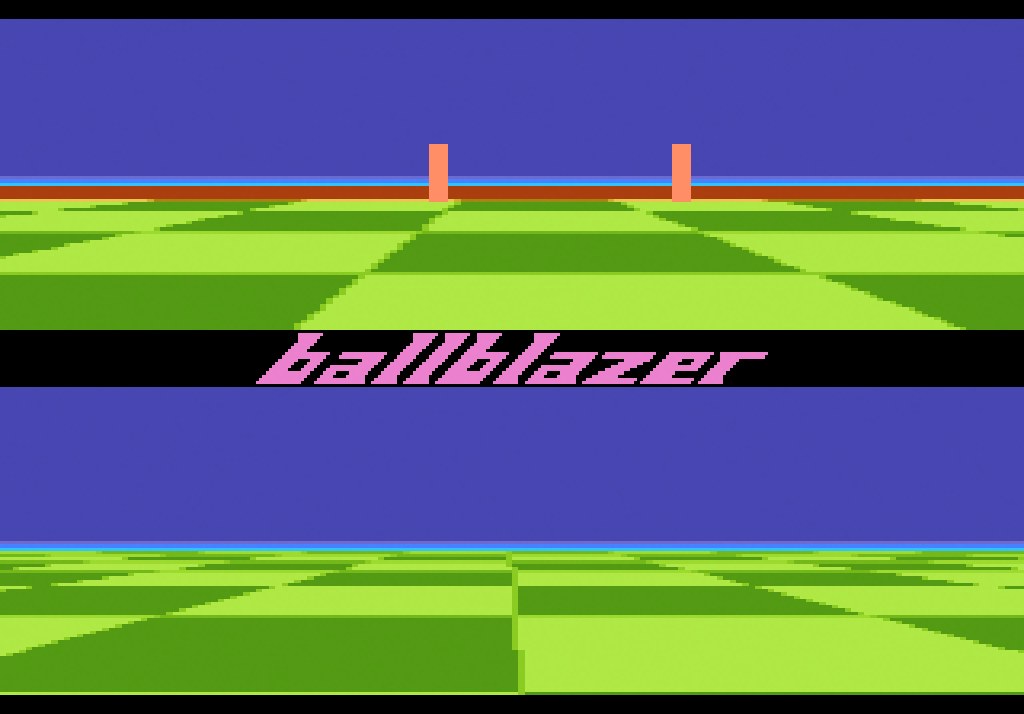
A POKEY in the cartridge, a jazz band in the code, and the smoothest split-screen sport of its decade. Ballblazer is the 7800 showing off.
Reservations are few and mostly inherited from the design itself. The view can disorient new players — the camera is your craft, and the ball’s position is something you learn to feel through the radar-like cues rather than see. Matches against the lower droids are over quickly once the clicks happen. And like all split-screen games of the era, it is at its absolute best with a second human on the couch, which is a logistical problem rather than a design flaw. None of this dents the core achievement.
The geometry of a goal
The scoring system deserves a slower look, because it is where Ballblazer’s genius hides. The goalposts are not fixed architecture; they drift slowly across the end line, and they narrow every time you score. A shot squeezed between them from close range is worth one point. Score from distance — the game measures it honestly — and the same shot can be worth two or three. This creates a rhythm no other sports game of the era attempted: possession becomes a question of appetite. Do you dribble the plasmorb in close, fighting your opposite number for every metre, and take the guaranteed single point? Or do you yield ground deliberately, let the posts wander, and fire the long bomb that either wins the exchange or hands the ball straight back? The over-the-shoulder pressure of the split screen makes that decision loud. You can literally watch the other player deciding the same thing.
The force field mechanics support the drama. Your rotofoil’s field can hold the ball, steal it with a well-timed burst, or — when you don’t have possession — become a defensive tool for body-checking the carrier off line. Shots can be curved by the spin of your release, and the ball’s ricochets off the goal frame and the field’s edges are consistent enough to become tactics rather than accidents. It is, in the best sense, a physics toy with a scoreboard: simple inputs, compounding consequences, and a skill ceiling that the nine droids map out rung by rung.
Lucasfilm’s calling card
Context sharpens the achievement. Ballblazer was one of the first two games from Lucasfilm’s new computer division — the team that would become LucasArts — built by designers like David Levine with a brief to do things the young home market hadn’t seen. The 7800 version arrived late, in 1988, when the console was fighting the NES for oxygen, and it is tempting to wonder what might have been if software of this calibre had led the 1986 relaunch. As it stands, the cartridge is a small historical treasure: a pioneering 3D game, a pioneering AI ladder, a pioneering procedural soundtrack, all running beautifully on the machine that history nearly forgot to release.
A practical word for modern players: give the game fifteen minutes before you judge it. Ballblazer’s controls are unusual — your craft rotates as you steer, the ball is often off-screen, and first matches feel like piloting a shopping trolley on ice. Then the instincts arrive: you start hearing possession in the sound cues, reading the other screen in your peripheral vision, and shaping shots around the drifting posts. That learning curve is not a flaw in the port; it is the game itself, one of the earliest examples of a design that trusts the player to grow. The 7800 version’s gift is that nothing — no slowdown, no muddy audio, no compromised view — stands between you and that growth.
The verdict
Ballblazer is one of the essential 7800 cartridges: a landmark of early 3D, a masterclass in opponent AI, and — thanks to that POKEY in the cart — the best-sounding game on the system by a distance that embarrasses everything else. It plays as fast as it ever did, its two-player mode remains a couch-sport classic, and its ideas (physics sports, risk-priced scoring, adaptive music) read like a preview of the next thirty years. Own a 7800? Own this.
Score: 9.0/10 — Lucasfilm’s future sport, with the definitive home soundtrack. A top-five 7800 game, full stop.