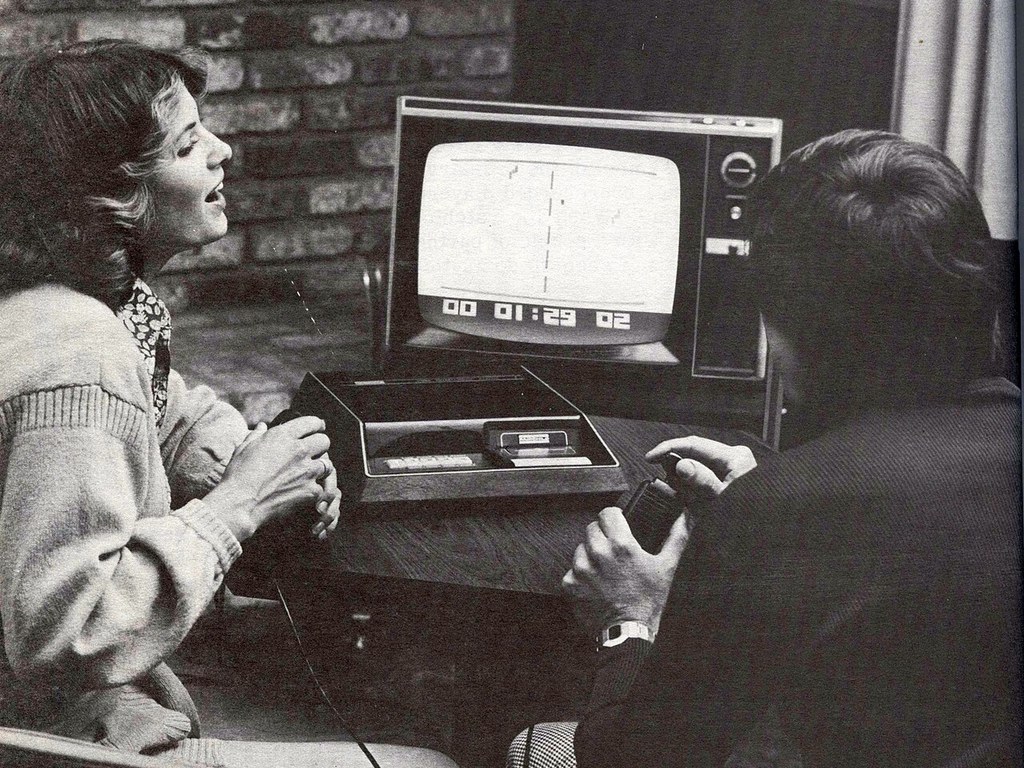
It is the most one-sided famous rivalry in gaming history: the Fairchild Channel F versus the Atari VCS, 1976 against 1977, the cartridge’s inventor against the cartridge’s conqueror. The scoreline is not in dispute — the Channel F sold roughly 350,000 machines; the VCS, rebadged 2600, sold tens of millions and became the decade’s defining console. But scorelines are not judgements, and this feature is an attempt at the judgement the scoreline usually replaces: judged fairly, machine against machine, launch against launch, what did each console actually do better? The answer is less comfortable for the winner than the history books imply.
Set the launches side by side. The Fairchild — launched as the Video Entertainment System in November 1976 at $169.95 — was a microprocessor console with a framebuffer display, two games built into its ROM, the first pause function in home gaming, and controllers offering three axes of input. The Atari VCS arrived in September 1977 at $199 with the Combat cartridge bundled, a machine built around the TIA chip’s racing-the-beam graphics: no framebuffer, no built-in ROM at all, but hardware sprites and a display philosophy that traded flexibility for speed and colour in motion. The naming tells the era’s story in miniature: Atari called its machine the Video Computer System, and Fairchild — whose machine had been the Video Entertainment System first — rebranded to Channel F to escape the confusion. The inventor renamed itself to accommodate the challenger. It would not be the last accommodation.

What the Channel F did better
Begin with the loser’s genuine wins, because they are substantial. The framebuffer — the Channel F’s supposed weakness — made it the better thinking machine of the two: text, numbers and arbitrary diagrams cost it nothing, so its library grew card games, baseball simulations, board games and educational software of a clarity the VCS visibly strained to match. Its built-in Baseball offered a three-pitch duel its rival could not answer for years; its Video Blackjack out-presented Atari’s; its Casino Poker, as late as 1983, was being called the best card game on any system. The Channel F also shipped with two real games inside the console, a pause button, and controllers a generation more expressive than Atari’s single-button stick. And it shipped first — eleven months first, an eternity at that market’s speed — with the cartridge concept itself, which Atari adopted entire. On specifications, on software breadth at launch, and on sheer invention, the Channel F is the better 1976 machine. It is not very close.
Now the winner’s case, which is equally real. The TIA’s design, for all its programmer-tormenting austerity, put more moving, colourful action on the screen per dollar than the framebuffer could, and action was what the arcade decade wanted. Atari had distribution through Sears, the Warner Communications acquisition behind it, and — decisively — proximity to the arcade hits and the capital to license them; when Space Invaders arrived on the VCS in 1980, the contest ended commercially forever. Third-party developers, unthinkable in Fairchild’s closed, numbered-cartridge world, turned the VCS library into an ecosystem while the Channel F’s stayed a catalogue of 26. The VCS was not the better machine. It was the better platform — cheaper to feed, easier to find, and aimed at the games the moment actually wanted to play.

The fair verdict
Judged as engineering, the Channel F wins its year. Judged as a business, the VCS wins the decade, and the two judgements are both true because the products were optimised for different contests: Fairchild, a semiconductor company, built a demonstration of what a microprocessor could put on a television; Atari, an arcade company, built a delivery system for arcade desire, and hired the decade’s distribution to push it. The tragedy in the Fairchild story is not that the worse machine won — the VCS was a legitimately brilliant design within its own philosophy — but that the better library for grown-up games never got its audience: the poker, the baseball, the maze generators, all the things the framebuffer did best, were exhibited to a market that had already left the room to watch Space Invaders.
The Channel F was the better machine of 1976 and the worse platform of 1980 — and the cartridge era belonged, as eras do, to the platform.
Fairchild sold the system to Zircon in 1979; Zircon’s System II and its final cartridges — including, in a neat irony, a Space Invaders of its own, Alien Invasion — kept the machine alive into 1983. The VCS became the 2600, collapsed with the great crash, and is remembered as the era’s synonym. Posterity is slowly re-balancing the ledger: the Channel F is now universally credited as the first cartridge console, its engineer Jerry Lawson is honoured by name, and its best games hold up in the ways this package’s reviews describe. But fairness cuts both ways, and the fair summary is this: Atari did not steal the cartridge era from its inventor by treachery or luck. They won it by understanding, earlier than the inventor did, that a console is a shop window first and a computer second. The Channel F remains the more interesting machine. The VCS remains the more important product. History, uncharacteristically, has room for both sentences.

The eleven months
One unfairness in the standard account deserves correcting in the rivalry’s ledger: the implication that the Channel F failed despite its head start, as if eleven months were a moat. Eleven months in the 1976 games market was a single Christmas — and the Channel F’s first Christmas was spent proving that cartridge consoles could sell at all, educating retailers, absorbing the returns and the scepticism, and teaching the public a category that Atari’s machine then entered fully formed. Pioneers in platform markets routinely pay the education costs that fast followers convert into sales; the railways and the search engines are full of the pattern. Fairchild’s board, watching semiconductor margins from a chip company’s chair, never funded the second act the education had purchased — no arcade-licence war chest, no keyboard accessory, none of the 1978 brochure’s promises kept. Zircon’s stewardship kept the flame but not the fire. None of this acquits Fairchild of its choices, and none of it convicts Atari of anything worse than competence. It simply restores the eleven months to their true size: not a squandered eternity, but one Christmas of evangelism, billed to the evangelist.
There is a postscript the fairness project requires. The VCS’s victory gave its library fifty years of oxygen — reissues, documentaries, a permanent seat in the culture — while the Channel F’s library survived on the devotion of archivists. Judging the machines fairly in 2026 therefore means correcting for survival bias: the Atari canon looks inevitable partly because it never stopped being sold. Set both libraries on the same table, as this site’s shelves attempt to do, and the showdown of 1976-77 reads the way it should have read in 1978 — as a genuine contest between two philosophies, one of which happened to own a distribution network.
Coda: the games remain
What a modern player should take from the showdown is not pity for the loser but curiosity about its library. The rivalry’s surviving artefacts are asymmetric: millions remember the VCS’s arcade canon, while the Channel F’s distinctive strengths — the thinking games, the twist-controller sports, the sonar played by ear — are preserved in a catalogue of 26 cartridges that can be explored in weekends rather than years. The 1976-77 showdown was judged fairly by the market on the criteria the market cared about. Judged on the criteria of invention, generosity and design nerve, it deserves its rematch — and this site’s twenty-five-article Channel F shelf is our way of holding it.