
Here is a sentence that would have baffled the industry of 1983: the Channel F has a release schedule. Not a long one, and not a commercial one — but decades after Zircon wound the platform down, hobbyist programmers are still writing new software for the first cartridge console, still pressing it onto yellow cartridges, and still finding, inside a 1976 framebuffer with 64 bytes of scratchpad memory, room for games the original library never attempted. The homebrew resurrection of the Channel F is the smallest scene in retrogaming and, pound for pound, one of the most impressive: to program this machine at all is an act of historical re-enactment, and its practitioners have responded by porting the two most famous games they could think of.
The landmark arrived in 2009. Programmer Fredric Blåholtz — the Swedish enthusiast whose VES Wiki and channelf.se resources underpin nearly all modern Channel F scholarship — completed a conversion of Pac-Man for the machine and released it as a physical cartridge, complete with box and instruction booklet, informally numbered Videocart-27: the library’s numbering, dormant since Alien Invasion closed it at 26 in 1981, extended by a fan twenty-eight years later. Consider what the port required. Pac-Man is a maze game of four ghost personalities, fruit bonuses, energizers and precise tile logic, designed for arcade hardware with tiles, sprites and a 224-by-288 display. The Channel F has a 128-by-64 framebuffer, no sprites, no tiles and an F8 processor with no stack. The homebrew Pac-Man is not faithful because the hardware allowed it; it is faithful because its programmer refused, at the level of individual pixels, to accept what the hardware allowed. The Libretro thumbnail set that supplies this site’s screenshots files its box art alongside the originals — Videocart-27 in spirit, and in the archive, in fact.
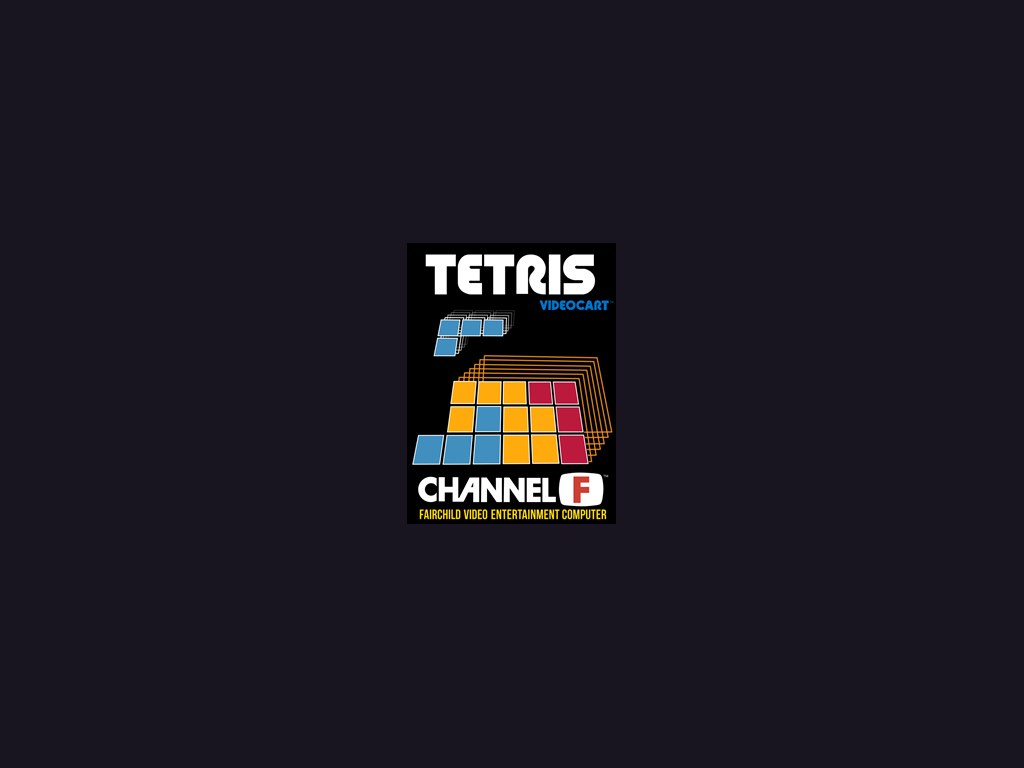
Tetris, and the multicart that holds everything
Tetris followed it into the archive — the other inevitable port, the game every programmable display eventually receives as a christening. On the Channel F its falling tetrominoes are plotted into the same framebuffer the built-in Hockey used, and the conversion makes a sly kind of sense: a well, a stack and a score are all things this text-and-diagram machine draws natively. Between Pac-Man’s maze and Tetris’s well, the homebrew canon covers the two poles of arcade design, both executed on hardware older than either game’s invention. The scene’s third pillar is infrastructure: the Channel F Multi-Cart, developed by Sean Riddle, which gathers the library — originals and homebrew alike — onto a single modern cartridge. The multicart changes the economics of the whole platform for collectors: instead of hunting 26 ageing Videocarts, an owner can slot one cart and hold the entire history, homebrew chapters included. It is the scene’s library card, and its box art sits in the same Libretro set as the originals, because archivists understand what the multicart is: not a convenience, a continuation.
The tooling deserves a sentence of its own. Modern Channel F development rides on decades of reverse engineering — the VES Wiki’s documentation of the F8’s peculiar command-bus architecture, the emulation cores (MAME’s driver and the Libretro FreeChaF core among them) that let a programmer test on a laptop what once required burning ROMs, and the surviving hardware knowledge of a community that has mapped everything from the RF output to the cartridge’s spring-loaded dust door. Every one of those resources traces back to enthusiasts who treated a forgotten console as a document worth preserving letter-perfectly. The homebrew games are the flowers; the documentation is the garden.

The archive is the scene
It is also worth naming the unglamorous half of the resurrection, because without it there are no new games at all: preservation. The Channel F’s software survives in playable form because enthusiasts dumped the Videocarts’ ROMs, documented the F8 system’s command-bus peculiarities down to the pin, photographed the boxes, scanned the manuals and argued the release dates into a reliable chronology — the same scholarly apparatus this site’s reviews lean on throughout this package, from the Libretro thumbnail archive that supplies our screenshots to the VES Wiki’s hardware documentation. The scene’s own histories are candid that the work was salvage: cartridges are fifty-year-old plastic, consoles fail, and an unarchived platform’s library can go from “unfashionable” to “unrecoverable” inside one generation of house clearances. That the Channel F instead became one of the best-documented obscure consoles in existence is the precondition for everything else in this feature — the ports, the multicart, and indeed the twenty-five articles you are reading. Homebrew gets the headlines; the archive does the resurrection.
Why program a machine from 1976?
Ask what the point is and the scene’s answer is the platform itself. The Channel F’s constraints are so severe that they become a genre: 102 visible pixels across, four colours on a chosen background, a beeper, 64 bytes of working memory and a processor whose subroutines cannot nest. To ship a recognisable Pac-Man inside that is a feat of the same species as demoscene work — proof, offered cheerfully, that the limit was never really the machine. There is also the historical symmetry, which no one in the scene misses: the first cartridge console was the first machine that could receive new games after sale. Homebrew is that founding promise, still being kept — by volunteers, in yellow shells, with boxes and booklets, half a century on.
Pac-Man as Videocart-27, Tetris in the framebuffer, and a multicart holding the whole library: the smallest homebrew scene in gaming keeps the first cartridge console’s founding promise.
The scene’s scale should be stated honestly — this is a handful of dedicated programmers and a devoted archival community, not an industry; new releases arrive in years, not months, and many projects live as documented experiments on the VES Wiki rather than cartridges on shelves. But scale is not significance. The Channel F was nearly erased once, surviving as a trivia question while its rival got the museum wing. Its second life — emulated accurately, documented obsessively, and still, occasionally, extended by a brand-new game in a yellow box — is the reason a site like this one can review its library fifty years on and mean it. The resurrection is quiet. It is also complete: the machine that invented the cartridge is still accepting new ones.

The emulation thread matters here too: the homebrew scene develops against the same cores collectors play on, and the Libretro archive’s decision to catalogue homebrew box art with the same care as the 1976 originals is a small act of canon-formation — Pac-Man and Tetris filed, in the record, as Channel F games, full stop. Canon is what a library is when someone is still tending it.
The living library
For the player rather than the historian, the practical upshot is simple. The Channel F library is no longer a closed set of 26 cartridges and two built-ins, frozen in 1983. It is 26 cartridges, two built-ins, a Pac-Man that out-punches its hardware, a Tetris, a multicart, and whatever the next patient programmer is currently coaxing out of the framebuffer. Consoles are supposed to die when their makers leave. The first cartridge console declined to — because the cartridge, Jerry Lawson’s idea, means a machine is never finished while anyone, anywhere, still cares to write for it. In the Channel F’s case, someone still does.