
At a glance: Cosmic Chasm · Vectrex · GCE, 1982 · Cavern exploration shooter · Score: 8.0/10
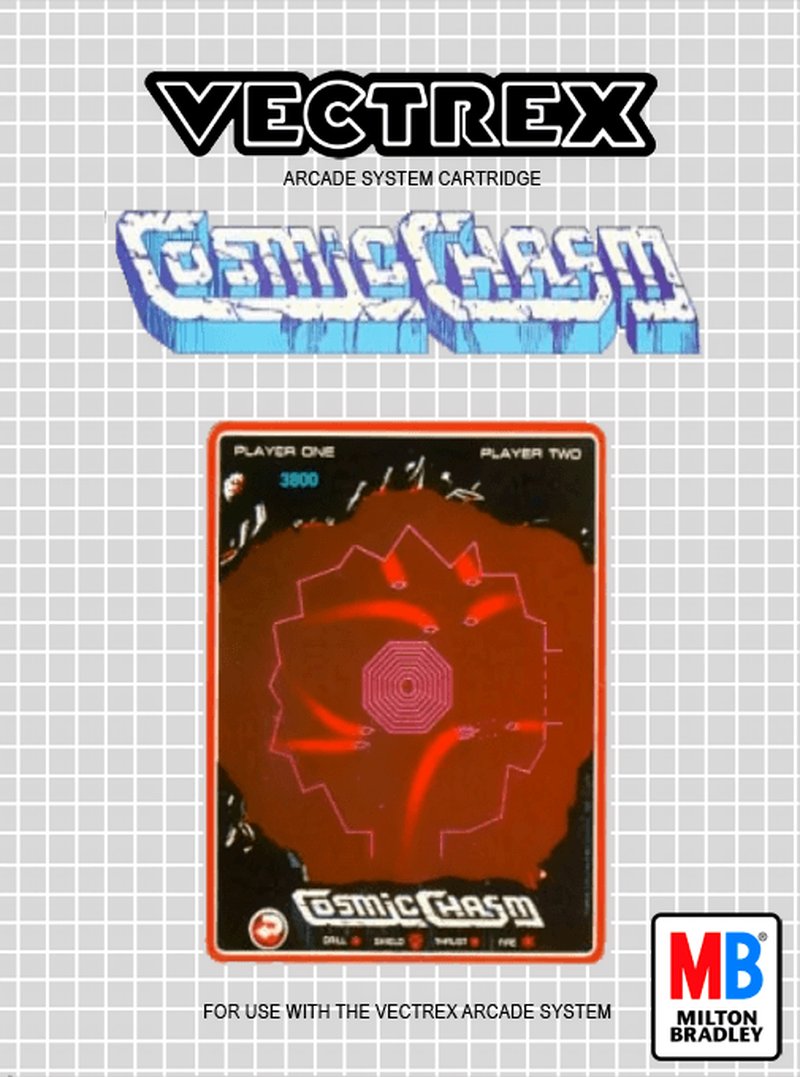
The usual direction of travel in 1982 was arcade first, home port second, quality optional. Cosmic Chasm reversed it. This labyrinthine cavern shooter was created for the Vectrex — designed at GCE as an original work for the home machine — and only afterwards travelled the other way, adapted by Cinematronics into a colour vector arcade game. That makes the Vectrex version not a port but the source text, and it plays like one: a game built around the machine’s exact strengths, its analogue stick, its bright little screen, and its ability to draw a cave system as a single web of light. It is one of the most ambitious designs in the early library, and one of the most rewarding to master.
The mission has a shape most 1982 games never attempted. An enemy power station sits at the heart of a cavern complex — a maze of interconnected rooms shown on a map screen between sorties. You pilot a lone ship into the caves, room by room, fighting each chamber’s defenders, until you reach the central cavern, destroy the station, and then — the design’s masterstroke — escape. The explosion gives you a countdown, not a cutscene: the same maze, retraced at speed, with the walls themselves becoming the enemy. Many Vectrex games end when the target dies. Cosmic Chasm’s target dying is the halfway point, and the easier half.
Rooms, doors and the long way home
Navigation is the game. Each cavern room is a small arena with doors on its walls, and moving between rooms is a physical act — you fly through the openings, momentum and all, while each chamber’s sentries do their work. The defenders vary their menace: drones that home, shooters that hold position, and the ever-present danger of the cavern walls themselves, which kill on contact with the impartiality of all good cave systems. Between rooms, the map offers the game’s strategic layer. Do you take the short route through defended chambers, or the long way round through emptier caves, spending time to save hull? Cosmic Chasm asks questions like that constantly, in an era when most shooters asked only whether your thumb was fast.
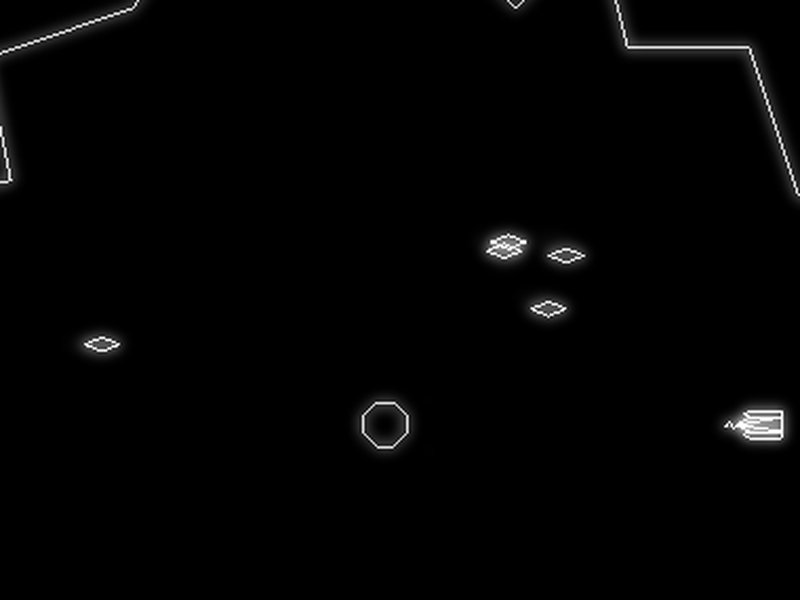
Your ship’s equipment supports the expedition feel: a shield for the collisions skill cannot avoid, firepower for the chambers that cannot be crossed politely, and handling — via the analogue stick — fine enough to thread a doorway while under fire from two directions. The vector drawing flatters the subject enormously. The caverns are drawn as clean angular chambers, your ship a bright dart among them, and the sense of burrowing deeper — room after glowing room, the map filling in behind you — gives the game an atmosphere no raster spelunker of the day could match. It feels like exploring something, not clearing something.
The escape is the game
Veterans of Cosmic Chasm talk about the escape the way climbers talk about the descent. The station destroyed, the countdown running, the maze suddenly reads differently: doors you drifted through become gates you must hit at speed, and every chamber’s surviving defenders are now simply obstacles between you and daylight. The design decision to make the player earn the ending twice — once on the way in, once on the way out — gives the game a narrative arc built entirely from mechanics. Success feels like a rescue film starring yourself. Failure, three rooms from the exit with the counter at zero, feels like the cave keeping what it caught.
Most games end when the target dies. In Cosmic Chasm the target dying is the halfway point — and the easier half.
Where does it lose marks? The difficulty of the deeper caverns will wall some players: the combination of wall-lethality, homing defenders and an unforgiving escape clock asks for practice that breezier cartridges never demand, and the between-rooms map, for all its strategic charm, breaks the flow for players who came for pure shooting. The arcade adaptation that followed also showed what colour could add to the caves’ readability. But these are the complaints of a game reaching further than its peers, and mostly succeeding.
Home first, arcade second
The reversal at the heart of Cosmic Chasm’s history is worth dwelling on, because it almost never happened in that era. Home games in 1982 were understood to be echoes: an arcade hit would cool for a year, then arrive on consoles in reduced form. GCE’s designers instead built Cosmic Chasm for the Vectrex’s own specification — the analogue stick’s fine movement for doorway-threading, the small bright screen for the caverns’ intimacy, the vector line for the cave geometry — and the result impressed Cinematronics enough that the traffic reversed, the arcade version following as a colour vector adaptation in the coin-op vector era’s twilight. Played today, the Vectrex original still feels like the design’s natural home: the caves are supposed to be monochrome-dark, the ship is supposed to be a coal of light in them, and the map screen’s stark cartography suits a game about spelunking by instrument.
Its systems reward study in ways the first evening only hints at. The shield is a resource to be budgeted across an entire expedition, not a panic button — spend it bullying through an early chamber and the deep caverns will present the invoice. Room order matters at a level most maze games never attempt: the map lets a careful pilot clear a cavern’s defenders in an sequence that keeps retreat lanes open, so that when the countdown starts the escape route has already been swept by the inbound journey. Even the firing has a spelunker’s patience to it — the chambers are small, the walls are lethal, and wild shooting mostly rearranges your own options. Cosmic Chasm’s pleasures are the pleasures of competence accumulating: routes memorised, shields husbanded, a maze that begins as a threat and ends, several evenings later, as a place you know like a childhood street — right up to the moment it starts exploding, and you run its length one last time at full tilt.
The verdict
Cosmic Chasm is the Vectrex’s proof that the machine was not merely an arcade-port terminal but a place where original designs could be born and then exported to the arcade itself. Its explore-fight-escape structure was years ahead of home-game convention, its caverns remain atmospheric and exacting, and its final countdown still raises a pulse like few things in the library. New players should expect a learning curve and budget an evening. The cave rewards the investment, on the way in and — gloriously — on the way out.
It is worth adding that Cosmic Chasm’s reputation among owners has climbed steadily for decades, from launch-era curiosity to consensus classic — the surest trajectory a game can have. Designs that are merely fashionable fade; designs that are merely difficult get abandoned. This one kept converting its players, one escaped countdown at a time, until the whole community agreed with the caverns. First impressions said good. The long verdict says essential.
Score: 8.0/10 — A home original good enough to be promoted to the arcades: explore, destroy, and run for the light.