
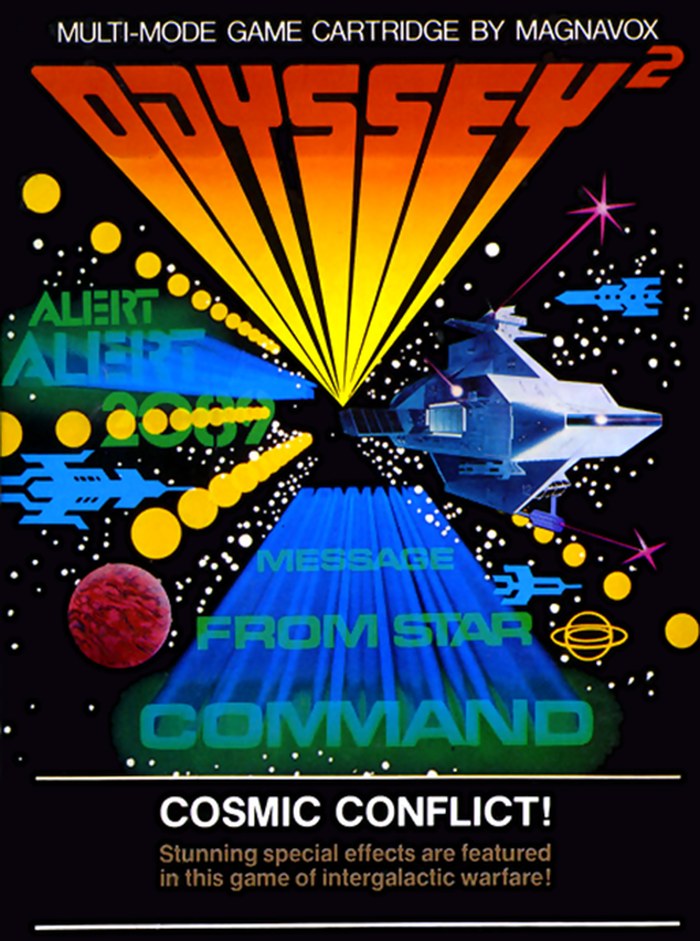
At a glance: Cosmic Conflict! · Odyssey 2 · Magnavox, 1978 · First-person space shooter · Score: 6.5/10
The viewpoint is the headline. Where its 1978 contemporaries showed your ship from outside, Cosmic Conflict! shows space from inside: stars stream past, enemy craft cross your field of view at varying distances, and your fire goes down the crosshair at the centre of the screen. It is the Star Raiders idea arriving on the Odyssey 2 in simplified form — a cockpit shooter about tracking, leading targets and managing a mission clock rather than dodging in a plane. For a launch-era cartridge on an Intel 8048, the ambition of the perspective alone earns it a place in the library’s story.

How it plays
The mission structure gives the shooting a frame: a set number of enemy ships must be destroyed before time — your starship’s endurance — runs out, and contacts appear at ranges that change how hard they are to hit and how much they threaten you. Movement is effectively about swinging the view to intercept, and the skill is anticipation: ships drift, your shots travel, and hits at long range feel genuinely earned. A sector-by-sector rhythm builds across a run, and later stages compress the time until the whole game becomes target prioritisation under pressure.
The limitations are the era’s. The starfield is sparse, enemy variety is minimal, and the beeper offers a shot sound and little atmosphere. Repetition is held off by the clock rather than by content. But judge it as what it is — a 1978 attempt to give home players the sensation of being in the ship — and the simplifications become the style: clean vector-like shapes, immediate readability, a gunsight’s-eye view that any player understands in three seconds.

Stars ahead, crosshair centred, clock running — in 1978, putting the player inside the cockpit was the boldest thing a cartridge could do.
The details that decide it
It also matters that this was not a one-off experiment for the system: the Odyssey 2 returned to space combat repeatedly, and Cosmic Conflict! is where that thread starts, before Freedom Fighters! gave it momentum and Attack of the Timelord! gave it a villain. Playing the three in order is a small history of a console learning what it could do.
The longer game
The cockpit framing does one more thing worth crediting: it makes the Odyssey 2’s limitations look like instrumentation. A sparse starfield reads as deep space rather than an empty screen; a drifting enemy sprite reads as a distant contact rather than a small graphic; the crosshair turns the television into a gunsight and the player into a pilot. Other early games apologise for this hardware. Cosmic Conflict! casts it. The mission timer completes the effect — you are not surviving waves, you are completing a patrol against a fuel clock, and that single change of story turns a target gallery into a sortie.
There is a lineage to trace forward as well. The first-person space game became one of the industry’s prestige genres on home computers, and its console ancestry is usually told through the 2600’s later conversions. Cosmic Conflict! predates most of that story on consoles, designed for the machine from the start rather than ported down to it. It lacks the computer games’ galactic scope — no star map, no trading, no ranks — but the essential sensation they all sell, a ship around the player and a sky full of work, is present in embryo in 1978.
Playing it today
The game’s restraint is worth one more consideration, because it points at something the Odyssey 2 understood early: a television in 1978 was a small, curved, often black-and-white-adjacent window, and games designed for it had to be legible at a glance across a room. Cosmic Conflict!’s clean sky, large contacts and single crosshair are that legibility discipline in its purest form. Nothing on its screen is decorative; everything is information. Modern minimalist space games chase the same clarity with a thousand times the resources, which makes playing this cartridge feel less like archaeology than like visiting the source.
Its place in the collection is therefore secure even at its modest depth: it is the system’s first space game, the ancestor of its better ones, and a three-minute demonstration — cockpit, crosshair, clock — that explains 1978’s ambitions to any visitor faster than a shelf of sports titles can. Pair it with the flagship history elsewhere in this series and the arc completes itself: the console that began by putting players inside a starship ended by putting boards on their tables and voices in their living rooms.
Buy it loose and cheap, European or American, and fly the patrol now and then. Some cartridges are destinations; this one is a birthplace, and birthplaces are for visiting.
Verdict
Cosmic Conflict! will not displace the system’s greats, and it does not try to. It is a launch game with a genuinely forward-looking idea, executed cleanly — and ideas like that are why the early library is worth revisiting at all.
Loose copies are inexpensive and plentiful, European Cosmic Conflict included. It will not hold a modern player for a weekend; it will hold their respect for an evening, which for a launch-year cartridge is a fine exchange — and it pairs naturally with Freedom Fighters! for anyone tracing how this console learned to fly.
Six-and-a-half for a launch game whose idea outruns its content — and in 1978, the idea was the content. A cockpit, a crosshair, a clock and a sky: Cosmic Conflict! gave the Odyssey 2’s first owners the sensation that the coming decade of space games would industrialise, and it did so natively, for this hardware, while its rivals were still drawing ships from the side. The repetition that modern players feel is the era’s repetition — a single sortie structure, a handful of contact types — and the game’s defence is that its sortie is honestly built and its clock honestly kept. Collect it as the system’s Year Zero space game, play it as a three-minute communion with 1978’s optimism, and then fly Freedom Fighters! to feel how far the same company travelled in four years on the same silicon. Few libraries let you watch a genre being born this clearly, this cheaply, in this few cartridges. The stars ahead are sparse because the future had not filled them in yet. It was this game’s job to point at them, and it pointed true.
In this series: Cosmic Conflict! is one of eighteen Odyssey 2 cartridges reviewed in this build-up of the system’s shelf, alongside features on The Voice, the Master Strategy Series, the keyboard and the Videopac years, a hidden gems list and a full buying guide. Read it with the flagship history, Odyssey 2 Forever, for the whole story of the keyboard console — and if you are choosing a first cartridge from the set, the scores in this series are the shortlist, with the buying guide’s hedged price ranges as the shopping list.
In Europe it kept its name as Videopac 11, one of the launch-era numbered titles. Our verdict: A simple, historic first-person shooter. Thin by later standards, but the perspective was the point — and it still lands.