
At a glance: Showdown in 2100 A.D. · Odyssey 2 · Magnavox, 1979 · Two-player duel shooter · Score: 7.0/10
The premise is a duel and the game never complicates it: two gunfighters face off across a screen dotted with trees, and the first to land the winning number of shots takes the showdown. What elevates it from a 1979 parlour game to a lasting two-player favourite is control — specifically, control of the bullet. After firing, you can curve your shot in flight, bending it around the trees that block the straight line. A duel becomes a contest of banked, arcing shots, of reading your opponent’s dodge against the arc you are drawing through the air.
How it plays
The trees are the third player. They absorb direct fire, define the lanes, and rearrange the geometry of every exchange: a fighter screened by trunks can afford patience, while one caught in the open must move and trust a curving reply. Movement is deliberate, shots are precious, and rounds build genuine tension — the stand-off moments, both players waiting on the other’s first move, are as much the game as the shooting. It is high noon designed by people who understood that a duel is mostly anticipation.
Variations selected on the keyboard adjust the terms — including the mischievous possibilities around ricochet and ammunition — and the cartridge supports the system’s usual alternation of solo target play, though, like War of Nerves!, this is a game whose heart is two-player. Against the machine it is a pleasant diversion; against a sibling, a grudge engine. Early Odyssey 2 multiplayer design repeatedly punches at this weight, and Showdown is one of its cleanest examples.
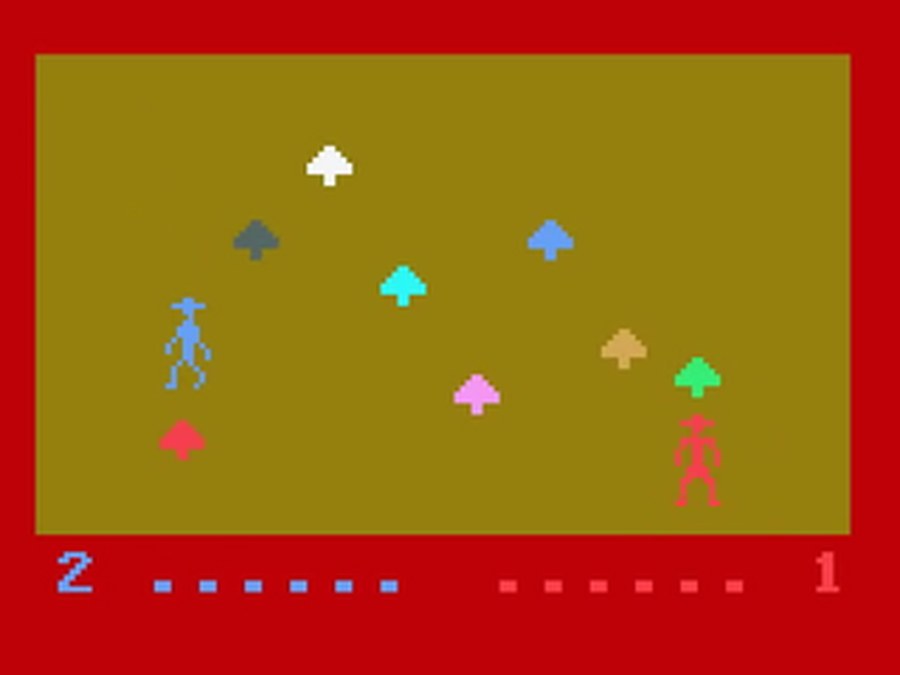
Steerable bullets around the trees at high noon — the duel is simple, and the mind games are not.
The details that decide it
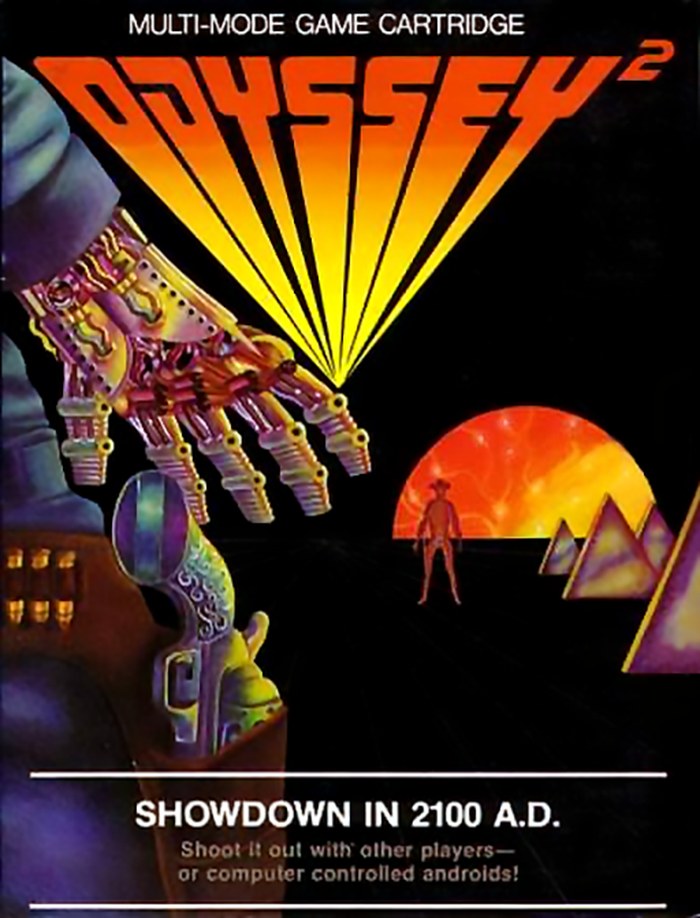
Presentation is period-minimal — stick-figure gunfighters with unmistakable hats, a row of trees, a beeper crack for gunfire — and entirely sufficient, because the information that matters (cover, angle, the bullet’s curve) is always perfectly legible. The future-western framing, robots at high noon in the year 2100, gives the box more science fiction than the screen attempts, which is itself a charming period detail.
The longer game
The steerable bullet is a deeper mechanic than its simplicity suggests, because it moves the duel’s skill from aiming to prediction. A straight shot is a question about where your opponent is; a curving shot is a question about where they will commit to being, asked while the bullet is already in the air and your opponent is answering it in real time. The trees complicate every answer — cover that stops a straight line merely bends a curving one — and the result is that exchanges develop feints: a fighter shows movement to draw the shot, then cuts against its arc. Two experienced players produce rallies that look choreographed. Two beginners produce comedy. Both are the game working as intended.
That design intelligence, in 1979, from the same small stable of programmers who built most of this library, is a recurring theme of the Odyssey 2’s story: the hardware was modest, so the ideas had to be load-bearing. Showdown’s single load-bearing idea has carried it onto most retrospective lists of the system’s multiplayer essentials, alongside War of Nerves! — and the pair make a persuasive exhibit that this console’s two-player design was ahead of its single-player design by a clear margin.
Playing it today
Two more felicities deserve the record. The first is the game’s economy of lives and rounds: a showdown is short, so defeat is cheap and rematches are instant, the exact rhythm a duel game needs to turn into an evening’s running championship rather than a single contest. The second is its sound discipline — on a system whose beeper is asked to do everything, Showdown spends its audio on the crack of the shot and the silence of the stand-off, and the silence, between two players waiting on each other’s nerve, is the most effective sound effect in the early library. Design students could do worse than study how much tension this cartridge manufactures from two figures, some trees and one bendable bullet.
Its modern reputation has quietly risen with the multiplayer revival: as retro nights and couch-versus play have returned to fashion, the Odyssey 2’s two-player bench — War of Nerves!, Monkeyshines!, this — has become the system’s most rediscovered asset. Showdown is the bench’s purest entry, the one that needs no explaining to a visitor beyond ‘your bullets curve, there is the tree line, draw.’
Cheap, complete in five minutes’ learning and bottomless in rematches, it is the cartridge this reviewer would hand a sceptic who thinks 1979 games are museum pieces. Museum pieces do not start arguments about who drew first. This one still does.
Verdict
Simple, sharp and social: Showdown in 2100 A.D. is the cartridge you reach for when someone asks what two people actually did with an Odyssey 2 in 1979. The answer is: they dueled, and they steered their bullets, and they asked for one more round.
It remains cheap, common and immediately playable — American copies and European Gunfighter cartridges alike — with no learning curve beyond ‘the bullet bends.’ Keep it beside the console for visitors. High noon takes five minutes to explain and the rest of the evening to settle.
Seven out of ten, and the seven is for depth of content rather than quality of idea — the curving bullet is a ten, in a cartridge too small to hold more than its one perfect thing. That is not the insult it appears: the early library’s masterpieces are mostly one perfect thing, honestly built — a shield, a swarm, a steerable bullet — and Showdown in 2100 A.D. is the purest of them, a duel reduced to nerve, cover and geometry. What it asks of a collection is modest: a slot beside the other two-player essentials and a household willing to keep score. What it returns is outsized — the fastest five-minute education in 1979 game design available anywhere, and an argument, renewed every rematch, that limitation was this generation’s muse. The trees are still standing in the year 2100. The gunfighters are still walking out at noon. All that has been missing, for forty-odd years, is your hand on the second joystick and your bullet already bending around the trunk your opponent is hiding behind.
In this series: Showdown in 2100 A.D. is one of eighteen Odyssey 2 cartridges reviewed in this build-up of the system’s shelf, alongside features on The Voice, the Master Strategy Series, the keyboard and the Videopac years, a hidden gems list and a full buying guide. Read it with the flagship history, Odyssey 2 Forever, for the whole story of the keyboard console — and if you are choosing a first cartridge from the set, the scores in this series are the shortlist, with the buying guide’s hedged price ranges as the shopping list.
In Europe it was plain Gunfighter, Videopac 14. Our verdict: One of the system’s essential two-player games. A single idea — the curving shot — executed perfectly.