
At a glance: Crash ‘n Burn · 3DO · Crystal Dynamics, 1993 · Combat racing · Score: 7.5/10
Every console launch has a game that exists to answer one question: what can this machine do that the old ones cannot? For the 3DO, that game was Crash ‘n Burn, Crystal Dynamics’ combat racer, packed in with the Panasonic FZ-1 in North America and therefore the first 32-bit experience thousands of players ever had. Its answer was textured 3D tracks at speed, a cockpit full of weapons, and a post-apocalyptic attitude delivered with a grin. Judged as a technical demonstration it was sensational. Judged as a game — which is the job here — it is a fast, shallow, enormously likeable arcade racer whose tricks were better than its depth, and whose historical importance outruns its lap count.
The fiction is cheerful Mad Max: after the collapse, racing is war, and your hover-age battle car runs arena circuits against five rival psychos, earning cash for armour, engines and guns. There is no championship narrative to speak of — no characters to remember, no story to finish. There is a ladder of tracks, a shop between races, and the simple, durable pleasure of shooting the car in front of you until it stops being in front of you.
Speed first, questions later
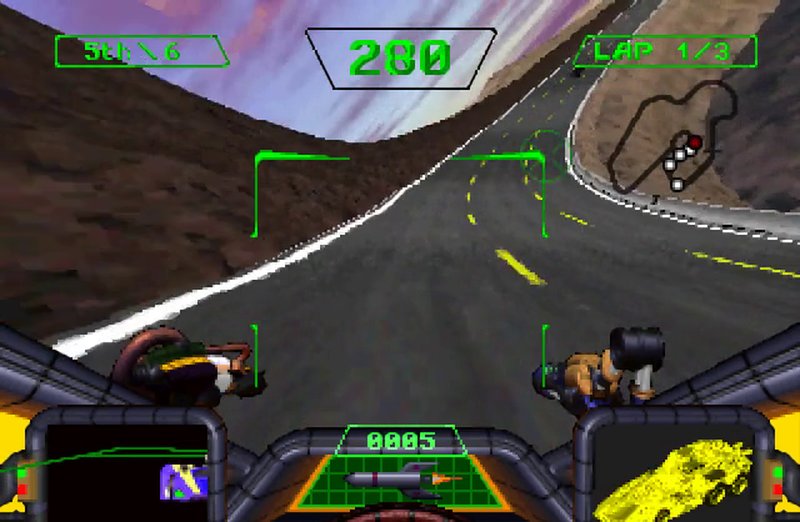
The driving is pure arcade: fast, grippy, forgiving, with a cockpit view that puts the road where it belongs and a dashboard full of toys — twin screens tracking damage and position, weapons bays, and a speedometer that lives in the high two-hundreds. Tracks swoop through tunnels, deserts and flooded sections with a variety that showed off the hardware’s texture work to a generation raised on flat-shaded polygons and Mode 7. The frame rate, for a 1993 CD game, is the real headline: Crash ‘n Burn moves, and its motion sold more 3DOs than any specification sheet.
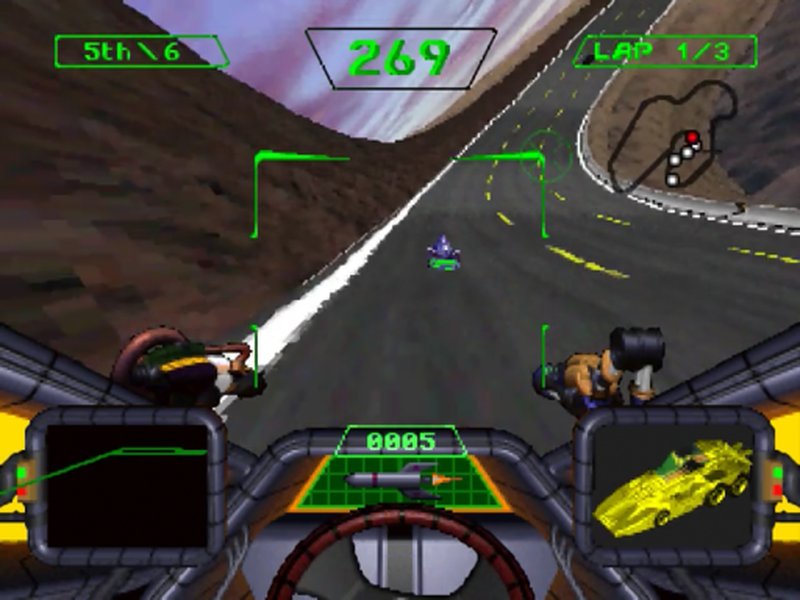
Combat is the seasoning rather than the meal. Missiles, mines and guns soften rivals up, wrecks litter the racing line, and the cash economy rewards aggression with upgrades. But the weapons never develop the tactical depth of a Mario Kart or the menace of a Road Rash: opponents are obstacles with hit points, and races are usually decided by clean driving and upgrade maths rather than duels. The result is a game that is thrilling for an evening and friendly for a month, rather than a rival for your year.
The pack-in burden
Context explains the shape. Crash ‘n Burn was built to be understood in ninety seconds by a shopper watching a demo pod: big numbers, big speed, explosions. Its tracks are short, its structure transparent, its difficulty curve a welcome mat. Crystal Dynamics — who would make Gex and Soul Reaver on the strength of this era — were learning 3D in public, and the learning shows in the best way: everything in the game exists because it looked exciting in motion. Even the shop, thin as it is, understands the arcade loop: race, wreck, upgrade, race faster.
Crash ‘n Burn was not the 3DO’s best game. It was its first impression — and first impressions are a kind of greatness too.
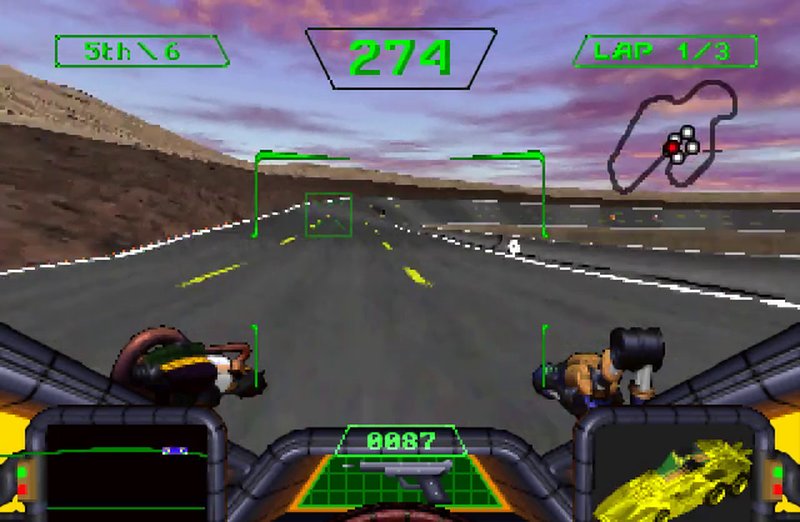
What has aged worst is the opposition: five rivals is a thin field, their behaviour is predictable, and once the upgrade ladder is climbed there is little left to chase beyond times. What has aged best is the feel — the weight of the car, the rush of the tunnels, the sheer 1993-ness of its chrome-and-fire cockpit. In a museum of launch titles, most of which are unplayable tech demos, Crash ‘n Burn remains genuinely fun to pick up, which is not a small achievement for a game designed as a shop window.
Its place in the story
Every 3DO collection tells two stories: the masterpieces the machine accumulated, and the promise it made on day one. Crash ‘n Burn is the promise, preserved. Play it after Road Rash and The Need for Speed and its limits show — then remember it predates both, on hardware nobody understood yet, and opened the door they walked through. As the system’s founding artefact and a still-speedy arcade racer, it earns its place on the shelf and in the drive.
Reading the launch, thirty years on
To understand Crash ‘n Burn completely you have to reconstruct its first audience: shoppers in late 1993, standing in electronics stores, watching demo pods. Against the SNES’s Mode 7 and the Mega Drive’s scalers, this game’s textured tunnels and free-moving camera were not incremental — they were categorical, the visible arrival of the thing the magazines had been promising. Crystal Dynamics, a young studio founded by Sega and Virgin alumni, had bet its existence on the machine, and Crash ‘n Burn was its calling card to the entire industry. The game wears that purpose openly: every track is a showroom, every effect a demonstration, every camera angle a salesperson’s gesture toward the screen.
What is surprising, revisiting it, is how much of the modern Crystal Dynamics is already here — the confidence with spectacle, the instinct for a track that reads like a film set, the understanding that a player should be shown something new every twenty seconds. The economy of upgrades between races, thin as it is, is the seed of the progression systems the studio would spend decades refining. Even the fiction’s shrug — post-apocalypse as an excuse for chrome — is a kind of honesty: the game knows you are here for the driving and declines to waste your time pretending otherwise.
And the driving, finally, is why the disc still earns its shelf space next to the system’s masterpieces. The two great 3DO racers that followed it ask more of the player — simulation in one case, violence in the other. Crash ‘n Burn asks the least and delivers its pleasures fastest: pick it up, and ninety seconds later you are flat-out through a tunnel with a missile locked and the future arriving at 300. Launch games are supposed to date the worst of anything. This one dates like a poster.
The opposition, such as it is
One more honest entry in the ledger: the rival drivers are personalities in name only, five silhouettes with aggression settings, and the game’s difficulty lives in its tracks and its clock rather than in any duelling intelligence. A modern combat racer would build a nemesis system and market it on the box. Crash ‘n Burn’s rivals exist to be passed, shot and forgotten — which fits the arcade brief the game was built to, and explains both its immediate charm and its ceiling. It is a game about racing through the future, not about the people in it, and thirty years have not changed what it is for.
For the shelf
Collectors will find Crash ‘n Burn in two period forms: the jewel-case pack-in that travelled with the FZ-1 and the long-box retail edition, and the honest truth is that the pack-in is the historically correct one — the disc as most first owners met it. Either way it is among the most affordable of the system’s significant titles, which makes it the correct first purchase for a new 3DO owner: the founding artefact, at a founder’s discount, still fast enough to justify the shelf it stands on.
Verdict
Crash ‘n Burn is a launch title that still plays like one — in the best sense. Fast, shiny, shallow and proud of it, it introduced the 32-bit generation with a bootful of nitrous and remains the most historically important racer on its system. Score: 7.5/10