
At a glance: Crossed Swords II · Neo Geo CD · ADK, 1995 · Action / hack-and-slash · Score: 8.0/10
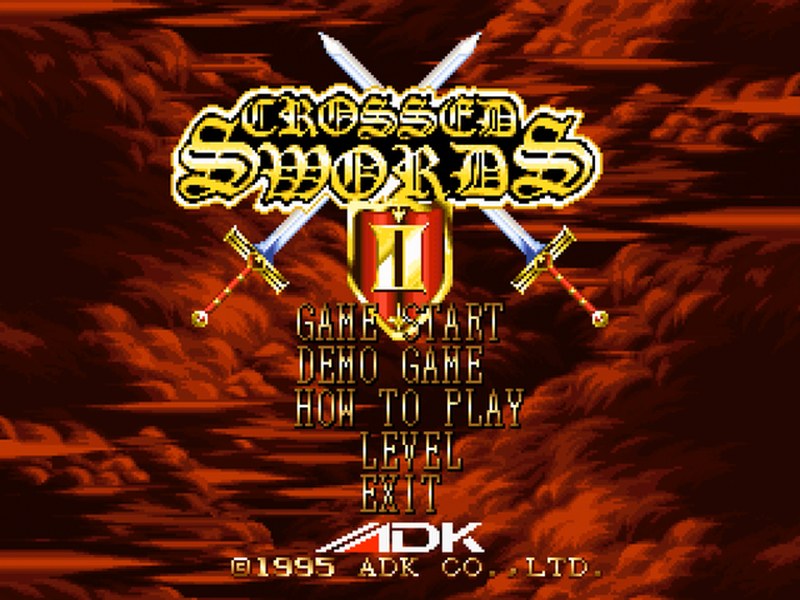
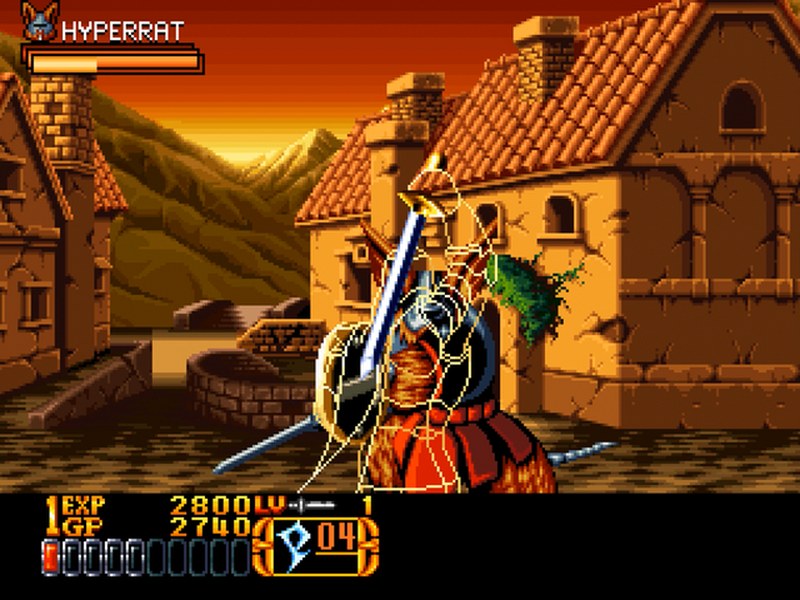
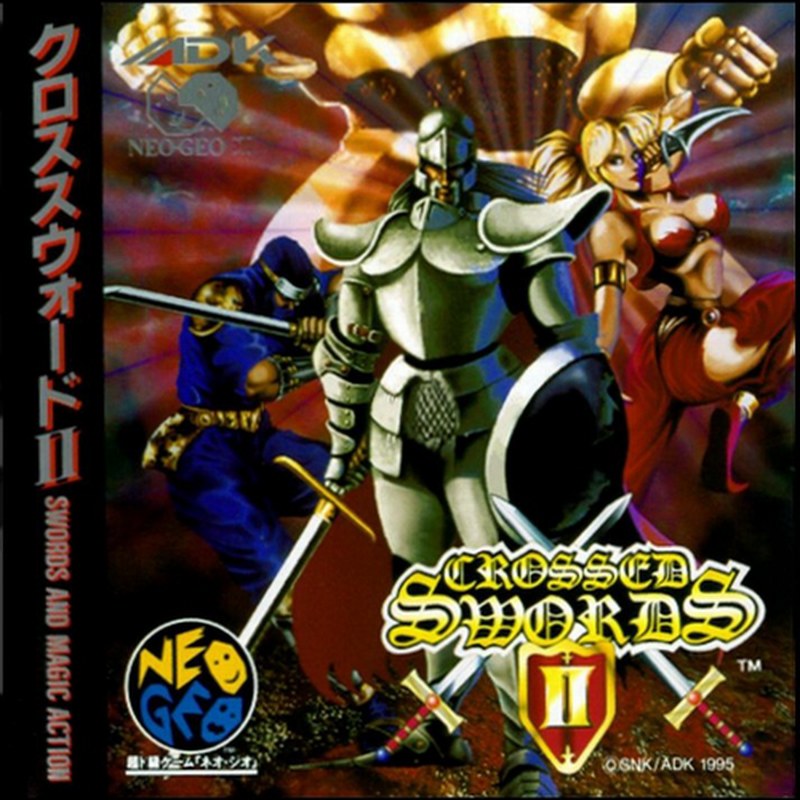
Crossed Swords put you behind your knight’s translucent back, sword in one hand and shield in the other, parrying and striking in first person as fantasy’s bestiary closed in. The 1991 original was an arcade and AES release; its sequel, Crossed Swords II (1995, ADK), was made exclusively for the Neo Geo CD — the format’s other great exclusive alongside Ironclad, and the stranger of the two. Everything is amplified: three selectable knights with different speed and power, a fuller moveset of thrusts, sweeps, magic and shield-bashes, gold and shops between stages, and a campaign across a demon-invaded kingdom that runs longer and weirder than the original’s.
The combat remains a rhythm discipline: read the enemy’s wind-up, block high or low, counter in the window, manage the crowd. Skeletons feint, slimes split, bosses fill the screen with patterns that must be blocked as much as dodged. It is slow by modern action standards and all the more distinctive for it — a fencing game wearing an RPG’s clothes, with levelling, equipment and a two-player co-op that turns defence into teamwork.
The CD treatment
As a CD-native production the game is built around its loads: stages arrive in monkey-measured chunks between bouts of action, the structure breaking naturally at arena boundaries, and the CD soundtrack gives ADK’s medieval score the full orchestral-synth treatment. Nothing here was ported down from a bigger original — the disc is the original — and performance is clean throughout, the big sprites and scaling effects running as authored. The versus mode, knight against knight in the same behind-the-back framing, is a curiosity that plays better than it has any right to.
Its exclusivity cuts both ways for collectors: never ported in its era and skipped by most later compilations, the CD is simply how you play Crossed Swords II, which has kept the disc in honest demand. For the format’s historians it is essential evidence — SNK’s CD strategy included real originals, and this is the one with the swords.
Crossed Swords II kept an entire genre-of-one alive for exactly one more game — and made it count.
Three knights and a kingdom
The sequel’s campaign structure is its quiet upgrade: where the original was a linear gauntlet, Crossed Swords II opens into a kingdom — stages branching across a map, gold accumulated and spent on weapons and armour between bouts, and a difficulty curve that assumes you are building a knight rather than renting one. The three selectable heroes formalise the original’s single silhouette into genuine choice: speed, power and the balanced middle, each with distinct magic. Encounters escalate from the first game’s skeletons and slimes into a bestiary with ranged threats, feints and genuine crowd problems, and the blocking game — high, low, timed — grows from a mechanic into a discipline as the campaign lengthens. It is, structurally, an action-RPG wearing a first-person brawler’s perspective, which is a combination exactly one series has ever attempted.
The CD production values carry the expansion: larger sprites, more varied arenas, and a soundtrack given the full disc treatment, with the versus mode as the era’s home-format bonus. Nothing about the package feels like a budget sequel; it feels like ADK using the CD’s economics to make the bigger game the arcade’s coin economy would not have funded. That is the exclusives argument again, wearing armour this time.
The CD version in 2026
Playing Crossed Swords II today means playing it here — the disc is the original and, in its era, the only edition — which simplifies the buying advice to the format’s usual virtues: region-free pressings, sane prices beside the AES catalogue’s legends, and modern options (the CDZ’s faster drive, SD loaders) that trim the stage loads its structure already civilised. Emulation has made sampling easy for the curious, and the curious should sample: this is a deliberate, fencing-paced game whose pleasures are real but specific. For players they suit, the disc is not a compromise edition of anything. It is the archive of a genre of one, kept by the only format that ever hosted it.
The verdict
Crossed Swords II is a fascinating, enjoyable oddity: a genre of one, extended with confidence, available only here. It will not convert players who bounced off the original’s deliberate pace, but for everyone else this exclusive is one of the strongest reasons the CD library rewards exploration beyond the famous conversions.
Blocking as a language
The combat’s grammar is worth one precise paragraph, because no other game speaks it. Enemies telegraph in a vocabulary of wind-ups — high, low, feinted — and your shield answers in kind; a correct block opens the counter window, a wrong one costs health and position, and crowds turn the vocabulary into simultaneous translation. Magic is the punctuation, rationed and decisive. The system is learnable in an hour and still teaching at ten, which is why the original built its cult and why this sequel’s refinements — three knights, better tells, a shop economy that rewards clean fights — land as generosity rather than clutter. It looks, in stills, like a curio. In motion, at the third hour, it feels like fencing school run by demons.
The CD is the school’s only building: no arcade original, no cartridge, no era port. Prices have respected that singularity without surrendering to it, and the disc’s condition — like all the exclusives — should be checked with the care its irreplaceability deserves. Genres of one are fragile things. This one’s keeper is a compact disc, and it has kept it well.
The last word belongs to the perspective itself: behind-the-shield framing was tried by others in the CD’s era and abandoned, which leaves this series as the sole keeper of a genuinely different way to fight — closer to fencing’s eyeline than to any brawler’s camera. Preservation arguments are usually made for stories and scores; here is one made for a viewpoint, and it is a good one.
Play it in the order the format intends — original first if you can, sequel after — and the sequel’s generosity reads as a studio answering its own critics with a bigger, kinder, stranger game. Sequels that listen are rare. Sequels that exist only because a cheaper format freed their budget are rarer. This is both.
Final notes
ADK’s house style is the subtext worth naming: the studio’s games — Magician Lord’s gloom, Ninja Master’s hybrid daring, this one’s earnest chivalry — share a willingness to be strange that the bigger SNK internal teams polished away. The exclusives shelf is substantially an ADK shelf, and retro gaming is richer for the studio’s odd confidence.
Two-player co-op transforms the campaign’s back half, where crowd control becomes a genuine partnership of shields — the feature the arcade original pioneered socially and this sequel, at home, finally lets you schedule. Bring a fellow knight; the kingdom is long.
Condition note for hunters: as an exclusive with a modest pressing, clean complete copies reward patience in the search. The game waited out its own obscurity for thirty years. It can wait out your auction alerts, and it is worth the wait it keeps promising.
Score: 8.0/10 — A genre of one, extended with confidence, available only here. Fascinating and genuinely fun.