
At a glance: Dead Rising · Xbox 360 · Capcom, 2006 · Survival action · Score: 8.0/10
Frank West has covered wars, you know. What he’d never covered, until September 2006, was a shopping mall containing roughly fifty thousand zombies, a three-day countdown, a camera, and every object in retail America waiting to be used as a weapon. Dead Rising was one of the 360’s first essential games: a strange, stressful, hilarious and genuinely innovative survival game that took George Romero’s satire, Capcom’s zombie craft and a time-management structure borrowed from Majora’s Mask, and built something that still has no real imitator. It is also, deliberately, a game that lets you fail. That’s the point.
72 hours in Willamette
The structure is the game. Dropped onto the roof of the Parkview Mall, freelance photojournalist Frank West has 72 in-game hours — about six real hours — until his helicopter returns. The main “Case Files” unfold on a schedule whether you’re ready or not. Side stories (survivors to rescue, psychopaths to fight) appear and expire on theirs. You cannot do everything in one run, and the game knows it: your level, unlocked moves and knowledge carry into the next attempt, turning failure into tuition. First runs end in the security room, overwhelmed, watching scoops expire. Second runs are choreographed like heist movies. It is a roguelike structure years before the genre had a name for it, wearing a zombie game’s clothes.

Inside the clock, the mall is the star: a fully explorable American megamall — food court, hardware store, toy shop, sporting goods, a cinema, an indoor plaza with a maintenance tunnel beneath it all — rendered with a density of interactive clutter no 360 game had attempted. Hundreds of zombies can crowd the screen at once, a genuine hardware flex in 2006, and everything not nailed down is a weapon: benches, mannequins, shopping carts, shower heads, lawnmowers, the legendary Real Mega Buster for those who earn it.
Psychopaths and photography
The humans are worse than the zombies — Romero’s rule, honoured faithfully. The mall’s psychopaths, ordinary people snapped by the apocalypse (a clown with balloons and twin chainsaws, a Vietnam veteran in the hardware store, a chef who has found a new protein source), are Dead Rising’s boss fights and its best writing: tragic, funny and frightening at once. Between them, Frank’s camera is the quiet stroke of genius — photography is scored by genre (horror, drama, erotica, brutality, humour), teaching you to look at the carnage like a journalist and turning every set piece into a photo opportunity.
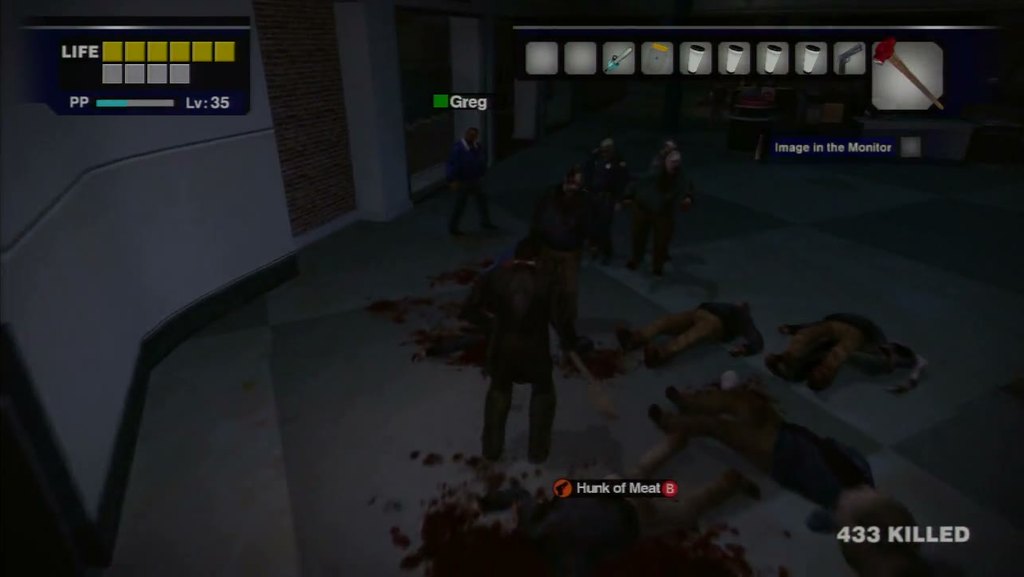
Survivor escort is the friction point, then and now: the rescued are brave, stupid and magnetically attracted to zombie crowds, and shepherding three of them across the plaza with a bench over your shoulder is either the game’s finest emergent comedy or its most infuriating habit, depending on your blood pressure. The save system — sparse save points, one slot — compounds the pressure deliberately. Dead Rising wants you stressed. Players who bounce off it usually bounce here, and their complaint is legitimate; it’s simply also the source of everything the game does that nothing else does.
An ending, several endings, and overtime
Multiple endings grade your run from the true S-rank resolution — which unlocks Overtime Mode’s final day and then the endless Infinity Mode for the truly committed — down to Frank simply missing the helicopter and the story. The breadth of outcomes, the unlockable costumes and weapons, and the sheer density of hidden detail (combo weapons’ ancestors, secret survivors, the tunnel system’s nightmare basement) make Dead Rising a game about mastery over weeks, not completion in a weekend.

A technical flex that became a series
Dead Rising’s other legacy is technological. Capcom built it on the MT Framework engine that would power much of its HD-era catalogue, and the sheer crowd counts — achieved with instancing tricks, aggressive level-of-detail work and an unshakeable commitment to the bit — were a genuine showpiece for the young 360. Nothing else in 2006 put that many characters on screen outside a strategy game, and the mall’s interactivity (every shelf stocked, every register a weapon) made the crowd count feel like a philosophy rather than a spec: this world is all real, all usable, all dangerous.
The series that followed — three sequels, spin-offs, a Wii reimagining, and remasters including a full Deluxe Remaster in 2024 — progressively sanded the original’s edges: bigger malls, friendlier saves, co-op, combo weapons. Each is more convenient. None is more interesting. The 2006 original remains the critics’ and cultists’ choice precisely because of its stubbornness — the single save, the expiring scoops, the survivors who will not follow instructions — every friction a deliberate weight on the scale against the clock. It is the rare launch-era game whose design arguments are still live, still unsettled, and still worth having with a controller in your hand.
Frank, the camera, and the comedy
One more element keeps the darkness playable: Dead Rising is, minute for minute, one of the funniest games of its generation, and the comedy is systemic. It lives in the servbot helmet slipped onto a zombie’s head, in the shower-head that sticks where it lands, in the sight of Frank — a paunchy, ageing, entirely ordinary-looking man, the anti-action-hero — riding a child’s bicycle through the food court in a Mega Man costume he found in the toy shop. The unlockable wardrobe is enormous and gloriously undignified, and the photo-scoring system rewards you for framing the apocalypse like a tabloid. Capcom understood Romero’s deepest point: the mall is funny until it isn’t, and the swing between those states is the whole experience. Games that copied the crowds copied the least of it.
Come to it patient, then. Expect your first run to end badly, your second to end better, and your third to feel like conducting an orchestra of chaos with a shopping cart. That learning curve — from victim to choreographer — is Dead Rising’s unique gift, and no sequel, remake or imitator has bottled it since.
The verdict
A zombie game about time, not undead: Capcom’s mall remains one of the boldest designs of its generation, as happy to let you fail as to let you triumph.
Dead Rising is the 360 launch era’s most original game — funny, cruel, dense and utterly itself. Its escort AI and save discipline will test modern patience, but they are load-bearing parts of a design that still feels like the future. Frank West has covered wars. Give him three days and a hardware store, and he’ll cover this one too.
Practical closing notes: install the disc if you can (the mall streams constantly, and twenty-year-old DVD drives deserve the rest), accept the single save slot as the design it is rather than a defect to route around, and do not be proud about abandoning a doomed first run — the game is built on the dignity of starting again, stronger. Players who give Dead Rising that much trust tend to end up evangelists. The mall is waiting, the clock is already running, and the helicopter comes at dawn on the third day whether you are ready or not. Be ready.
Score: 8.0/10