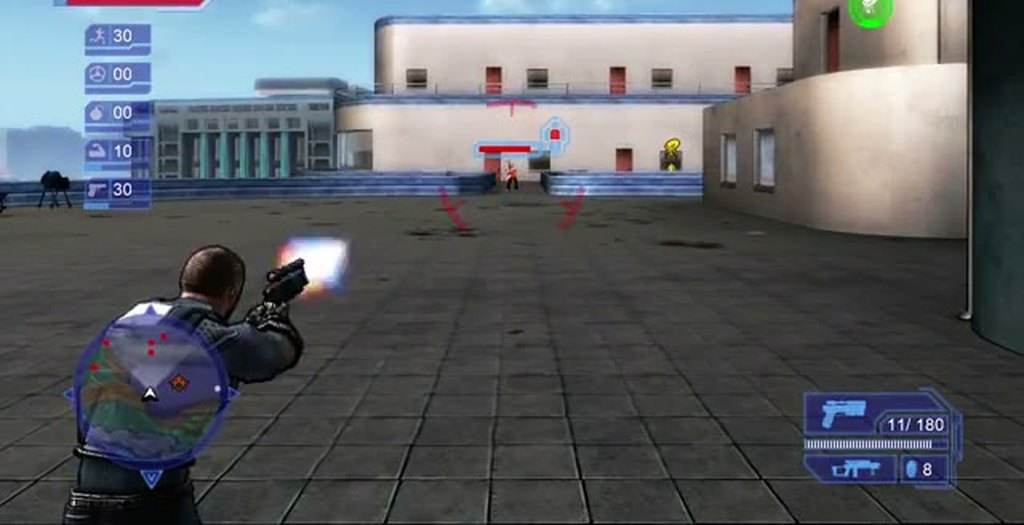
At a glance: Crackdown · Xbox 360 · Realtime Worlds / Microsoft Game Studios, 2007 · Open-world action · Score: 8.0/10
Crackdown is famous, unfairly, for the company it kept: the disc carried the Halo 3 multiplayer beta invite, and half its audience bought it as a very expensive beta key. The joke, discovered within weeks, was that the “free” game in the box was one of the most purely joyful open-world games ever made. Crackdown has almost no story, no cutscene fat, no interest in your feelings. It has a city built like a jungle gym, a super-cop who levels up by doing whatever he’s already doing, five hundred glowing orbs hidden on rooftops — and it trusts you to make your own fun. You will.
Pacific City is a climbing frame
You are the Agent, a genetically engineered officer of the Agency, turned loose on Pacific City to decapitate its three crime syndicates — Los Muertos, the Volk and the Shai-Gen — by killing their generals and kings in any order, by any method, at any time. That structural freedom was radical in 2007 and remains bracing: the whole city is open from minute one, every boss reachable the moment you can survive the approach, and the game’s guidance amounts to a dossier photo and a cheerful “good luck, Agent.”
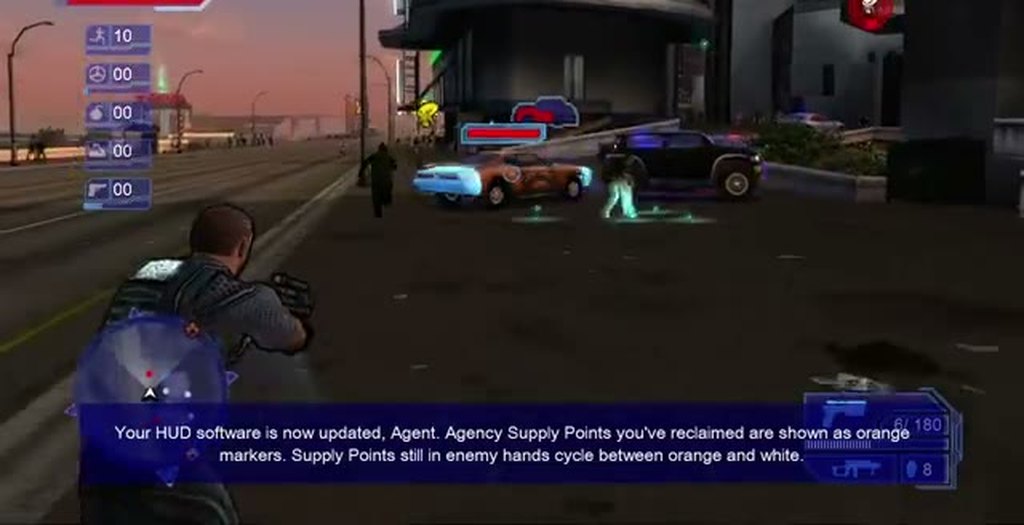
What makes it sing is verticality. Pacific City was designed by Realtime Worlds — David Jones’s studio, from the Grand Theft Auto and Lemmings lineage — as a city to be climbed, not driven. Your agility skill grows as you collect the green orbs scattered across every rooftop, and your jump grows with it, until crossing the city becomes a flowing parkour of leaps, ledge-grabs and thirty-storey falls you walk away from. The Agency Tower at the city’s centre, the tallest climb in the game, became a generation’s rite of passage — capped by the leap of faith into the water far below. Modern open worlds are full of this DNA.
Skills for kills, Agent
The progression system is gloriously blunt: use a thing, get better at the thing. Shoot people, and your firearms skill swells until you’re headshotting from a rooftop with a harpoon gun. Hurl dumpsters, and your strength grows until you’re throwing trucks. Drive like a maniac — through gang members, ideally — and your driving skill transforms the Agency’s vehicles around you, armour blooming from the chassis in real time. Explosives need no summary. It’s an RPG stripped to its dopamine skeleton, narrated by the Agency director’s booming voice (“Skills for kills, Agent — skills for kills”) in a performance of pure, encouraging menace.

Combat itself is cheerfully overpowered: lock-on shooting, physics-driven brawls, rocket launchers against crowds, and piles of vehicles to weaponise. Crackdown never wants a fair fight; it wants a highlight reel. Two-player co-op — drop-in over Xbox Live, whole city, both Agents levelling independently — multiplies the chaos, and remains one of the 360 era’s great shared pleasures. One period caveat worth knowing before you promise a friend the second controller: there is no split-screen, so co-op means two consoles or the (now quiet) online route.
Where the seams show
The honesty paragraph: Crackdown has about four mission types wearing different gang colours, a targeting system that occasionally locks onto a car when a general is shooting you, and a final-boss tower climb that tests agility more than combat. Its story is a single twist delivered in the last ninety seconds. None of this mattered in 2007 because the moment-to-moment freedom was the content — but a player raised on modern open-world density should know this is a playground, not a narrative. The playground, however, is all killer: rooftop races, stunt rings, orb hunting and stronghold sieges fill twenty hours without a fetch quest in sight.

The orb effect, and what came after
Ask players what they remember and it won’t be a boss or a cutscene. It will be the sound — that bright, rising chime of an agility orb, engineered to be audible across a rooftop and irresistible at a hundred metres. Crackdown’s orbs are the purest collectible design ever shipped: visible from afar, audible from nearer, always placed to teach the city’s geography, and tied directly to the verb you most want to improve. The hidden orbs, the stunt rings, the rooftop races — the whole game is a conspiracy to keep you airborne. Game design courses still cite it; every open world studded with glowing baits is quoting it.
The sequels tell you how hard the trick was. Crackdown 2 (2010) reused the city and divided opinion; Crackdown 3 arrived nine years later on newer hardware with cloud-computing promises and landed softly. Neither recaptured the original’s balance of freedom, verticality and cheerful, unpretentious mayhem — partly because the original’s restraint was the point. It never interrupts you. It never explains itself. In an era when open worlds groan under waypoints and cutscenes, Crackdown’s confidence that the city plus physics plus orbs is enough content remains almost radical, and it is why the “free game in the Halo box” outlived its joke.
David Jones and the sandbox lineage
Crackdown’s design makes sense when you know its family tree. David Jones created Lemmings at DMA Design, then Grand Theft Auto in the same building; Realtime Worlds was his next act, and Crackdown reads like the synthesis of both inheritances — Lemmings’ joy in systems colliding, GTA’s city-as-playground, and neither series’ interest in telling you a story. The comic-book cel shading, unfashionable in the brown-and-grey of 2007, has proven to be the era’s most age-resistant art choice: Pacific City today looks like a graphic novel while its “realistic” contemporaries look like old photographs. Add a soundtrack of licensed cuts piped through car radios and the Agency director’s immortal narration, and you have a game whose surface has barely dated at all.
The co-op note deserves repeating in the recommendation: if you have any way to play this with a friend — two consoles, two screens, one city — do it that way first. Crackdown solo is a delight. Crackdown with a partner, racing to strongholds and duelling across rooftops between missions, is one of the defining social games of its console. The beta key was a footnote. This is the text.
The verdict
The game that taught open worlds to climb: five hundred orbs, one superhero cop, zero filler — Crackdown is joy with a badge.
History has reassessed Crackdown upward, correctly. What looked like a beta-key bonus in 2007 now reads as a founding document of the modern open-world playground — vertical, systemic, player-directed — and it’s still absurdly playable, especially in co-op. The sequels never quite recaptured why it worked. The original still does. Welcome back, Agent.
The score, for the record, is held at eight only by the thin mission structure and that targeting quirk — judged purely on the verbs it gives you and the city it gives you to use them in, Crackdown is close to unimprovable. It is the game this reviewer reaches for when a modern open world has spent twenty minutes explaining itself: within ninety seconds of booting Crackdown you can be on a roof, and within three you will have heard the orb chime and forgotten every plan you had. That is not a small thing. That is the whole thing.
Score: 8.0/10