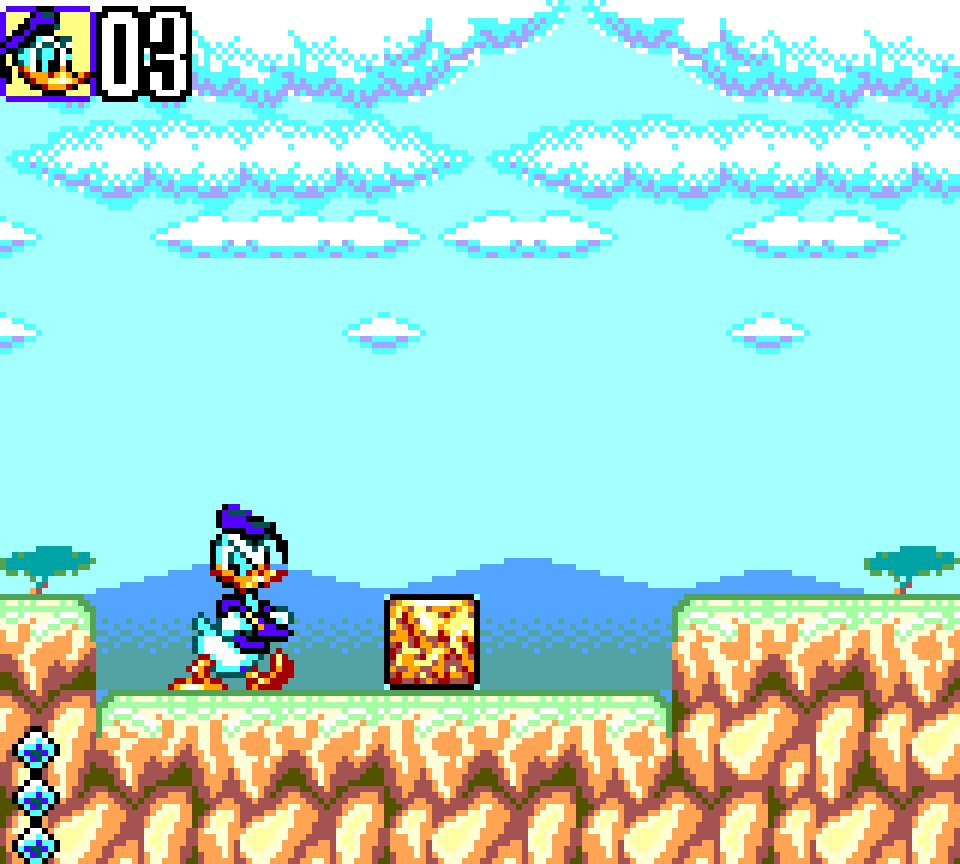
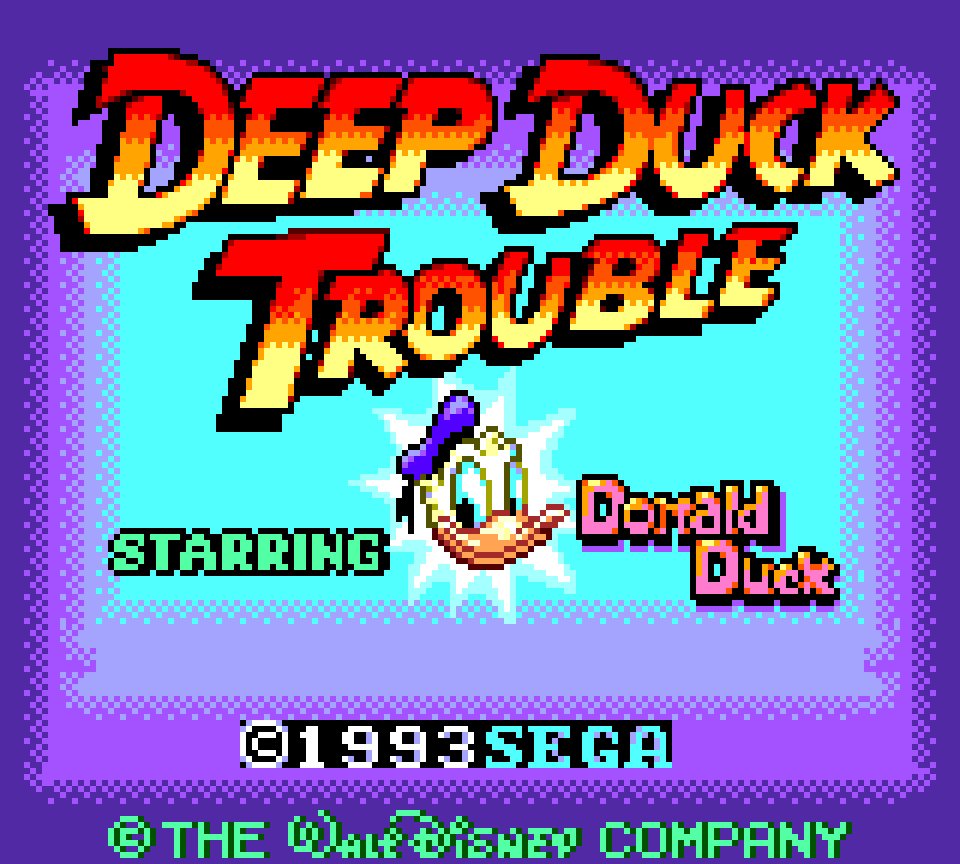
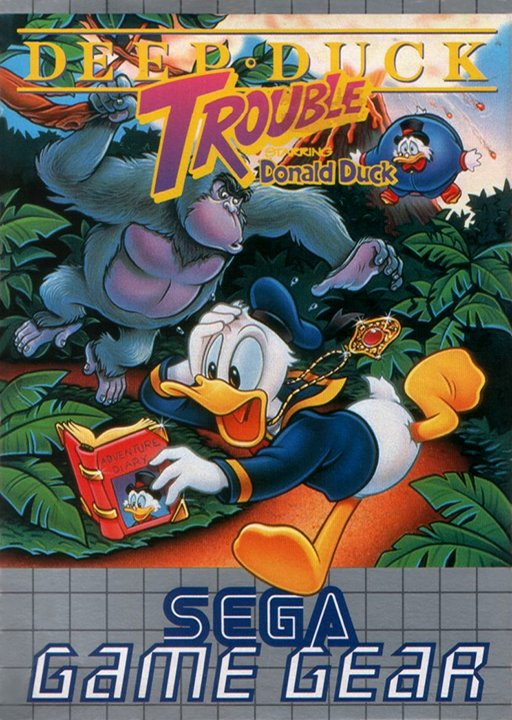
At a glance: Deep Duck Trouble Starring Donald Duck · Game Gear · Aspect / Sega, 1993 · Platformer · Score: 7.5/10
Every great series earns a wilder sequel, and Deep Duck Trouble is Donald Duck’s. Where The Lucky Dime Caper sent Donald globe-trotting in a tidy, disciplined platformer, its 1993 follow-up — developed by Aspect, the studio behind the handheld Sonics — loosens the tie: bigger sprites, stranger stages, a cursed pendant, an Uncle Scrooge swollen to giant size by dark magic, and a Donald armed with nothing but his temper, his bounce and an alarming fondness for chilli peppers. It is a shorter, quirkier game than its predecessor, and while it never quite reaches the Illusion series’ heights, it has a personality entirely its own and a place in the Game Gear’s Disney shelf that no other cartridge fills.
The premise is pure Duckburg. Scrooge has brought home a pendant from his travels; the pendant is cursed; Scrooge inflates like a parade balloon and drifts helplessly; Donald, guided by his nephews’ research and Gyro’s counsel, must retrace the expedition across jungles, ruins, the high seas and a volcano to find the cure. The tour structure gives the game its variety: each stage is a postcard from the treasure-hunting life, and the whole thing moves at a holiday snap.
Donald, in full temper
What Aspect understood is that Donald is not Mickey. Mickey bounces with grace; Donald attacks with his feet in a flailing tantrum, kicks blocks across the screen, and — fed a chilli pepper — erupts into a brief, glorious rampage of invincible sprinting that sends enemies flying and the player laughing. The tantrum is the game’s signature mechanic and its best joke, a power-up that is also a character study. Between rampages, Donald’s moveset is the Illusion-family standard — bounce, kick, swim, climb — executed with the studio’s usual competence and generous sprite work. Donald himself is a superb piece of pixel acting: the idle impatience, the foot-tapping, the full-body fury of the pepper state.
The stages are where the game spends its budget. A jungle of swinging vines and rising water, Aztec-style ruins with rolling hazards, a pirate interlude, an icy detour and the volcanic finale — each is drawn with the Game Gear palette in mind, all saturated greens and furnace oranges, and each introduces its gimmick cleanly before combining it with the last. Boss encounters cap the tour with size and silliness in equal measure. The whole adventure is, however, brief: four main areas and a finale, an afternoon’s play for a practised platformer player, and the difficulty barely rises above friendly until the last stage.
Game Gear only, and it shows
Unlike the Illusion games, Deep Duck Trouble has no Master System counterpart of its own era to be cropped down from — it was built for the handheld (a Master System version exists only as a much later Brazilian rarity assembled from this game’s bones). The benefit is the one we praise throughout this library: honest sight lines, sprites sized for the small screen, hazards that never arrive unannounced. The cost of the era is a password system for progress and a soundtrack that, while cheerful and well-made, sits a tier below the Illusion scores’ memorability.
Feed Donald a chilli and stand back: Deep Duck Trouble’s rampage mode is the funniest power-up on the Game Gear.
Set against The Lucky Dime Caper, the trade is clear. The earlier game is the more substantial adventure — more stages, more structure, a globe genuinely trotted. Deep Duck Trouble is the more characterful afternoon: funnier, prettier, looser, and over sooner. Children of the era often preferred the sequel for exactly those qualities, and returning to both now, it is easy to see why. What it lacks in the series’ trademark exploration — no tools, no backtracking, no map — it partly repays in pace and charm.
The honest charge sheet
Brevity is the main count: this is one of the shortest first-party platformers on the system, and its price at the time bought less game than the box promised. The chilli rampage, for all its glory, is rationed to set-piece stretches, and a few mid-game stages recycle their gimmicks. Collision on the kick attack can feel a pixel ungenerous. None of it is fatal; all of it explains why Deep Duck Trouble is remembered as the delightful second-tier Disney game rather than the essential one.
The tour, stage by stage
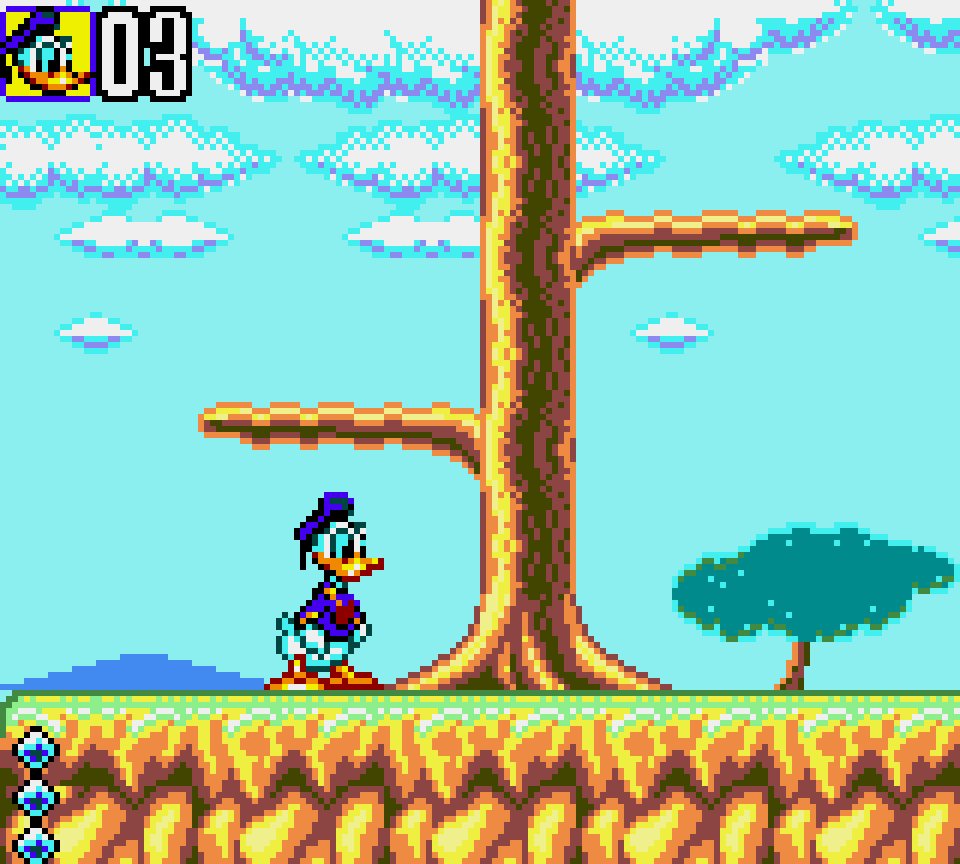
Each stop on Scrooge’s itinerary has a distinct mechanical flavour, and the variety carries the short campaign. The jungle is the vertical one — vines, rising water, bounce-chains over the canopy. The ruins go horizontal and mean: rolling stones, crumbling floors, momentum. The sea stages add swimming with Donald’s particular spluttering grace, and the volcano finale assembles everything under a rising-lava deadline that finally asks the player to be quick as well as careful. It is a well-paced little world tour, and its brevity has one more defence to offer: there is no filler stage in it. Every cartridge of the era had one. This one, whatever else, does not.
It is also a useful fossil of Aspect at work. The studio that made the handheld Sonics brought the same virtues here — generous sprites, confident colour, difficulty that respects children without boring their parents — and applied them to another company’s characters with total assurance. The Disney games on this system divide into Sega’s own Illusion line and Aspect’s contributions, and the seam is invisible to anyone not looking for it. That consistency is why the Game Gear’s Disney shelf, taken together, is the strongest licensed corner of any 8-bit library.
For the modern buyer, one practical note: the cartridge stayed affordable, partly because history filed it under its predecessor’s name and partly because brevity never inflates. That makes it the easiest recommendation in this Disney run — a low-price, high-charm afternoon that shows off the machine’s colour and Aspect’s craft, and asks almost nothing of you but a sitting. Not every game in a great library must be a monument. Some are postcards, and this is the brightest postcard the Game Gear ever sent from Duckburg.
The nephews’ role is a small delight worth noting: Huey, Dewey and Louie serve as the game’s brain trust, briefing Donald between stages with the earnest competence they have brought to every Duckburg expedition since the comics. Their presence ties the cartridge to the wider Duck universe more firmly than any logo could, and their briefings give the tour a narrative spine most platformers of the size never bother with. It is one more sign of a production that cared about its characters beyond their sprites.
Replay, briefly: the stages are short enough to invite the perfect run, the score system gives the perfectionist a reason, and the whole cartridge has the pick-up-and-finish quality that made it a schoolbag staple. Slight it may be, but slight and perfect is a harder trick than long and good.
Verdict
Deep Duck Trouble is the Game Gear’s funniest platformer: a short, vivid, character-perfect Donald adventure whose chilli-fuelled rampages and beautiful stages outweigh its brevity. It stands in the Illusion family’s shadow and knows it, and plays the class clown with total commitment. Disney collectors and platformer fans should own it; everyone else should borrow it for an afternoon and finish it smiling.