
At a glance: Land of Illusion Starring Mickey Mouse · Game Gear · Sega, 1993 · Platformer · Score: 9.0/10
The Illusion series is the crown of Sega’s 8-bit platforming, and Land of Illusion is its finest hour on any hardware. Released in 1993 as the sequel to the beloved Castle of Illusion, it takes everything that made Mickey’s first 8-bit adventure special — the bounce, the picked-up blocks, the storybook forests — and builds a bigger, cleverer, more generous game around it: fourteen stages across forests, lakes, deserts, castles and clouds, a map to choose your route, and a new ability earned from nearly every boss, each one re-opening earlier levels to exploration. On the Game Gear it is, quite simply, one of the best platformers of its generation.
The story is a fairy tale told straight. The sorceress Mizrabel — no, wait, that is Castle’s villain; Land’s threat is the Phantom, a shadowy figure who has stolen the crystal protecting a village, and Mickey, fresh from rescuing Minnie in the previous game, volunteers to climb, swim and bounce his way across the land to win it back. The framing is slight by design: this is a picture-book world, and the game trusts its forests, its flooded ruins and its cloud castles to carry the wonder. Donald, Goofy and other familiar faces appear as helpers along the way, each cameo placed like an illustration in the margins.
Every boss teaches a new trick
The design idea that elevates Land of Illusion is its toolset. Beat the forest’s guardian and Mickey gains the flute that charms certain blocks into platforms. The rope opens sheer climbs. The shrinking potion, the bottled cloud, the power of flight in the late game — each reward converts impassable scenery in stages you have already visited into new routes, new stars, new secrets. The world map, dotted with stages you can tackle in a forgiving order, turns the whole game into a gentle metroidvania years before the term settled, and the star-collecting gives completionists a proper second quest inside the first.
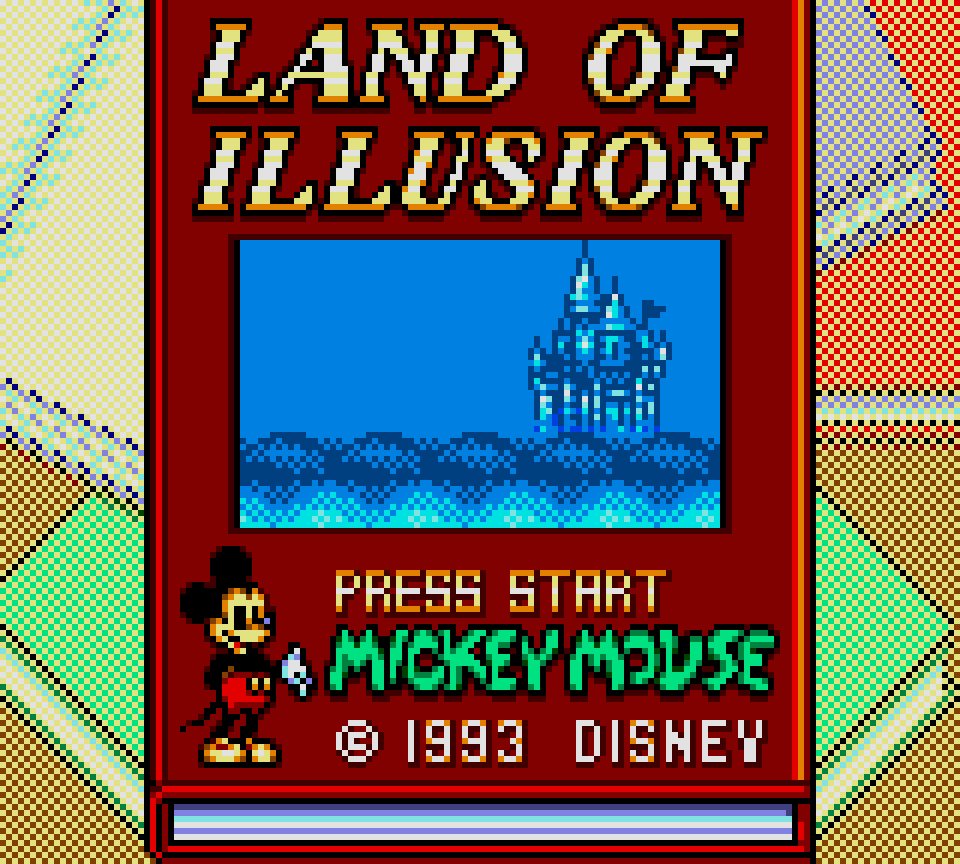
Mickey himself controls beautifully. The famous bounce — bottom-first onto enemies and springs — remains one of the most satisfying verbs in 8-bit platforming, and it is joined here by block-carrying inherited from the Master System Castle of Illusion, rope climbs, swimming with a proper sense of buoyancy, and a run that builds to exactly the speed the level design wants. Everything is readable at the Game Gear’s scale: the sprites are large, the hazards honest, the checkpoints kind. Difficulty rises with real care, from the forest’s tutorials to a final castle that assembles every skill into one long examination.
Game Gear versus Master System
Land of Illusion was built for both of Sega’s 8-bit machines from the same design, and the Game Gear version is the one to seek out for a subtle reason: it is the native habitat of this game’s art. The two versions are near-identical in content — stages, bosses, tools — but the handheld’s richer palette gives the forests deeper greens, the sunsets warmer skies and the Phantom’s castle a colder blue, and the game was plainly drawn with that colour in mind. The trade is the familiar one: the Game Gear shows a smaller window of the world than the Master System does on a television, and in one or two vertical climbs that narrower view asks for faith. It is a smaller price here than in faster games — Land’s pace is deliberate, its camera rarely your enemy — and most players will take the colour and the portability gladly.
Fourteen stages, a pocketful of magical tools, and not a wasted screen: Land of Illusion is the 8-bit platformer at its most generous.
The music, by the series’ returning sound team, matches the art: woodland themes with genuine melody, underwater passages that breathe, a final castle theme with the Phantom’s menace in it. Sound effects — the boing of the bounce, the splash, the magical chime of a new tool — are small masterpieces of feedback. In an era when licensed games were usually a warning label, Sega’s in-house Disney work was the standing counterexample, and Land of Illusion is the pinnacle of that argument on 8-bit hardware.
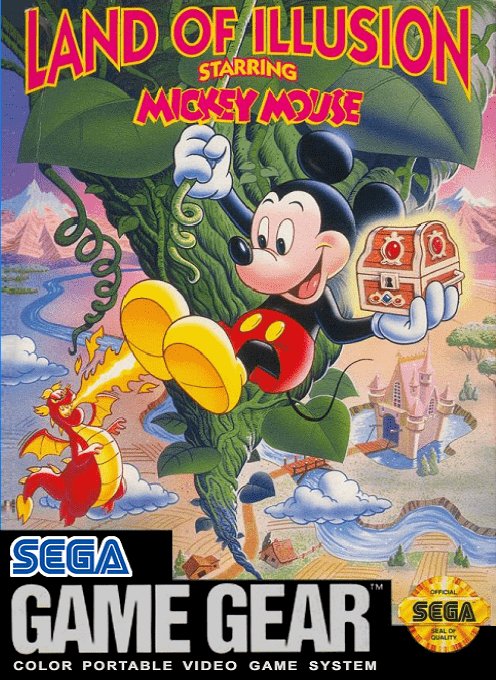
Small shadows
A fair review notes the few. The password system returns to carry progress between sessions, and in 1993 that was normal and in any year it is a chore. A couple of the mid-game bosses repeat their patterns a beat too long. The final stage, while magnificent, will spend your extra lives freely if you arrive under-practised on the flight sections. And completionists should know the star hunt hides a few collectibles behind genuinely obscure block placements. That is the whole of the charge sheet, and it is short because the game is excellent.

A tour of the fourteen
The stage list itself is an argument for the game’s ambition. The forest teaches; the lake introduces swimming with a kindness that later stages withdraw; the desert and its temple test the rope; the toyroom and the castle of the clouds play with scale and gravity; and the Phantom’s stronghold assembles the full toolkit into the series’ finest final examination. Side areas hide in most stages — a door behind a waterfall, a star above a suspicious ceiling — and the game tracks your completion with a generosity that invites the second pass. Few 8-bit platformers of any year can show fourteen stages with this little repetition between them, and none on a handheld.
Technically, too, this is late-period 8-bit craft at its peak: parallax where the hardware supposedly cannot, animation that gives Mickey weight and intent, and a frame rate that holds its nerve in all but the busiest screens. Coming two years after Castle, from a team that had clearly been allowed to learn in public, Land of Illusion shows what Sega’s 8-bit division could do at full confidence. The Master System version shares the glory almost exactly — but the Game Gear’s colour, again, is where the art was always meant to live.
The cameo economy is the final charm. Donald dispenses advice, Goofy guards a junction, Horace and Clarabelle keep the small kindnesses of the world — each appearance a page from the picture book, none of them outstaying a screen or two. Licensed games usually spend their characters like advertising. Land of Illusion spends them like a storyteller who knows the reader already loves these people and needs only to meet them on the road. It is the surest sign of the whole production’s confidence: a game this good did not need its guests, and invited them anyway.
And if a single screen must stand for the whole: Mickey, flute in hand, coaxing a block out of the forest floor while the light comes through the trees in bands of green and gold. That is the Illusion series in one image — magic as a tool, wonder as a mechanic — and the Game Gear renders it in the richest colour the image ever had.
Verdict
Land of Illusion is the Game Gear’s essential platformer: a big, beautiful, cleverly structured adventure that improves on a classic in every direction — more stages, more tools, more secrets, more heart. The Game Gear version’s colour makes it the edition to own, and its gentle metroidvania structure makes it the 8-bit Mickey game that modern players take to fastest. If the system has a masterpiece, this is the strongest claimant.