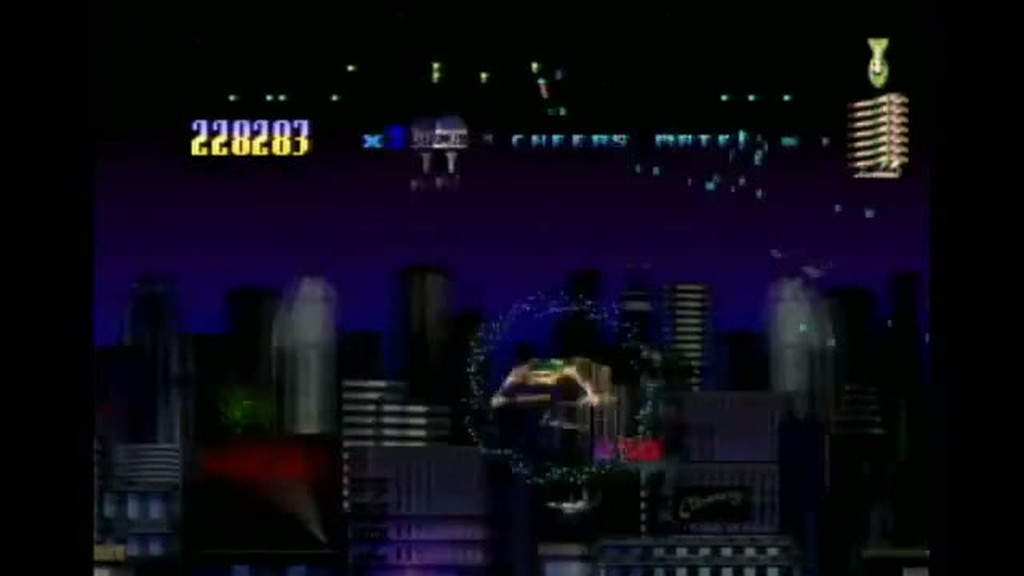
At a glance: Defender 2000 · Atari Jaguar · Llamasoft (Jeff Minter) / Atari, 1996 · Shooter · Score: 8.0/10
Jeff Minter made the Jaguar’s defining game with Tempest 2000, so when Atari handed him Eugene Jarvis’s other sacred text, expectations were unreasonable in both directions. Defender 2000 is what happened: three games in one cartridge — a faithful port of the 1981 arcade original, the expanded Defender Plus, and the full Minterised Defender 2000 — wrapped in techno, plasma and sheep-adjacent psychedelia. It is not quite the second masterpiece the faithful hoped for. It is, instead, a very good one, and the best way ever devised to play Defender at home.
Three Defenders, one cartridge
The original Defender remains what it always was: the most demanding arcade shooter of its generation, a game of impossible multitasking in which you patrol a scrolling planet surface, rescue falling humanoids from alien Landers, and hold an entire ecosystem of threats in your head at once. Minter’s port is respectful and accurate, right down to the scanner — the long radar strip that is Defender’s second screen and true battlefield. It plays superbly on the Jaguar pad and it will still, forty-plus years after the arcade, humble anyone who thinks themselves good at video games.

Defender Plus takes that foundation and floods it with colour and weaponry — bigger explosions, power-ups, a general sense that the 1981 machine has been lovingly hot-rodded. And Defender 2000, the main event, rebuilds the formula at Jaguar scale: larger sprites, rolling plasma backgrounds, warp-speed bonus stages, AI wingmen (“droid” companions that fight alongside you once rescued and upgraded), power-up chains and a thumping electronic soundtrack. The core loop is untouched — patrol, rescue, protect the humanoids, because a planet stripped of them turns hostile and mountainous — but everything around it is turned up with the confidence of a man who had just shipped Tempest 2000 and knew exactly how far the Jaguar’s sprite hardware could be pushed.
The Minter method
What distinguishes a Minter conversion is that the psychedelia is never decoration for its own sake; it is feedback. Every rescue, chain and power-up state is written in light and sound so that an expert player reads the game in their peripheral vision, which is fortunate, because Defender at full song leaves no attention to spare. The 2000 mode’s difficulty curve is the friendliest of the three — Plus and the original are sterner teachers — and the warp bonuses give the scoring game a second rhythm that pure survival lacks. Two players can alternate or cooperate depending on mode, and the high-score table has the usual Minter property of becoming a household obsession.
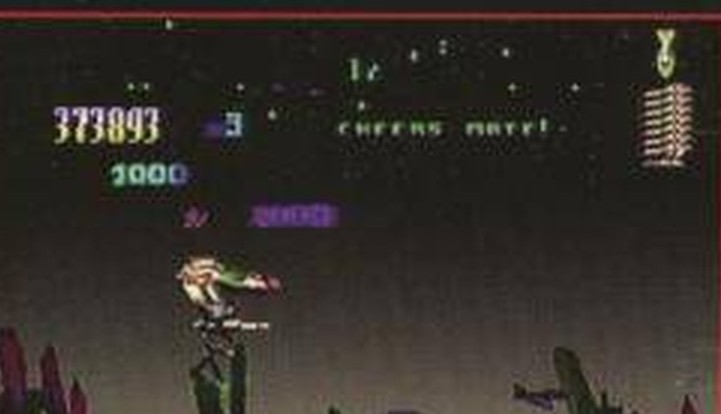
The criticisms, then and now, start with the sprite size in the main mode. Defender 2000’s ship and enemies are big, chunky and gorgeous, but Defender is a game about precision at the edges of the screen, and the larger art can make the playfield feel crowded — purists have always maintained that Plus, or even the original, is the “truest” Defender on the cart, and they have a point worth hearing. The plasma backdrops, glorious in screenshots, occasionally fight the action for readability at the exact moments the game can least afford it. And much as with Minter’s other work, the whole package is unapologetically a score-attack arcade game: no campaign, no progression system, no concessions. You play until you die, better each time. That is either the entire appeal or the entire problem.
Standing in the library
Context flatters Defender 2000. It arrived in 1996, as the Jaguar was being wound down, into a market that had decided the system’s story was over — and it is consequently one of the rarer and more sought-after cartridges in the catalogue, a late gem in the most literal sense. Alongside Tempest 2000 it gives the Jaguar the two finest “classic arcade, reimagined” treatments of the entire 16/32-bit era, from the same programmer, on the same unlikely machine. Sega and Nintendo both published respectable classic compilations; neither had a Minter.
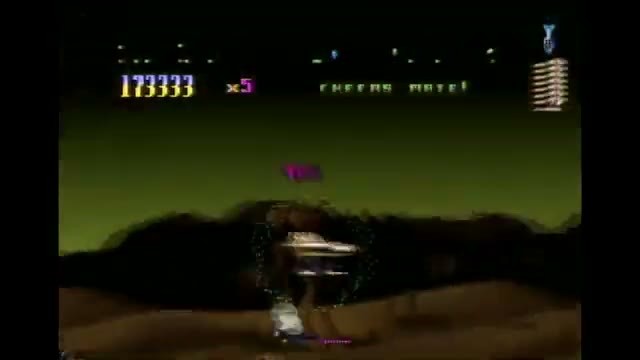
It is also, quietly, one of the best Jaguar games to hand a sceptic. No polygons to apologise for, no era-specific controls to learn, no campaign to invest in — just the purest loop in arcade history, in three strengths, tuned by the one programmer alive who had earned the right. The cartridge’s rarity means most people will meet it through emulation or reissues of Minter’s catalogue; the Jaguar original remains the fullest single package of the three modes together.
Scoring, sheep and the long game
Two smaller pleasures deserve their sentences. The first is the scoring culture the cartridge builds: Defender has always been a points game wearing a survival game’s clothes, and the 2000 mode’s rescue chains and warp bonuses give that culture its richest Jaguar form — the difference between a good player and a great one is not survival time but the arithmetic of humanoids saved and bonuses chained, and the cartridge’s tables make the distinction gloriously public within any household foolish enough to compete. The second is the humour woven through the production, the Llamasoft house style of cheerful surrealism that treats the apocalypse as an occasion for colour and noise. Where Tempest 2000’s psychedelia was sleek, Defender 2000’s is shaggy and joyful, and the cartridge is the warmer of the two for it.
None of which rescues the game’s one structural truth: it is a 1996 cartridge for a discontinued console, and it has lived the afterlife of that fact — scarce, admired, more discussed than played. The modern Llamasoft reissues have carried Minter’s later Defender-line thinking to new machines, and they are excellent; but the specific three-in-one generosity of this cartridge, original and Plus and 2000 under one label, belongs to the Jaguar alone. It is the system’s last great cartridge of the commercial era, and it went down swinging in neon.
Which Defender should you play first?
New owners, a route map. Start with 2000, whose friendlier curve and modern feedback teach the game’s grammar — scanner discipline, rescue priorities, the geometry of the wrap-around planet — without the original’s arcade brutality. Graduate to Plus when the 2000 mode’s spectacle starts to feel like assistance, and approach the 1981 original as the masterclass it is: the same game, stripped of every mercy the decades have added, played by the rules Eugene Jarvis enforced with a coin slot. That all three educations live in one cartridge is the package’s final generosity. Most compilations give you history as a museum. Defender 2000 gives it to you as a ladder, and dares you to climb it in public, on the high-score table, in front of your household.
Households are warned, finally, that the cartridge’s tables do not forget. Defender 2000 scores have outlasted tenancies, consoles and at least a few friendships. Sign yours with intent.
Three modes, one scanner, and the oldest lesson in arcade gaming: the planet is yours to lose, one falling humanoid at a time.
Verdict
Three Defenders, one master at the controls. The 2000 mode’s excesses are real but so is its joy, and with a faithful original in the same cart, the package covers every taste the game has ever inspired. Score: 8.0/10