At a glance: Defender · Atari 5200 · Atari (Williams licence), 1982 · Scrolling shooter · Score: 7.0/10
Defender was the hardest game in the arcade, and it was not close. Williams’ 1980 masterpiece gave you a ship over a scrolling planet, a scanner showing the whole battlefield, aliens abducting humanoids from the surface, smart bombs, hyperspace, reverse thrust — and five buttons plus a two-way stick to do it all with. Home conversions faced an impossible translation problem, and most failed honourably. The 5200 version, an early release for the system, is the most interesting of the early attempts, because the 5200 controller — that strange stick with a twelve-button keypad — was oddly well shaped for it. Defender is one of the few games where the keypad earns its existence.
The planet, the scanner, the panic
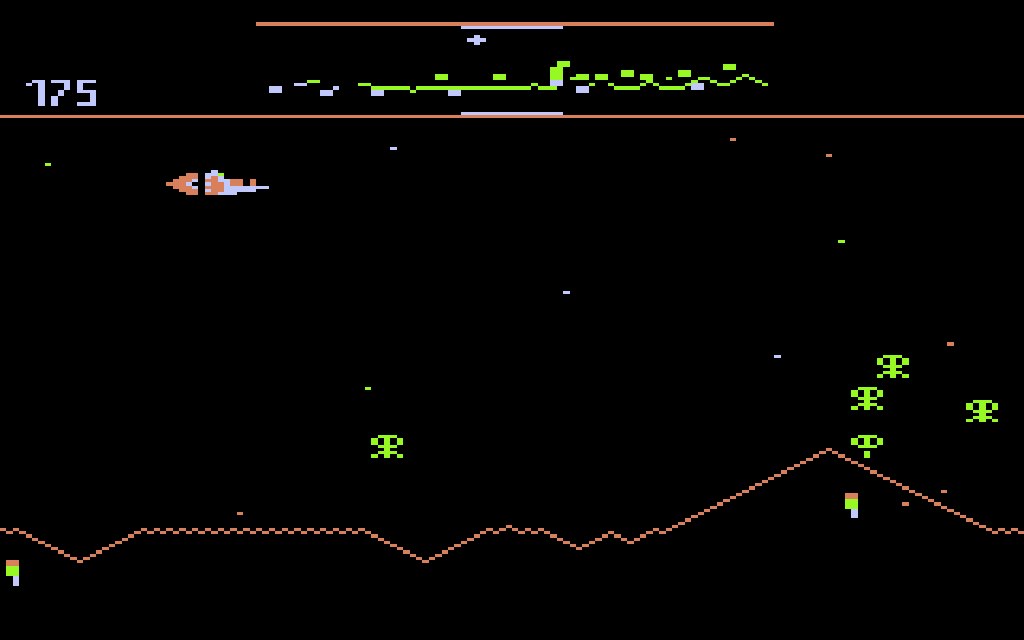
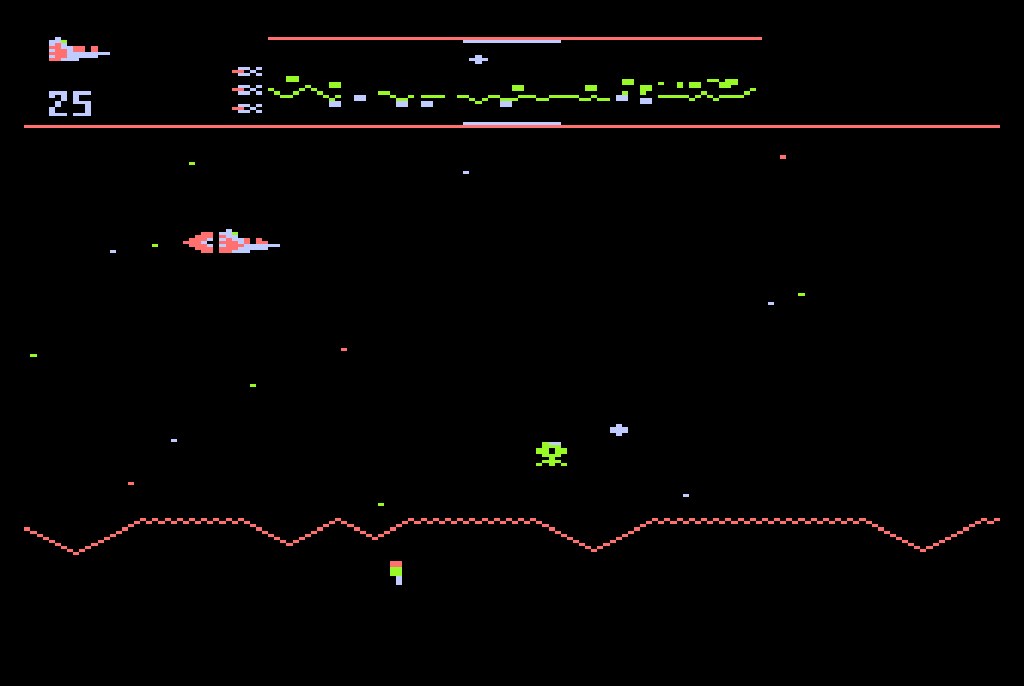
The essential Defender is intact. Your ship patrols a wraparound landscape drawn as a jagged line at the bottom of the screen, the long-range scanner at the top shows the whole planet’s traffic, and the Landers are doing what Landers do: descending on the ten humanoids standing on the surface, carrying them up toward mutation. Shoot the Lander, catch the falling humanoid, set him down gently — that rescue loop, the most imitated in shooter history, works here with its rhythm preserved. Bombers lay mines, Baiters arrive to harass you when you dawdle, Pods burst into Swarmers, and if all ten humanoids are lost the planet explodes and every Lander becomes a Mutant. The game is complete, and it is recognisably, ferociously Defender.

Graphically it is a mixed report. The scanner and landscape are faithfully rendered and the ship is the ship, but the sprites are chunkier than the arcade’s and the colour palette leans on what the 5200 does easily. The scrolling is smooth enough to play at speed, which is the real test, and the game keeps its pace under pressure — when three Landers are lifting off at once on different parts of the planet and the scanner is shouting at you, this version does not fall apart.
The keypad’s finest hour
Arcade Defender’s control panel had buttons for thrust, fire, reverse, smart bomb and hyperspace, and home ports usually amputated half of them. The 5200 keeps the set: the stick flies the ship, a fire button shoots, and the keypad — those twelve little buttons everyone else made fun of — hosts smart bomb and hyperspace where your other hand can reach them. It is not the arcade panel, and the keypad buttons are small, numb things to be stabbing for in a crisis, but the completeness matters. Smart bombs are Defender’s pressure valve and hyperspace is its panic button, and a port without them is a port of half the game.
Difficulty is selectable, from an Easy game that gives a new player room to learn the rescue loop up to difficulties that approximate the arcade’s contempt for human life. Even on Easy, Defender’s fundamental character survives: it is a game about triage, about deciding in a half-second which crisis on a planet-wide scanner matters most. That is a sophisticated thing for a 1982 cartridge, and it explains why the game still has devotees when flashier shooters of the era have dated into curiosities.
Where it loses to its rivals
The compromises show in the detail. The ship’s handling through the stick is looser than the arcade’s crisp up-down lever, the humanoids are tiny, and catching a falling one — a manoeuvre built on pixel judgement — is harder here than it should be. The Atari 8-bit computer version is this game’s sibling and plays a comparable match; the later Stargate sequel never came to the 5200, which leaves this cartridge as the system’s whole Williams-defence story. Sound is functional: POKEY does the laser and explosion work adequately without ever thrilling.
For a modern player, the recommendation comes with a difficulty warning that is really a compliment: this is a faithful port of the most demanding shooter of its age, and it will beat you up. Learn it, though — learn the scanner, the rescue, the triage — and it is one of the deepest games on the 5200, hiding inside the library of a console nobody bought. That combination is the system’s story in miniature.
Learning the hardest game in the room
New players should know what they are volunteering for, because this cartridge makes no concessions the arcade did not. Your first games will be measured in seconds. The scanner will show you disasters you do not yet know how to read; Landers will lift humanoids while you are fighting Bombers on the far side of the planet; a Swarmer will end a promising run from off-screen. This is not the port failing you — it is Defender, accurately. The way in is the Easy setting and a specific discipline: live on the scanner, prioritise Landers above everything, learn to catch a falling humanoid before you learn anything fancy, and treat smart bombs as a resource to be spent the moment a screen gets crowded, not hoarded for a worthier emergency. Players who put in that apprenticeship discover why Defender’s devotees talk about it the way chess players talk about chess: it is a game about the whole board, all the time, and there was nothing else like it at home in 1982.
The planet-explosion rule deserves its own salute. Lose all ten humanoids and the surface vanishes; you fight on in open space against a sky full of Mutants, with no rescues left to make and nothing to protect but your score multiplier’s memory. It is one of gaming’s first great failure states — a punishment that is also a spectacle, and a different, harder game hiding inside the first. The port keeps it entire, and the first time a careless ten minutes costs you your planet, you will understand both the cruelty and the genius of the design in a single screen change.
Against the modern field of ways to play Defender, the 5200 version is no longer the best available anywhere — but it remains the most interesting of the early home editions, precisely because its console was the only one whose standard controller could hold the whole control scheme. That historical aptness, plus the game’s undimmed ferocity, earns it its place.
Know your enemy
The enemy roster is the last piece of the port’s completeness, and it is all present. Landers do the abducting and are the game’s true clock. Bombers drift and sow mines across your flight lines. Baiters exist purely to punish hesitation, arriving when you survive too long in one stretch of planet. Pods are flying jack-in-the-boxes that burst into Swarmers — tiny, fast and vindictive — so that even your kills generate new problems. Mutants, the fate of any humanoid carried to the top of the screen, come straight at you with none of the Landers’ manners. Managing that ecology across a wraparound planet, with the scanner as your only complete information, is a cognitive load no other 1982 home game imposed, and the cartridge imposes it undiluted. The learning aids are the era’s usual — a manual worth reading, options worth starting low — but the game itself never lies to you about what it is. That integrity is why Defender’s fans are lifers, and why this unglamorous silver cartridge belongs in any serious 5200 collection.
Verdict: A complete, demanding Defender with its smart bombs, hyperspace and rescue loop intact — and a rare game that makes the 5200 keypad look like foresight. 7.0/10