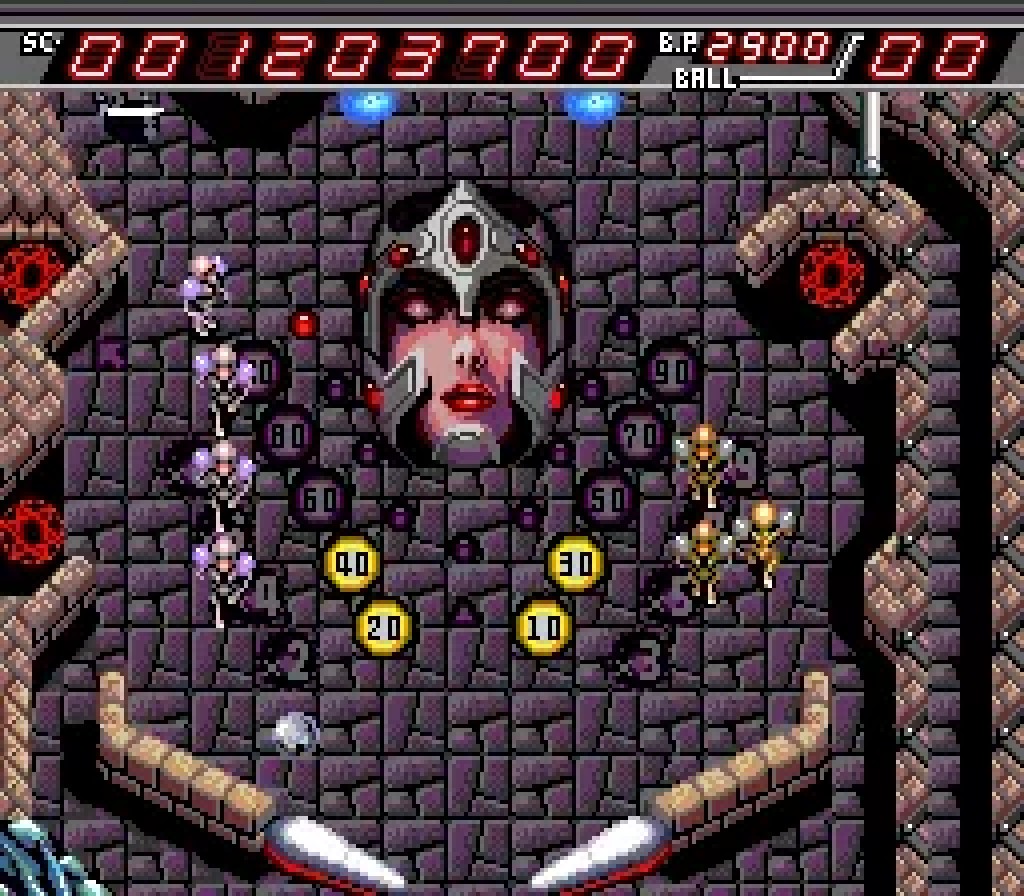
At a glance: Devil’s Crush · TurboGrafx-16 HuCard · Compile / Naxat, 1990 · Video pinball · Score: 9.0/10
Video pinball lives or dies on a paradox: the table must be imaginary enough to justify the video part, and honest enough in its physics to deserve the pinball part. Devil’s Crush — Devil Crash in Japan, released in 1990 as the second of Compile and Naxat’s Crush pinball games after Alien Crush — threads that needle so completely that it remains, decades and entire genres later, the game other video pinball is measured against. Its table is a dark-fantasy triptych three screens tall, ruled by a she-demon, infested with dragons, armoured knights and hooded cultists, and every inch of it is trying to kill your ball beautifully.
The layout is the design. The main table scrolls vertically across three tiers, each with its own flipper pair, so the ball is forever falling through worlds: a skull-faced lower realm, a middle court of wandering monsters, and an upper sanctum where the demoness herself presides over the table’s deepest secrets. Creatures do not sit still as targets; skeletons and knights patrol the playfield, a dragon breathes at your passing ball, and hitting the right mouths, eggs and pentagrams peels the table open layer by layer — including the transformation of the central face, which ages and corrupts as you score, one of the era’s great visual gags rendered completely straight.
Bonus stages as boss fights
The Crush series’ masterstroke, perfected here, is the bonus stage as destination. Sink the ball into the right skull mouth or tower at the right moment and you are warped to one of several self-contained bonus tables — arenas where you battle a specific horror, from a multi-headed dragon to a swarm of knights, with a single ball and a fortune in points on the table. They play like boss fights designed by a pinball mind: learn the angles, manage the risk, cash the reward. Failing drops you back to the main table with the clock of your run still ticking. It is the structure every fantasy-pinball game since has borrowed, usually without credit and never with this atmosphere.

Underneath the theatre, the pinball is serious. Ball physics are weighty and predictable, flipper response is instant, nudging is present with a tilt conscience, and two ball speeds plus a choice of musical accompaniment let you tune a run. A password system records high scores in an era when a great run deserved paperwork. The skill ceiling is the genre’s truth: this is a score-attack game, measured in tens of millions, and the table’s secrets — the perfect bonus chains, the ball-lock rituals, the final confrontation the deepest play unlocks — were designed to be discovered across months.
Art and sound from the pit
Toshio Furukawa’s table art is the TurboGrafx palette turned to rot and candlelight: bone whites, bruise purples, arterial reds, all of it dense with carved detail that never confuses the ball’s path — the discipline that separates a great table from a pretty picture. The soundtrack, led by a main theme that pinball players can hum decades later, drives at exactly the tempo of a good run, and the sound design gives every bumper and sling a voice. The Genesis port, Dragon’s Fury, is a respectable cousin; this original is the one with the atmosphere intact and the table laid out as designed.

Reservations are the genre’s, honestly stated. If pinball’s loop — nudge, aim, pray, repeat — leaves you cold, the finest table ever drawn will not convert you, and the game’s difficulty is real: drains are frequent teachers, and the gulf between a lucky million and a skilled fifty million is a education. Extra balls and the table’s mercies are earned, not given.
The Crush legacy
Alien Crush proved the concept in 1988; Devil’s Crush perfected it, and the Japan-only Jaki Crush that followed had the misfortune of being measured against it. On a system famous for shooters, this is the great exception that belongs in the same conversation — a game with no campaign, no ending to speak of, and more atmosphere per screen than adventures ten times its size.

The table, tier by tier
A guided descent helps. The lower tier is the table’s engine room — flippers, the skull-faced locks, and the wandering skeletons whose defeat feeds the bonus counters; learn to keep the ball alive here and the whole game opens. The middle tier is the court: knights and creatures patrol lanes that must be cleared to light the table’s deeper features, and the central face — the game’s icon — watches from above, its expression and form shifting as your score corrupts it, a progress bar rendered as damnation. The upper tier is the sanctum, where the demoness presides and the table’s richest locks and multipliers live; reaching it is easy, surviving it is the skill, and the fall back through two tiers of hazards is the game’s cruelest and fairest sentence.
The bonus stages form a bestiary worth listing by reputation: the dragon arena, where the ball becomes a weapon against a multi-headed horror; the knight stage, all armour and angles; the skull stage, a memento mori with flippers. Each has its own geometry, its own scoring logic and its own way of ending your run’s momentum if you enter it cold — which you will, the first dozen times, because entering them at all feels like winning. The mastery curve of Devil’s Crush is really two curves: the table, and the six arguments the table sends you to.
Physics, feel and the two speeds
The unglamorous paragraph is the important one. The ball has weight and honest momentum; it does not float, snap or cheat. Flipper shots go where geometry says they should, bank passes work, dead-flipper passes work, and the nudge — the genre’s conscience — is strong enough to save a drain and honest enough to be rationed by the tilt logic. The two ball speeds are real difficulty settings: the faster game is not merely quicker, it changes which shots exist. Add the choice of musical themes, the password-preserved high scores, and a two-player alternating mode that turned the table into a duel, and the package is complete in a way few single-table games have ever attempted. Compile’s programmers were shooter people, and it shows in the best way: everything here is tuned like a weapon system.
That is the final context for the score. Devil’s Crush is not a great conversion, a great licence or a great novelty. It is an original design in a genre the industry kept treating as a simulation problem, solved by a team that understood it was an atmosphere problem and a physics problem in equal measure. The TurboGrafx-16 has louder flagships. It has very few better games.
Getting good, slowly
Advice for the newly damned: spend your first hours on the lower tier alone, learning the ball’s weight off each flipper and the angles that feed the skull locks, because every run in this game is built from the bottom up. Watch the wandering monsters as timing information rather than decoration — their patrols are the table’s clock. Save your nudges for the outlane emergencies they were invented for. And chase the bonus stages without fear: a run that ends reaching for a bonus arena teaches you more than a safe million ever will. The table is patient. It has been waiting since 1990, and it plans to keep your initials for a while.
Verdict
The greatest video pinball game of the 16-bit era and a TurboGrafx-16 essential: a table that is also a world, a score chase that is also a descent. Pull the plunger.
Score: 9.0/10