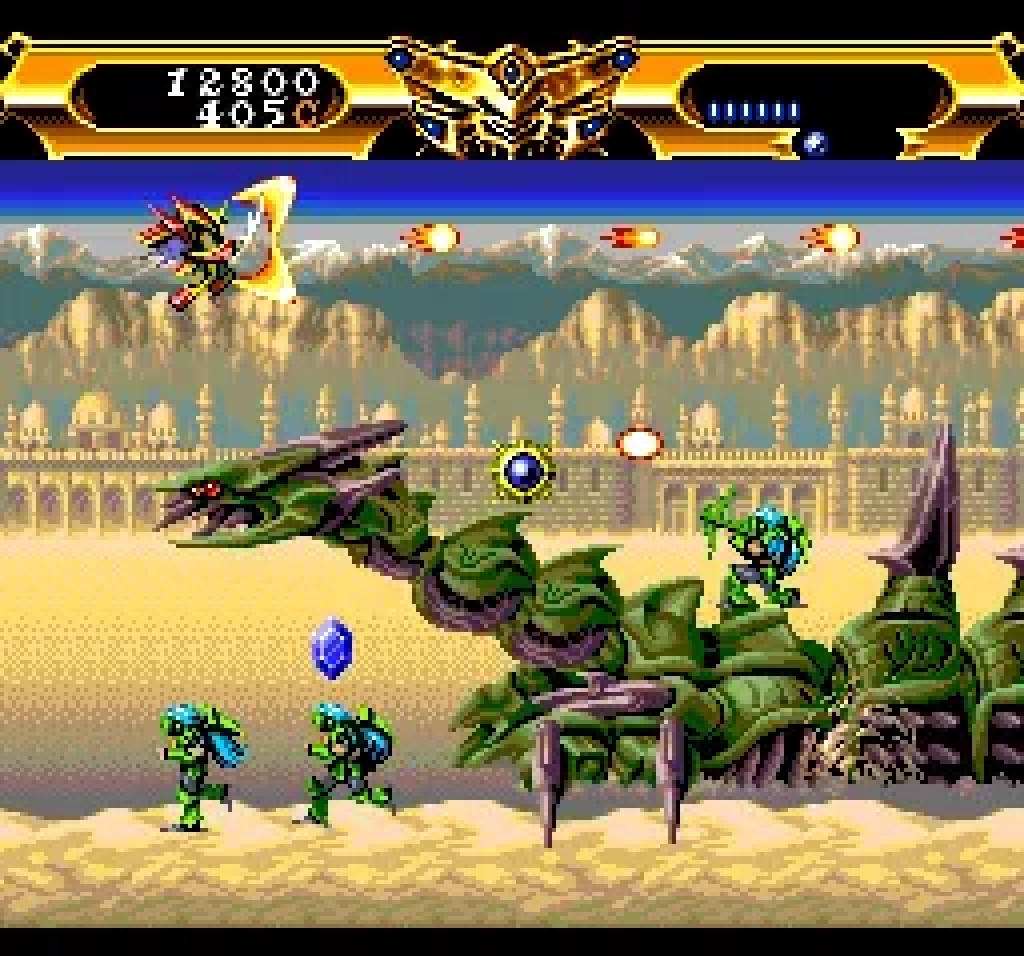
At a glance: Lords of Thunder · TurboGrafx-CD (Super CD) · Hudson Soft / Red Company, 1993 · Horizontal scrolling shooter · Score: 9.5/10
Some games announce themselves. Lords of Thunder kicks the door in wearing armour, trailing lightning, while a guitar solo tears out of your television. Released for the PC Engine Super CD in Japan in 1993 as Winds of Thunder and brought West by Turbo Technologies the same year, Red Company’s shooter casts you as Landis — Dyu in some tellings — a knight descended from the hero who once sealed the god Deoric and his six warlords. The seals have failed. You have a sword that fires shockwaves, four suits of elemental armour to earn, and seven stages of the most confident shooting on the TurboGrafx-CD. It is not merely one of the best shooters on the system. It is one of the best shooters, full stop.
The structure has a strategist’s twist: after an opening stage, you choose the order of the next five, in the Mega Man manner. Each stage is ruled by a warlord aligned to an element, and the armour you win — Earth, Water, Fire, Wind — is not cosmetic. Armour changes your weapon: the spread of your sword-waves, your bombs, your defensive options. Entering a stage wearing the element its boss fears is the game’s quiet puzzle, learned across runs.
A sword, a shop, and no wasted motion
Combat is close-quarters shooting. Landis’s sword produces ranged shockwaves that reward aggression — damage falls off with distance, so the game constantly pulls you toward the danger its patterns create. Between stages, a shop converts the crystals enemies drop into health, bombs, shields and armour, an economy that gives death a cost beyond the continue screen: die carelessly and you arrive at the next warlord poorer. The famous quirk is the voice that announces your purchases, one of the CD era’s beloved eccentricities, and the between-stage ritual — shop, armour choice, stage select — gives the campaign a campaign’s shape rather than a credit-feeder’s treadmill.
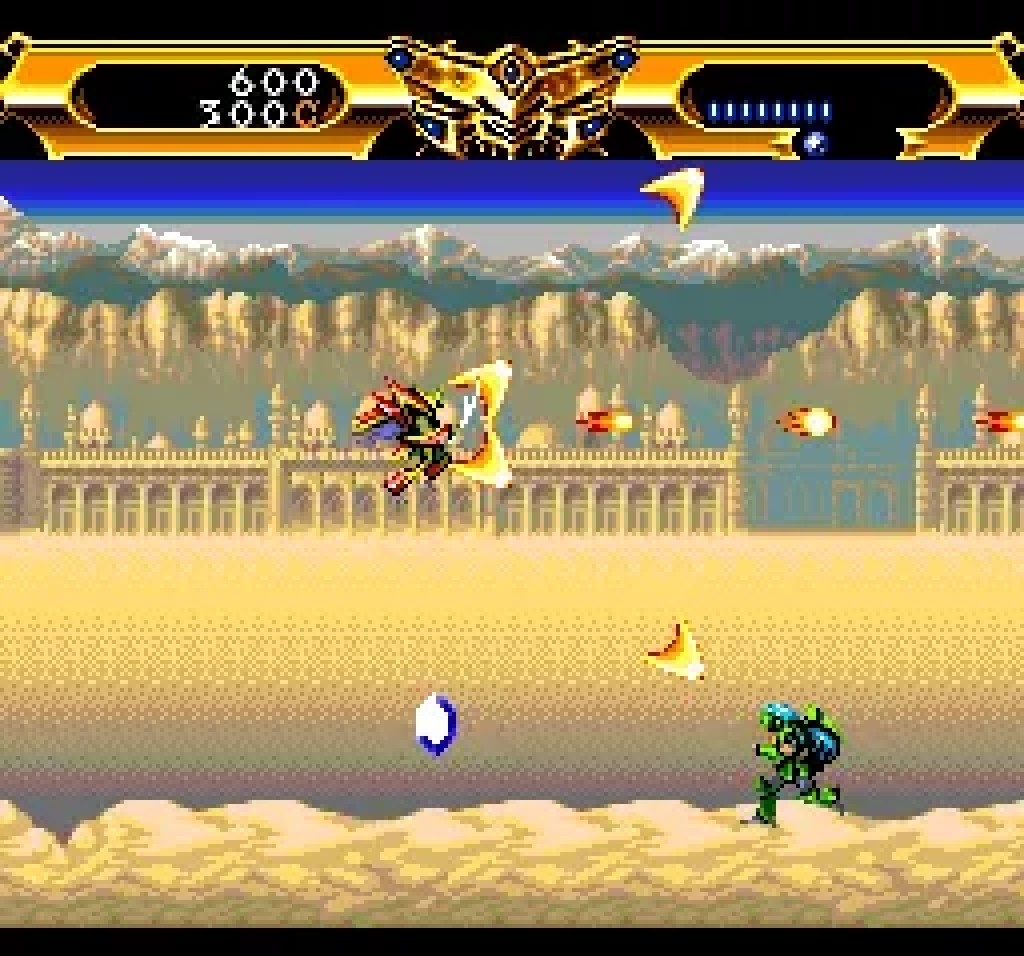
Stage design is where Red Company’s craft peaks. Each world is a complete fantasy diorama — deserts with buried leviathans, an ocean stage fought above and through weather, forests, ice, a dark realm — all scrolling with layered depth and studded with mid-bosses that would be final bosses in lesser games. The warlords themselves are huge, multi-pattern encounters that test the armour you brought. Throughout, the game maintains a pace that feels reckless and controlled at once: dense enemy choreography, minimal cheap shots, and slowdown only in the most overloaded moments.
The soundtrack is not a garnish. It is the point.
We need to talk about the music, because everybody who plays this game talks about the music. Satoshi Miyashita’s score is full heavy metal performed for CD audio — twin guitars, driving drums, solos that arrive exactly when the stage does — in 1993, from a console, at a fidelity its cartridge rivals could not approach. It is not background. It is the game’s emotional engine, the reason the armour feels heavy and the sword feels righteous. Gate of Thunder had already shown what CD audio could do for a shooter; Lords of Thunder made it a genre landmark. The Sega CD received a port the following year with a rearranged soundtrack and softer difficulty, and the comparison is a standing lesson in why players seek out this original.
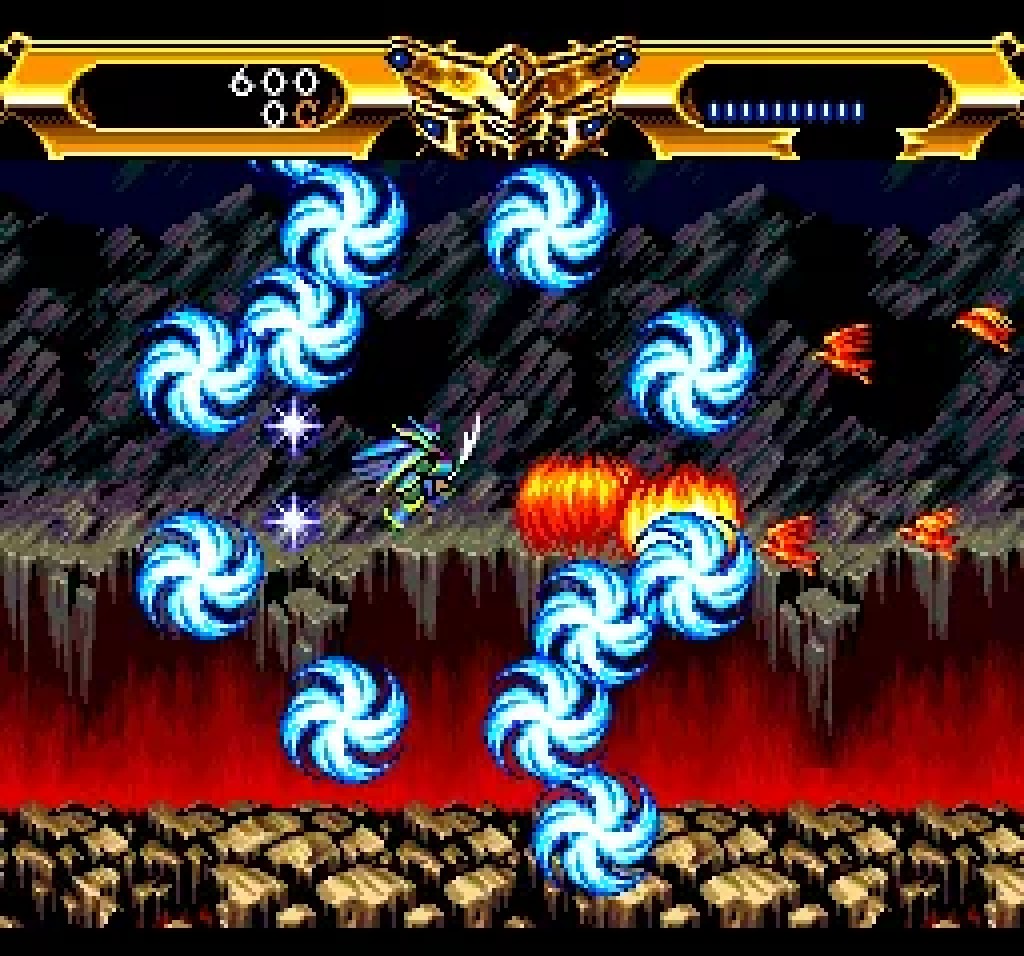
Difficulty deserves an honest note: this is a demanding game, but a legible one. Enemy patterns are aggressive rather than arbitrary, your sword’s range logic is consistent, and the shop economy means a thoughtful player can always convert a good run into insurance for the next stage. The final confrontation with Deoric’s forces is a genuine exam. It is also fair in a way the arcade-bred shooters of the era often were not, because this game was built for a home and a campaign, not for your pocket change.
Presentation as worldbuilding
The animated introduction, the armour designs, the shopkeeper, the stage-select map — Lords of Thunder spends its CD budget on identity. Red Company, the team behind the Bonk games and Air Zonk‘s world, were masters of the characterful shooter, and this is their most serious canvas: no jokes, all conviction. The result is a game that feels like the cover of the metal album it sounds like.
The armour system, and playing the elements
The four armours deserve a strategist’s paragraph, because they are the game’s replay engine. Earth armour is the bruiser — heavy frontal power for stages that come at you head-on. Water brings the spread that owns crowded skies. Fire rewards aggression with burning, wide damage. Wind is the connoisseur’s suit, fast and precise. The shop sells them in an order the game respects, and the stage-select structure means the campaign is partly a puzzle of sequencing: clear the stage whose armour counters the warlord you fear most, arrive at his gate wearing his weakness. First-time players clear the game in the order the map suggests and have a fine time. Returning players route it like a heist. That second game, inside the first, is why Lords of Thunder survives its own spectacle — the metal gets you in the door, the armour chess keeps you in the house.
The economy supports the same depth. Crystals are health, bombs and armour in potential form, so every stage is also a resource run, and the famous shop — with its serene keeper and her immortal welcome — becomes a place of real decisions under pressure: top up health for the warlord ahead, or bank the crystals toward the armour that makes him trivial in three stages’ time? Death, handled with similar intelligence, costs you currency rather than merely progress, so the game punishes carelessness in the wallet and rewards the deliberate. It is RPG thinking inside a shooter that never slows down to explain itself.
The warlords, and the Sega CD question
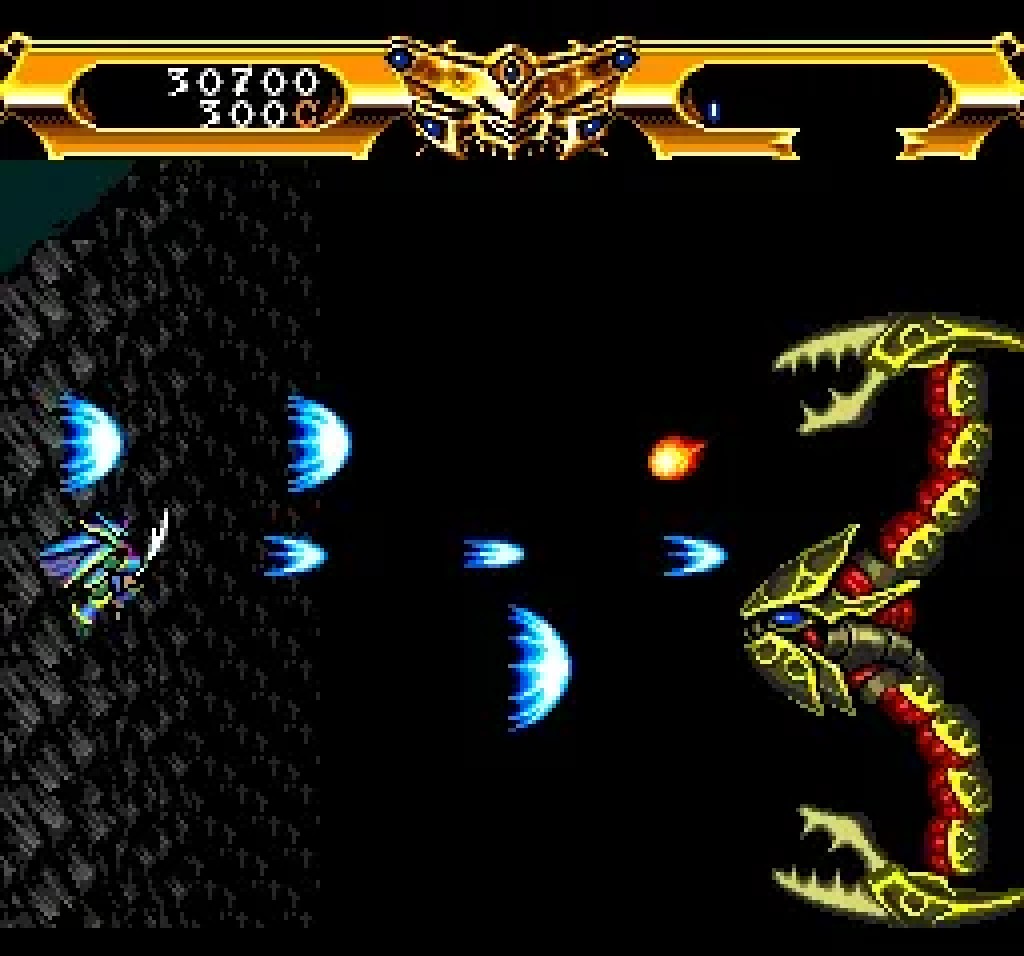
The seven confrontations are worth naming by feel: the desert’s buried horror, the ocean’s armoured leviathan, the forest’s and ice’s contrasting tempos, and a final sequence that stacks the game’s whole vocabulary — armour logic, crystal poverty, pattern memory — into a closing examination worthy of the soundtrack’s biggest riffs. Bosses in this game are large because Landis fights at sword range; the camera of the design is always close, always personal, and the warlords’ multi-phase patterns are built to punish the player who treats the sword like a gun.
Because readers always ask: the Sega CD port is a respectable game and a lesser Lords of Thunder. Its soundtrack was rearranged, its difficulty softened, its voice and balance altered in ways that add up to a different, tamer animal. The TurboGrafx-CD original — Super CD format, on the Duo or with the Super System Card — is the version this score belongs to, and the one the game’s legend is built on. If you play one CD shooter in your life, the argument of this review is that you play it here, on this hardware, at a volume your neighbours can file a complaint about.
Verdict
The TurboGrafx-CD has two shooter summits: Gate of Thunder for velocity, Lords of Thunder for everything else — design, music, world, nerve. This is the one that gets played loudest and remembered longest. A masterpiece.
Score: 9.5/10